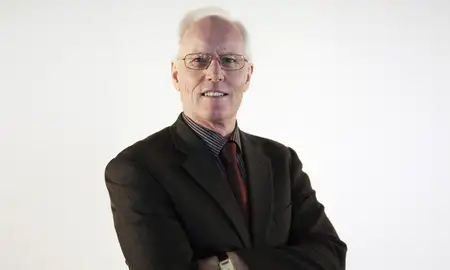
Mark Pennington.
Take a seat
Formway furniture’s world-leading Life chair.
Top: Mark Pennington with students during a
kite-flying field day. Photo courtesy of
Bill Toomath
Above: Design School staff in the 1980s
Mark Pennington, Jim Coe and Bill Toomath.
Mark Pennington strides ahead, into the iconic world he created. This is Te Papa’s Awesome Forces, the popular museum collection which goes beneath the Earth’s crust to explain lava, tectonic plates and how the ground beneath us rumbles and shakes.
There’s the clock that illustrates the millions of years of Earth’s development, the lever that shows the Earth crack in two, the globe which sets out exactly where the tectonic plates meet. He designed them all, everything you see, during several years in leading roles within Te Papa’s design team.
With a brisk walk and obvious excitement, he heads for his most famous Te Papa creation, the earthquake house where museum-goers can experience the exact pattern of jolts which rocked the eastern Bay of Plenty in March 1987.
“Look at their faces,” he says, peering in the door where visitors to the museum are transfixed on the shaking around them.
Lower Hutt-raised Pennington, 62 years old and a father of four, has worked alongside some of the world’s most famous designers, on everything from hi-fi systems to the world-famous Life chair. The chair, designed in Wellington and manufactured around the world, can be found in homes and businesses across Asia, Europe, The United States and Australasia. It retails from $600 to $1200, depending on fixtures, and has generated more than $400 million since its launch earlier this decade.
It may seem hard to imagine now, but Pennington’s parents were supportive but unconvinced by his career choice. In the early 1960s, design had a low profile and little appreciation in New Zealand. They were concerned Pennington might not be able to turn his artistic gifts and inquiring mind into a real, wage-earning, solid job.
But Pennington knew as soon as he stepped inside the then Wellington Polytechnic School of Design, that he didn’t want to be anywhere else.
Pennington’s enthusiasm for design is immense.

Third-year Industrial Design class of 1966, Wellington Polytechnic School of Design. From left: Nick Stewart (career path unknown); Mark Pennington (Holyoake Engineering; Holland: Philips; USA: Fitch Richardson Smith and Form Design; teaching at Rhode Island and Wellington Polytechnic; Formway); Michael Smythe, pictured in bath, (Fisher and Paykel, JASMaD, Marks and Smythe Designers, Designforces, Designsource, the Designers Secretariat, Creationz Consultants); Neil Booth (Modern Signs, transforming Waiheke’s Treebeard craft shop into the island’s first art gallery, freelance illustrator and writer); Gary Dunn (Motat, Design Co, Jomax Toys, Geddes Dunn Landscape Designers, Playgoods, Aquatic park (co-director/entrepreneur)): Erica Duncan (later Martin) (Sydney: Lester Bunbury Assoc; London: interior and industrial design firms; Wellington: Crag Craig and Moller, Erica Martin Designs); Gay Ashford (later Epstein) (PDL Plastics, Ballantynes; Australia: Metters, British Paints, David Epstein and Associates; Hong Kong: Concept Consultants and Play Tennis Ltd, Ashford Australia); Jim Dent (front) (career path unknown); Angus de Lange (British Office Supplies, Dominion Museum, Finland, teaching at ATI /Carrington Polytechnic, full-time painter). Photograph courtesy of Neil Booth and with thanks to Michael Smythe.
“It’s been the most fulfilling, stimulating, rewarding career path… I’ve met great people, I work with great friends, I’m excited, I’m stimulated by it, it’s diverse, and it’s good for New Zealand.”
He entered design school in 1963; part of a group that became known as The Golden Year. He studied with design critic Michael Smythe, product designer and fine artist Angus de Lange, the product and interior designer Erica Duncan, and businesswomen and designer Gay Ashford.
The school was then led by the visionary James Coe, whose bustling office Pennington remembers stuffed with skeletons, books, artwork, inventions and a curvilinear particle board desk.
Pennington plodded through the introductory and theory lessons of the first year. And then, in the second year, the course moved to practical design.
“And suddenly, I remember, I got it.”
He was plucked from school by industrial tycoon Noel Holyoake, nephew of then Prime Minister Keith Holyoake, who spotted Pennington’s talent at a student exhibition. Holyoake wanted a designer as his right-hand man in his domestic heating enterprises. Pennington designed range hoods and gas heaters and learned a lot about fast decisions and seizing business opportunities, but it wasn’t fun. He left to set up a consultancy.
Clients included Caltex, Unilever, the 1970 New Zealand Expo in Japan and, most significantly, work across Asia-Pacific for Philips Electrical.
In 1970, when he was just 24 years old, the electrical giant invited him to be guest designer at its Concern Industrial Design Centre in Holland. He worked conscientiously on the projects they gave him, but would then secretly work away at alternative designs; dismissing the rules and starting over.
“It was that healthy dissatisfaction and ability of New Zealanders to challenge convention and have a go. Without knowing, that set me up. That made the difference. It was an attitudinal thing; a willingness and a desire to explore, to utilise and amplify new technology. I was just wanting to do something better.”

Page 20, clockwise from top left: the design concept for a vacuum cleaner featuring handle-integrated controls, created for Whirlpool; a conceptual sketch for an electric blanket controller created for Ralta NZ; the final model for the controller; enamel cast-iron cookware for global distribution, created for Waterford of Ireland.
The director of the Centre, well-known designer Knut Iran, noticed the alternative design work on his desk and asked Pennington to present it to the Philips board. They were impressed and Pennington was teamed up with futuristic US designer Syd Mead, an already acclaimed and world-renowned designer who would go on to Hollywood fame with set work on films such as Blade Runner.
“I couldn’t have hoped for any more than that – to work with a guy of that calibre,” Pennington says.
They were world trend setters, designing 1970s lawn mowers and hi-fi systems in the days when led lights and touch controls were emerging from the Philips technical laboratories.
Pennington, his then wife and first child lived on a farm near the Belgian border. There was an equestrian centre on the farm and, utilising his explorative nature, Pennington borrowed a book on building, then designed and built swimming pools and rooms at the complex for his landlord.
From Holland, he moved to London to work for Pentagram, a multi-disciplinary company run by one of the world’s most famous designers, Kenneth Grange – designer of the Kenwood appliance range, the Parker pen, trains and other varied objects.
He was accepted into the Royal College of Art in London to do postgraduate study in design. But with a young family he turned this down and instead moved to the Cotswolds to work for David Carter Design Associates. The family lived in a 400-year-old cottage; the intimacy and richness of which would influence their future home in New Zealand.
\In the mid-1970s, they came home in search of a Kiwi upbringing for their children. The consultancy was resurrected but New Zealand felt constrained for the young designer.
“It was a young nation constrained by import tariffs, with an introverted production-led mentally.” Design, he says, was an afterthought.
He got work with Philips and various other clients, then James Coe came calling. He asked if Pennington would consider becoming a tutor.
Pennington was unsure is he was up to it. He worried that he didn’t know anything about being a tutor. But he found tutoring an enriching experience, one that forced him to consider his own ideologies and processes.
“It was a huge growth curve for me. If you want to teach someone about your subject, you have to know it very, very well.”
One of his students was Lyn Garrett, now undergraduate programme co-ordinator for the industrial design major within Massey’s bachelor of design.
He says Pennington’s enthusiasm for everything he does is hard to contain.
“But once he’s talking about design, his passion for the topic oozes out of his pores and hands in a way that is infectious and inspiring. Mention the phrase ‘smooth and creamy’ to any industrial design student from the ’70s or ’80s, and they’ll immediately say ‘Mark Pennington’, not Cadbury.”

Below: Cassette-radio players designed for Philips Eindhofen during late 1960s. A number of these design concepts feature advanced technologies for their day, such as touch controls and liquid crystal displays.
Garrett went on to work with Pennington at Formway and says his former tutor’s influence on New Zealand design, as a designer, strategist, inspirational educator and innovation activist, is immense.
“It’s the quality of his vision alloyed with his articulate passion for design and New Zealand which is partly responsible for what he has achieved: the other part of his success is that he is an immensely talented industrial designer. I’m not sure that being Mark Pennington has ever gone to his head,” Garrett says.
“I’ve always found him to be warm, human, thoughtful and articulate, and he smiles easily.”
Pennington loved working with students, seeing them developing their projects. His career developed too. He rose to head of design, developed industry links with the school, got a Queen Elizabeth Arts Council grant, and travelled the world on a Fulbright scholarship studying new educational approaches.
On his return, he helped move the school’s philosophy away from the rigid Bauhaus model common in Europe towards a more liberal, eclectic, independent South Pacific approach.
“We are isolated geographically but certainly not in a technical sense. But through that isolation, we have a sense of independence which is to our advantage, to view the world from afar… and to also be unfamiliar with the rules.
“We have this wonderful sense of independence and spirit of adventure as an adolescent nation, and we’re simply different. That is so utterly desirable on a global scale.”
That spirit would not be suppressed through the rigid German and English design school ideologies any longer. Instead, it was officially embraced.
Students started to win or be continuously placed in major international awards. Pennington says the school, and its graduates, were starting to become a significant design force in the world. Students of that era have gone on to lead design teams at Apple and Nike, influencing global trends.
After 17 years, Pennington left the design school. “It became part of me and I became part of it.”
He returned again to consultancy; interspersed with overseas roles such as a position as Associate Professor of Design at the Rhode Island School of Design, and as consultant at Richardson Smith in Ohio, US. Back home, work with a small Petone furniture company popped up. It was one of the businesses Pennington had collaborated with through students at the design school.

Page 23, clockwise from top: the highly successful Life chair; the utilitarian military aesthetic of this cassette-radio player designed for Philips Eindhofen in the late 1960s became highly influential; completed in the late 1980s, the Pennington-devised playground and lighthouse-slide on the waterfront at Frank Kitts Park is a Wellington icon and a popular meeting place.
Through this exposure, Formway’s owners – industrial chemist Allan Brown and accountant Rick Wells – realised they could grow the business through differentiation, but they needed to buy in expertise.
Pennington tidied up their existing models, then moved on to new products. Their first ground-up design was the Zaf chair. It won product design awards, including the prestigious Prince Philip Award for industrial design, and Formway moved into Australia on the back of the product’s success.
The company went beyond chairs to workplace design and Pennington, by now a shareholder and director, developed a desk system called Free. The desk system was entered in an international trade show in America. Formway could hardly afford the exhibition and travel costs. But, to everyone’s amazement, the Wellington furniture company won an unprecedented two gold medals in the show. This success helped launch Formway into the US market.
Pennington and his growing design team travelled to many international trade shows and moved from being initially in awe of the designs, to slowly starting to believe they could do better. There was always something inadequate with each design they saw. Imagine if you could eliminate all of those shortcomings? This feeling became overwhelming and Pennington and his colleagues formulated an audacious plan. The team would create “the best chair in the world”.
The perfect chair is a complex product to design. It must fit bodies of varied shapes and weights, and remain comfortable. Pennington says a chair is the ultimate design challenge.
And it was certainly a bigger undertaking than Formway realised at the time.
The design team grew to, at one point, 20 people. The development costs exceeded $4.5 million. It was the project which would either catapult Formway to global success, or sink the business.
Formway realised that design was its core competency and that manufacture and distribution needed to be carried out closer to the market. They courted US company Knoll International and convinced its top tier to travel to New Zealand for a presentation. There were risks taken on all sides, with the American executives staking their reputations, and undoubtedly their jobs, on the high-level trip Down Under.
At this stage Formway not only had to build a working model of this revolutionary chair, but also build and paint a presentation room.
When the Americans arrived, Formway’s factory staff erupted into a spontaneous haka. Everyone was painfully aware that livelihoods were riding on this meeting.
As soon as the chair was unveiled, the Americans leapt from their chairs and started embracing the Formway team. After three days of staunch negotiations, a deal was struck and the Life chair was going global.
Since then, the Life chair has won the Best of NeoCon at Chicago’s prestigious Facilities Management trade show, and numerous other international awards as well as a permanent place in the Chicago Design Museum collection. Around 150,000 chairs are now sold every year from Osaka to Oklahoma. It is one of the largest-selling high-performance chairs in the world and has become Knoll’s flagship product.
How is it possibly different from any other chair?
The life chair is lightweight, with a mobile support system. As you move around, the back of the chair moves with you, continuously supporting your body. It measures your body weight and auto-adjusts the back support system to give the relevant resistance.
In demonstration Pennington stretches back with his arms behind his head and shifts to the left and right.
“It’s like a good shoe,” he says. “It will always move naturally with you.”
His philosophies around design are borne out in the Life chair. “People are central to your work. The only reason you are a designer is, in effect, to contribute to people’s lives. So the better you understand people, the better the design.”
Pennington says the Life chair is an environmentally sound product; an outcome he initially saw as a challenge, then he decided was a responsibility with a product selling in such high numbers, and an opportunity for market advantage. It has since become the first product in America to win the environmental Smart Award.
Formway no longer has to pitch to large offshore firms. These days, prospective manufacturers approach them.
Tony Parker, Massey’s current Professor of Industrial Design, says Pennington’s work, particularly with Formway furniture, is studied, analysed and promoted as an outstanding example of how good design means good business.
“Working with other designers, both inside and outside his team, he has influenced the thinking and career development of people who will, in their own right, make significant contributions to design here and internationally.
“His passion and enthusiasm for design is contagious. His knowledge is that of a master or professor. His own talent and accomplishments give him mana and his genuine joy when his students produced work of quality fuelled an atmosphere of striving for excellence and achievement.”
Pennington’s recently bought a “humble brick box” on the beach front at Paekakariki and he’s looking forward to transforming it into something special. Of his four children, two are graphic designers, one is a budding fashion designer and another is in property but with a well-developed appreciation of design.
Pennington says despite their initial hesitation, his parents, now deceased, would have been “thrilled as thrilled” by his success; from his John Britten Award for design leadership, to his work on the national museum, to his years tutoring other generations of New Zealand designers.
“They would be moved and delighted that a career path has opened up that they never believed possible, and that I’ve been able to contribute in a way they couldn’t have foreseen.”
For information about studying industrial design at Massey, contact design@massey.ac.nz.
Related articles
Apocalypse tomorrow: sustainability and industrial designAgriculture Minister promises quick action on policy to increase numbers of rural vets
Three inducted into Hall of Fame
Parts of speech
Created: 21/11/2008 | Last updated: 01/12/2008
Share this article: