All organisations that involve animals for research and teaching are required to report on this each year to the Ministry for Primary Industries (MPI), classifying the purpose of each interaction and its impact on the animal. A strong commitment to ethical practice underpins how animals are involved, ensuring their welfare is prioritised while Massey trains future veterinarians and animal scientists. Concurrently, our scientists advance research into future farming systems, feeding approaches, pasture management, health, reproduction, growth and clinical practices that improve animals’ lives.
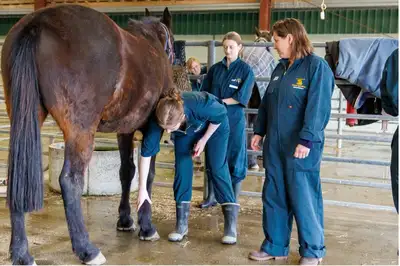
Massey has more than 2000 hectares of farmland including two working dairy farms with around 850 dairy cows, three sheep and beef farms containing 6,500 sheep, 200 dairy heifers, 900 beef cattle, 200 deer, a poultry unit and a teaching farm with cattle, sheep, pigs, alpacas, and horses. There are four separate working teaching hospitals where vet students gain experience in clinical practice prior to graduation. The clinics provide emergency veterinary care in the region, and great benefits for the community and the students.
Students are taught in these living laboratories under strict conditions, with every research project and lesson undertaken at the university involving animals requiring approval from Massey’s Animal Ethics Committee. The Committee is made up of academics from across the university, alongside three external and independent members, who assess each proposal for ethical and scientific rigour, as required by the Animal Welfare Act.
If approved, all animals included in teaching and research are recorded, facilitating transparency and accountability. For example, researchers may weigh lambs as they grow to assess the feeding value of a new pasture type. In line with reporting requirements, each interaction is recorded and the impact graded.
When Massey reports its animals in teaching and research each year to MPI, the purpose of each interaction is identified and its impact on the animal is classified into five grades: no impact, little impact, moderate impact, high impact and very high impact.
No impact may involve observation, gentle handing of a tame animal or providing an alternative palatable diet. This can in some cases provide a positive experience and may enhance an animal’s welfare.
Little impact activities might include taking a routine blood sample, restraining a sheep to determine its body condition score, or teaching students how to handle alpaca using low-stress techniques.
Moderate impact may include short-term capture and handling of wild animals, such as work undertaken by zoologists and conservationists to monitor species populations.
High impact research is almost never conducted and requires strong justification. For example, investigating a potentially more effective pain relief for animals during routine procedures, such as tail removal (docking) in lambs, falls into this category, as a ‘control’ group that is managed using standard practices must be included in the study.
Massey does not undertake very high impact research on any of the animals in its care.
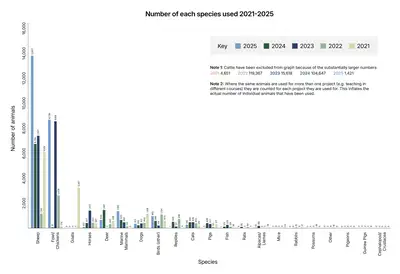
Over the past five years, more than 90 per cent of Massey’s reported animal use has been classified as having no or low impact. Between 2022 and 2024, that figure increases to 98 per cent.
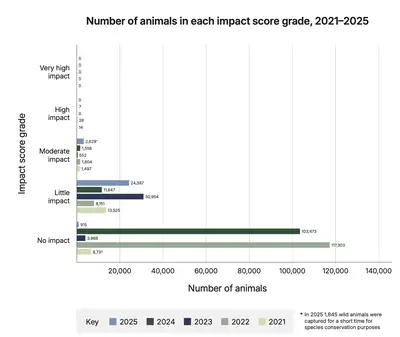
Most animal interactions at the university – ranging from 95 to 99 per cent over this period – occurs for the purposes of animal husbandry research, veterinary research, teaching, environmental management and conservation. In line with Massey’s areas of expertise, the animals most commonly involved are cattle, sheep and chickens, with smaller numbers of marine species, horses, birds, dogs, deer and cats also included.
At the conclusion of any research or teaching activity, researchers record the outcome for each animal in the university’s care. In most cases, animals are retained by Massey or returned to their owner. Wild animals are typically released back into their natural environment, unless they are pests and their release is not permitted by regulatory requirements. In some instances, animals may be humanely euthanised in line with standard veterinary or industry practices.
Massey University is New Zealand’s leading university for students seeking to work with animals. Students are taught by teachers and researchers with deep expertise across areas including animal welfare, animal nutrition, production systems, animal health, pain management, clinical skills and surgery.
The School of Veterinary Science – Tāwharau Ora is currently ranked 14th in the world in the QS Subject Rankings and has been internationally recognised for its approach to teaching, including the use of model-based clinical skills laboratories. These facilities allow students to develop practical skills and confidence before working with animals. The School is also first in the world for employability of graduates, with Massey’s veterinarians highly sought after and recognised for their skills, professionalism and strong ethical foundations.
Massey is also New Zealand’s top-ranked university for agriculture. Given the importance of animal-based production systems in New Zealand, students gain hands-on experience caring for animals as part of their studies. The university’s Animal Science degree, introduced in 2019, remains the only one of its kind in the country, with graduates contributing across industries including border control, breeding programmes, livestock production, nutrition, and animal welfare.
Across these programmes, Massey works with animals in a range of contexts, from companion animals to livestock production systems, and through this, students develop a strong understanding of animal needs, environments and welfare. The university also maintains strong connections with community and industry organisations, partnering with groups such as the SPCA on desexing and animal welfare initiatives, and contributing to animal welfare research that supports New Zealand Police dogs via the Working Dog Centre.
In doing so, Massey is preparing graduates to make informed, responsible decisions about animal care, underpinned by a clear commitment to ethical practice in every interaction with animals.
Related news
Opinion: Animal production science isn’t just a part of agriculture – it drives it
By Professor Paul Kenyon

Large Animal Teaching Unit celebrates 30 years of shaping veterinary education
The Large Animal Teaching Unit (LATU) marks a milestone this year, celebrating three decades of enriching veterinary education by enhancing students’ practical skills and deepening their knowledge of animal welfare.
Celebrating six decades of nurturing veterinary talent
As the institution for veterinary education in Aotearoa New Zealand, we are proud to celebrate World Veterinary Day by shining a spotlight on the enduring legacy of Tāwharau Ora School of Veterinary Science .