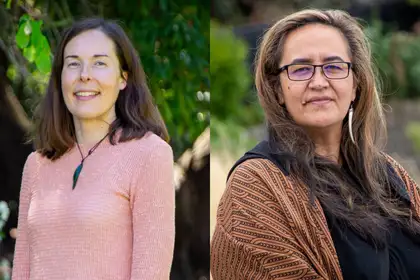
Dr Emma Scheltema and Associate Professor Te Rina Krystal Warren.
Dr Emma Scheltema and Associate Professor Te Rina Krystal Warren, Rangitāne, Maniapoto, Whitikaupeka-Mōkai Pātea, will use the fellowships to tackle complex challenges facing Aotearoa New Zealand, with research spanning wildlife health, digital innovation and community wellbeing.
The fellowships support emerging and established researchers whose work has the potential to deliver meaningful benefits for communities, industry and the wider public.
Dr Emma Scheltema - Strengthening infectious disease monitoring through connected wildlife health data
Dr Scheltema will use her fellowship to develop a knowledge-sharing platform that improves access to wildlife health data and strengthens the monitoring of infectious diseases.
Infectious diseases in wildlife are an increasing global concern, with the recent detection of avian influenza in New Zealand highlighting the importance of effective disease surveillance. While valuable health information is regularly collected by conservation groups, wildlife rehabilitation facilities, veterinarians and government agencies, much of this data remains inaccessible outside of the organisations that gather it.
Dr Scheltema says the need for better access to wildlife health information has never been greater.
"The body of wildlife health expertise and knowledge in Aotearoa New Zealand has expanded rapidly over the past 20 to 30 years, while the threat and impact of disease on wildlife populations continues to grow due to habitat loss, pollution and climate change."
Her research will explore ways to better connect those collecting wildlife health information. Using social network analysis to map existing relationships, she will work alongside stakeholders to co-design a data-sharing platform that enables information to be shared more efficiently.
By improving collaboration across the wildlife health sector, the project aims to support more efficient use of limited resources, prioritise future research and enhance the ability to identify and respond to emerging disease threats.
Dr Scheltema says improved access to data could help New Zealand better prepare for wildlife health emergencies, including highly pathogenic avian influenza (HPAI), which has had devastating impacts on wildlife populations overseas.
"In the event of a wildlife health emergency, I hope the information and framework developed through this project will enable more rapid mobilisation of wildlife expertise and data across organisations and disciplines, supporting informed decision-making and measures to protect wildlife."
The project has the potential to strengthen the protection of New Zealand's biodiversity, economy and communities, while also providing a model for improving wildlife disease monitoring internationally.
Dr Scheltema says receiving the fellowship is both a privilege and an opportunity to make a meaningful contribution to wildlife conservation.
"It is a huge honour to be entrusted with the fellowship, and I hope this work will make it easier to translate valuable wildlife health data into practical conservation tools that benefit not only wildlife, but also the people working to protect them."
Associate Professor Te Rina Krystal Warren - Investigating Māori digital participation and innovation
As technology continues to shape society and the economy, Dr Te Rina Krystal Warren will investigate how Māori engage with digital spaces and how concepts such as rangatiratanga and mana motuhake are expressed, sustained or constrained through technology.
The research will use kaupapa Māori cyber-ethnography, known as iRangahau, and will be undertaken in partnership with iwi authorities and Māori organisations to ensure it aligns with community priorities and decision-making needs.
Dr Warren says the fellowship will enable her to build on research undertaken through her PhD, deepen understanding of the Māori data ecosystem and identify the data needs and aspirations of Māori communities.
"As the world continues to evolve rapidly in the digital space, we must remain mindful of eColonialism and how digital environments can either constrain or strengthen tino rangatiratanga and mana motuhake."
Dr Warren says Māori have a long history of adopting and adapting new technologies, from early engagement with international trade and shipping to participation in today's rapidly evolving digital environment.
A key focus of the project is understanding what rangatiratanga and mana motuhake look like in digital spaces and how Māori can maintain meaningful control over their data.
"This research aims to gather community perspectives and experiences to better understand how rangatiratanga and mana motuhake can be realised in the digital age."
The findings are expected to provide practical insights for communities, policymakers and the technology sector, helping to inform future digital innovation and policy development in New Zealand.
"In the age of AI and large-scale data infrastructure, communities and particularly vulnerable communities such as Māori, will require strong protections and effective safeguards.
“A key objective of this research is to provide a robust evidence base that can inform policy development, strengthen governance frameworks and support community-led decision-making."
Dr Warren hopes the research will help lay the foundation for positive transformation in digital spaces while supporting communities to realise their aspirations and safeguard Māori values and knowledge systems.
"I hope this research contributes to a platform that is meaningful for communities, supports their aspirations, and helps prevent foreseeable harms associated with eColonialism. There is a need for practical and community-driven approaches that enable people to reclaim, exercise and sustain their rangatiratanga and mana motuhake in digital environments."
Mana Tūāpapa Fellowships are awarded annually by the Royal Society Te Apārangi. Recipients receive $820,000 over four years and are supported by the Society to develop leadership skills.
Related news
Massey researcher helps set the record straight on volcanic eruption myths
When a volcano erupts, misinformation can spread almost as quickly as the ash cloud itself.
Researcher awarded Explorer Grant to improve sleep and mental wellbeing for new mothers
Dr Ying Jin has received a Health Research Council Explorer Grant to investigate how wearable technology and artificial intelligence could improve sleep, mental wellbeing and postnatal care for new mothers in Aotearoa New Zealand.
