Professor Kirsty Ross.
With Mental Health Awareness Week upon us, it is a good time to think about what we mean when we talk about wellbeing. There is no shortage of advice about how to improve it: Get enough sleep. Exercise. Eat well. Manage stress. Practise mindfulness. Develop resilience. Spend less time on your phone.
That advice is sound and sensible. But it can also leave us with the impression that wellbeing is primarily something we create for ourselves—an individual project, achieved by making the right choices and developing the right habits. And if they are not feeling good, people often feel a sense of personal failure, that somehow they have not done enough or tried hard enough.
Yet wellbeing is not only something that happens inside individuals. It also happens between us.
As a psychologist, I am repeatedly reminded of how important it is for people to feel that they belong. Belonging goes beyond simply having relationships or being surrounded by other people. It is the feeling of being seen, heard, known and understood. It is the sense that there is a place for me here; I matter; I am accepted; my presence makes a difference; I would be missed if I wasn't here.
That distinction is important.
People can feel profoundly lonely while surrounded by others. We can have large families, busy workplaces and hundreds of online ‘friends’ and still feel disconnected. Loneliness is not necessarily about being alone; it is about the gap between the connection we have and the connection we need. So, the quality of our relationships matters. Genuine connection creates a sense of belonging, and belonging can be a powerful antidote to loneliness.
Feeling that we belong is also protective. Connection gives us people with whom we can share distress, seek perspective, celebrate success and experience the ordinary companionship of everyday life. Relationships can buffer stress and help us through difficult periods.
But they do something even more fundamental: they help us understand who we are. Our identities are formed partly through our connections with others. We derive meaning not only from what we achieve as individuals, but from being someone's parent, partner, friend, teammate, colleague, neighbour, kaumātua, mentor or volunteer—or simply being someone another person is pleased to see.
None of this is particularly surprising when we consider that human beings evolved as social creatures. For most of our history, connection with others wasn't simply nice to have; it was essential to survival. We depended on groups for food, protection, caregiving and knowledge. Being accepted by the group mattered. Exclusion could be dangerous. While our circumstances have changed dramatically, our need for connection has not.
In Aotearoa New Zealand, this relational understanding of wellbeing is already embedded in models such as Sir Mason Durie's Te Whare Tapa Whā (1994). Taha whānau, family and social wellbeing, is not an optional extra attached to individual health. It is one of the walls holding up the whare.
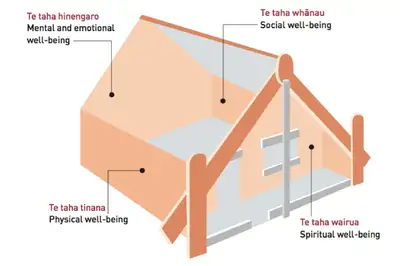
Similarly, whanaungatanga speaks to the relationships, reciprocal obligations and connections through which belonging is established and maintained. It reminds us that belonging is not simply something we either have or don't have. It is something that is continually created, supported and nurtured between people and within communities.
Our first experience of belonging is typically within family or whānau, but as we get older and our worlds expand, finding new connections and new places to belong can become a more intentional process that requires more effort. There are particular times in life when this becomes especially apparent: Leaving home. Starting university or a new job. Going flatting. Moving to a new town or country. Becoming a parent. Ending a relationship. Retiring and leaving behind the workplace and colleagues who have been part of everyday life for decades.
At these transition points, people don't simply lose routines. Sometimes they lose roles, relationships and places where they felt known. And that is why we need to be careful about responding to loneliness by simply telling people to ‘connect more’ or join a club. Loneliness and exclusion are not always failures of individual effort. We also need to ask whether the communities around people make connection possible. Schools can create belonging, or make a child feel perpetually on the margins. Workplaces can make people feel valued and included, or invisible. Neighbourhoods, marae, churches, sports clubs and community organisations can provide the repeated, ordinary contact from which relationships grow. Economic pressure, insecure work, discrimination, geographical isolation and the loss of community spaces can all make belonging more difficult.
Belonging is therefore not only an individual responsibility. It is a collective one. And often it is created through remarkably small behaviours.
- Remembering someone's name.
- Checking on the colleague who has become unusually quiet.
- Making room for the newcomer.
- Stopping to talk to a neighbour rather than simply waving.
- Noticing when someone who usually turns up has stopped coming, and sending them a message to check on them.
- Being curious rather than judgemental (popularised thanks to the wonderful show Ted Lasso).
- Making it safe for people to show up as themselves, and to show all of who they are.
These are small interactions, but their psychological message can be enormous:
I see you. There is room for you here. You matter.
There is another important part of belonging that we sometimes overlook. It is reciprocal. When we feel lonely or disconnected, understandably we ask: Who is there for me? Who understands me? Where do I belong? But we might also ask: Who around me might need to know that they belong? Inviting someone in, checking on a friend, learning a neighbour's name, volunteering, mentoring someone younger, reconnecting with whānau or simply giving another person our full attention can strengthen not only their sense of connection but ours as well.
Not every relationship needs to be deep. In fact, research suggests we have capacity for a relatively small number of genuinely deep, reciprocal relationships, given the effort they take to build and maintain. Our closest relationships matter enormously, but so do the lighter connections woven through everyday life: the person at the local café who knows our order, the neighbour whose dog we know by name, the colleague we joke with in the corridor, the familiar faces at the gym, school gate, sports club or supermarket. Together, those interactions tell us something important: I am part of this place.
Perhaps, then, Mental Health Awareness Week is an opportunity to broaden the questions we ask about wellbeing. Alongside asking how people are sleeping, exercising, coping or managing stress, we might ask:
- Who knows you?
- Where can you be yourself?
- Where do you feel you belong?
- Who would notice if you weren't there?
- Do you feel seen, known and accepted by the people in your life?
And, just as importantly:
- Are you aware there are people for whom life is better because you are part of it?
Loneliness creates significant suffering for people, and being around people doesn’t mean people feel they belong. Meaningful connections build a sense of belonging, and this gives people a foundation from which they can cope, contribute, recover from setbacks and flourish. Strong communities are built when people believe not simply that they live alongside one another, but that they matter to one another.
This week I would love for us to consider that wellbeing is not simply an individual goal or achievement. It grows in the spaces and connections between us. And sometimes strengthening it begins with something remarkably simple: noticing another person and letting them know: there is a place for you here and I am so glad to see you.
Professor Kirsty Ross is a Clinical Psychologist and Head of the School of Psychology at Te Kunenga ki Pūrehuroa Massey University.
Related news
Opinion: What social media replaces matters as much as what young people see online
By Professor Kirsty Ross and Professor Sarah Riley