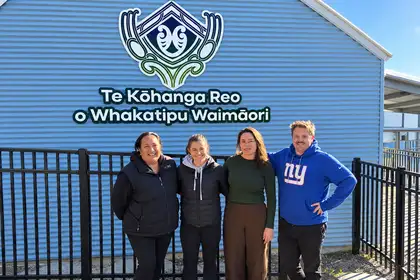
From left: Kaiwhāngai Tere Carroll, Kaiwhāngai Gemma Cribb, Kaiwhāngai June Caples and Co-Chair Brendon McIntosh.
The Queenstown-area kōhanga reo (total-immersion Māori language early childhood education) was five years in the making. Gemma helped turn the idea into reality, initially motivated by a desire to give her own children greater access to te reo Māori, tikanga Māori and mātauranga Māori. Unfortunately, her children had aged out by the time the kōhanga opened, but Gemma continued working towards creating something for future generations.
Gemma says the opening was incredibly special and emotional.
“I originally got involved because I wanted this for my own tamariki, and I do feel sad that they aged out before we were able to open the doors. But seeing other mokopuna there now, knowing they will have this opportunity, makes me incredibly proud and makes all those years of work feel worthwhile.”
Te Kōhanga Reo o Whakatipu Waimāori is not the first kōhanga reo in the Queenstown Lakes area. Kōhanga Reo Wakatipu opened in 1985 before closing around 1987. Since then, local whānau had not had access to kōhanga reo education in their own community.
The new kōhanga aims to restore that opportunity, creating a place where mokopuna and whānau can learn and grow together through te reo Māori and tikanga Māori.
The idea began with a small Puna Reo playgroup established by a group of wāhine who wanted more for their tamariki. As the group grew, so did the ambition.
“We soon realised there was a much bigger opportunity to create a place where our mokopuna could grow up surrounded by te reo Māori, tikanga and mātauranga Māori.”
It took five years of perseverance and mahi from whānau and supporters to get the kōhanga open. A major step came when Te Kura o Kā-Muriwai, Arrowtown School, made two unused classrooms available.
“Having a place we could call home was a huge step in making this dream a reality,” Gemma says.
For Gemma, being a Kaiwhāngai (teacher) at the kōhanga is about more than conventional teaching.
“Kaiwhāngai means to nourish, so we see the mokopuna as having the knowledge inside of them and our job is to nourish them to bring the knowledge from their tīpuna out,” she says.
Her path to becoming a Kaiwhāngai also brought her back to Te Kunenga ki Pūrehuroa Massey University
Gemma first studied at Massey more than two decades ago, completing a Bachelor of Business Studies in economics in 2002, followed by postgraduate study in finance and a Master of Management in finance. Years later, she returned to complete a Graduate Diploma of Learning and Teaching in Early Childhood Education, becoming eligible to graduate in December 2024.
Her early childhood education studies strengthened her understanding of the importance of the early years, particularly when it comes to identity, culture and belonging.
“One of the biggest things I have taken with me is that our tamariki need to see themselves, their whānau and their culture reflected in the places where they learn,” she says.
Gemma says the support she received from Massey lecturers also helped give her the confidence to contribute to change in her community. Their encouragement and willingness to share their expertise helped her believe she could make a difference.
“I think that support gave me the belief and confidence that maybe someone like me could chip away, do my little bit and help make a difference.”
Opening the kōhanga is a significant milestone, but it’s only the beginning of the next stage. The whānau are already talking with the local primary school about how mokopuna can continue their learning through te reo Māori after leaving kōhanga.
For now, she is excited to see the first generation of mokopuna grow up with te reo Māori and tikanga Māori as a natural part of their lives.
“I’m most excited about watching our mokopuna grow up with te reo Māori and tikanga Māori as a normal and natural part of who they are, and seeing that learning flow back into their whānau as well.”
Related news
What would it take for schools to start later?
Could starting school later help teenagers get the sleep they need? New research is examining what would help or hinder schools introducing later start times for senior secondary students in Aotearoa New Zealand.
Inspiring future innovators through STEM
Helping young people discover the possibilities of Science, Technology, Engineering and Mathematics (STEM) is what drives Brandon Montagnani every day. Earlier this year, that passion took his robotics team all the way to the VEX Robotics World Championship in the United States.
Finding a calling in the classroom
After 17 years in retail management, Raymond Carpendale realised the part of his job he enjoyed most wasn't the technology or the business. It was helping people.