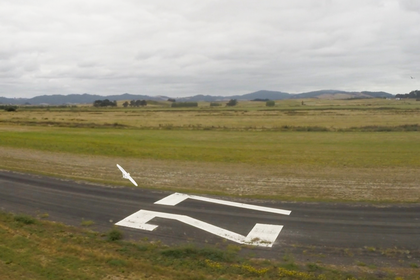
A drone flies at Mercer aerodrome. Image courtesy of Chris Jackson.
In the research, Armar Syahid bin Abdul Razak and School of Aviation lecturer Dr Isaac Henderson examined the ways airports are managing risks associated with drone operations through public-facing statements on their websites.
The websites of 288 different airports across 69 countries were surveyed, and it was determined that nearly half of the airport websites in the sample had no mention of the commonly used terms for aerial drones. They ascertained that this finding could be due to many airports not considering the risks of drones to be high enough, airports lacking the resources to create policies, or considering that the national regulations are sufficient for mitigating any associated risks.
The study was published in Drone Systems and Applications in early March, an achievement Armar says he is incredibly proud of. He completed the research project as part of his Bachelor of Aviation Management degree, which he studied via distance from Singapore. While studying, Armar was also working as a cabin crew member for a major international airline, which he believes gave him a unique perspective. “The advantage I feel I got from studying and working at the same time, and being in the industry as part of my work was that I could experience first-hand how what I learnt was being applied in practice. I took on the research project because to do research is very different to normal academic courses and I wanted to challenge myself.”

Armar Syahid bin Abdul Razak.
Armar says while conducting his research he found it particularly surprising that so many airports didn’t mention drones at all on their websites, despite the useful ways other airports were using their websites to communicate key safety messages and ways of complying with local requirements.
He also didn’t expect to find so many airports using drones for internal purposes, with 13.89 per cent of airports stating on their websites that they were using drones themselves. “In my 15 years as a member of cabin crew, I’ve been to many international airports around the world. I never expected that the runways we are landing on or the terminals we operate from might be inspected using drones, yet this is exactly what some of the airports I have been to are doing.”
The study also highlights how drones, when operated outside of the rules, can pose a significant risk within the vicinity of an airport due to the presence of low-flying manned aircraft. The study finds that some airports are managing the risks by referring operators to the relevant regulations, providing or linking to tools to help make compliance easier, notifying operators of potential consequences, imposing their own requirements, or investing in Counter-Unmanned Aircraft System (C-UAS) technologies. Many airports are also trying to proactively engage with the drone user community and promote safety amongst operators, seeing their websites as appropriate places to emphasise key safety messages.
Dr Henderson says that while the study shows how airports are currently using their websites, the key contribution is informing airport managers about how they might be able to better use their websites. “Unmanned aircraft users may use a search engine like Google as a first point of reference when seeing whether they can fly near a particular airport, and if so, under what conditions. This is likely to direct them to the airport’s website. My experience in the unmanned aerospace industry suggests that if you make it easy for people to comply with safety requirements, then they are more likely to do so. Armar’s research helps airport managers better understand how they can use their websites to do just that.”
Read the full article here.