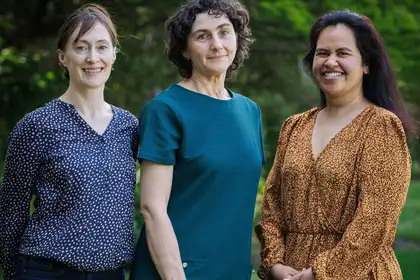
The Making Care Work research team. L to R: Dr Aisling Gallagher, Mary Breheny and Deanna Haami.
A new research initiative Making Care Work is exploring the realities of families trying to balance paid work and family responsibilities in Aotearoa New Zealand. Funded by a Royal Society Te Apārangi Marsden grant and spearheaded by researchers at Te Kunenga ki Pūrehuroa Massey University, the project aims to make the challenges faced by working families visible to policymakers and the wider public.
The Making Care Work project is grounded in the idea that combining paid work and family responsibilities creates profound challenges for families. This becomes far more complex when work has unpredictable schedules.
Project lead and Senior Lecturer in Social Geography Dr Aisling Gallagher says this research aims to highlight the everyday struggles of families and whānau who work outside the typical nine to five, Monday to Friday.
“Almost a third of employed adults in Aotearoa regularly work evenings, nights and weekends. This type of work is growing and with costs of living increasing, many families are working multiple jobs and more hours to make ends meet.
“However, taking on these extra hours also means increased emotional, cognitive, physical, and familial load, impacting the wellbeing of the whānau. This study will partner with families to understand how they are managing family life when they rely on non-standard hours of work,” Dr Gallagher explains.
These difficulties are compounded when work is low paid or unpredictable. The research team wants to understand the everyday challenges families face when juggling paid work and caregiving, and highlight how non-standard working hours, such as shift work or irregular schedules, impact family life and whānau wellbeing.
Through interviewing families and caregivers, the project will show policymakers what support is really needed to be able to combine non-standard work with family life and make paid work sustainable and equitable for families.
The project is still recruiting families to participate in this influential research.
“We would love to recruit families with a child or children aged between eight and fourteen who are working non-standard hours to this study. We hope to interview families and children about their experiences of family life around unpredictable and unsociable working hours,” Dr Gallagher says.