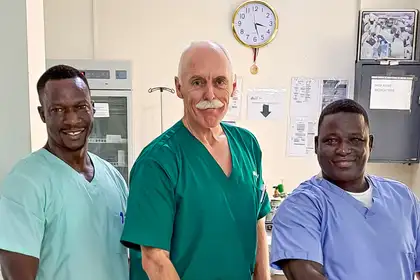
Andrew Cameron (centre) working as a nurse in Sierra Leone with local nurses, David (left) and Samura (right).
Today marks International Nurses’ Day 2026, with this year’s theme, ‘Our Nurses. Our Future. Empowered Nurses Save Lives’. This theme recognises the intense daily pressure on nurses globally who are doing extraordinary work to both save and improve the lives.
As a Massey alumnus, former lecturer, and current PhD student with Te Kura Tapuhi School of Nursing, Andrew is a passionate ambassador for his profession. He is also one of only 31 New Zealanders to be awarded the International Florence Nightingale Medal in the past 100 years.
“Being a good nurse is first and foremost about being there for people.”
Some people might consider Andrew’s international humanitarian nursing in conflict zones remarkable, but he says those nurses who work day-to-day caring for the elderly are his heroes.
“They are the nursing professionals who we should be celebrating on International Nurses’ Day. They are the largely unseen, providing real hands-on care and kindness that is the true essence of nursing.”
In 2025 Andrew embarked on a Doctor of Philosophy at Te Kunenga ki Pūrehuroa Massey University focused on what he has learned working as a nurse on humanitarian aid missions. His topic, Nursing Practice in Extreme Humanitarian Settings: A Critical Autoethnographic Narrative Inquiry, draws on his more recent experiences in conflict zones, disease outbreaks and humanitarian emergencies including Gaza, Ukraine, Rwanda and Sierra Leone.
In his thesis he will document the range of primary health care activities he’s undertaken as a humanitarian nurse, some of which are rarely described in curricula or journals. These include nursing activities like negotiating access with armed groups to deliver vaccines or nutritional aid; entering prisons to assess the health of prisoners of war, as well as travelling to remote villages to see how elderly and other vulnerable peoples’ living circumstances, such as shelter and food, can be improved.
The practical realities of humanitarian crises mean that Andrew has often found himself in charge of the unexpected. During the Ebola Virus outbreak in Sierra Leone, he was given the responsibility for managing the graveyard to ensure that the highly infectious bodies of the deceased were buried with dignity and respect.
Conceptually, his PhD is structured in a Three Dimensional Narrative Enquiry space, with the Minnesota Public Health Intervention Wheel, a method of Clinical Ethics, and Resilience Theory applied to interpret his nursing practice. While there are 17 standard public health interventions, these are typically delivered within stable, well‑resourced systems. Andrew’s thesis will explore the different interventions he undertakes in the midst of conflicts, wars and disasters. By applying theory to analyse Andrew’s practice in these extreme real-world settings his research will generate new knowledge that can inform nursing education and prepare nurses to work in extreme settings.
“There are not really any dedicated humanitarian nursing courses in the world, despite large numbers of nurses working in war zones and humanitarian crises. My research could inform future education in this area.”
Andrew has another two years of study towards his PhD. Meanwhile he remains on call with various aid organisations and can apply to Massey to travel abroad for a short nursing assignment, should the need arise during his study. He says his drive to help in desperate situations remains very strong.
“A lot of my work is just about being there. In Ukraine I was only international person in the hospital where I was working. Every day staff would come up to me and put their arm around my shoulder and exclaim with wonder that I had come all the way from New Zealand to the other side of the world simply to help them. They were excellent nurses, highly skilled in how they managed their work with limited resources and they were really happy that I had shown solidarity and come to help,” Andrew says.
A proud history of Nurse Education
Massey University began nurse education in 1972 with the first nursing studies programme at Palmerston North. Today students can become a registered nurse through Massey’s Bachelor of Nursing offered at the Manawatū and Wellington campuses. Massey also offers a Master of Clinical Practice (Nursing) and nurses looking to advance their career can choose from a suite of postgraduate programmes such as the Master of Nursing.
Massey’s Te Kura Tapuhi School of Nursing is ranked in the top 225 nursing schools in the world and in 2025,166 Bachelor of Nursing and Master of Clinical Practice (Nursing) students achieved a 100% pass rate in their State Final Examination.
Interested in studying nursing?
Related news
Understanding the bigger picture in trauma recovery
Therapy is often seen as a space focused on the individual. However, new research from Doctor of Clinical Psychology graduate Dr Jessie Anne Dennis shows that healing can also come from understanding the wider social and political forces shaping a person’s life.
Award recognises Nursing student’s empathy and generosity
Bachelor of Nursing student Lilly-Marie Olsen’s kindness and support for her fellow students has shone through in her first year of study at Te Kunenga ki Pūrehuroa Massey University.
A bold career change into mental health nursing
A desire for a new way to define success led law graduate Shivam Chawla to undertake Te Kunenga ki Pūrehuroa Massey University’s Master of Clinical Practice (Nursing).
New Human Nutrition major opens doors for aspiring health professionals
Te Kunenga ki Pūrehuroa Massey University’s new Bachelor of Health Science (BHlthSc) Human Nutrition major launching in 2026 is set to change the game for students keen to pursue nutrition but who may not have the usual chemistry or biology prerequisites.