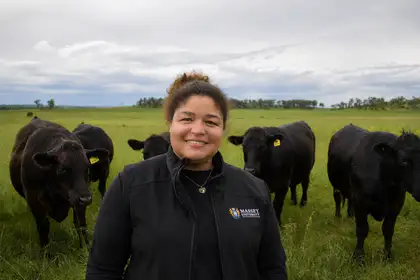
Dr Amelia Almeida, Senior Lecturer in Animal Science.
While her postdoctoral project at the University of New England – evaluating equations to predict methane emissions from grain-fed cattle – may not sound especially exciting to non-scientists, following its release last year, the study remained among the most-read papers for over five months. It’s also gained traction beyond academia, with Dr Almeida fielding regular enquiries from farmers, industry groups and policymakers.
“It’s rewarding because it shows the research is sparking real-world conversations in such an important and complex area,” she says.
Following the Paris Agreement, where New Zealand committed to reducing greenhouse emissions by 50 per cent below 2005 levels by 2030, countries must report their greenhouse gas emissions. Because it’s impossible to measure methane from every individual cow, governments rely on equations or models to estimate emissions.
Dr Almeida’s research revealed that grain-fed cattle in Australia produce 56 per cent less methane than previously estimated by the national greenhouse gas inventory.
“Models are always simplified; they can’t capture the full biochemical reality. But they’re essential tools for policy discussions and farmer decision-making. There will always be a better version than the one we have today and that, to me, is progress. It means we’re evolving as scientists and as humans, always moving closer to better answers. And that’s something to celebrate.”
Earlier estimates had relied on a model developed from the United States dairy cattle data in the 1970s, with conditions very different from today’s Australian grain-fed systems. With genetics and management practices continually improving, models must be updated to reflect reality. Using a dataset that captured modern grain-fed diets and cattle physiology, Dr Almeida was able to build far more accurate equations.
The findings reshaped the global conversation on methane emissions, challenging perceptions of how farmers and cattle contribute to greenhouse gases. Dr Almeida says the impact of this shift is significant: with more accurate methods, Australia’s greenhouse gas inventory now reports methane emissions from grain-fed cattle much more realistically.
“This strengthens farmer confidence in the reporting system, ensures more credible international reporting under the Paris Agreement and avoids overstating the cattle industry’s contribution to climate change.”
While most of New Zealand’s cattle are grass-fed, Dr Almeida says the lessons from Australia remain highly relevant. The key is ensuring that New Zealand’s national inventory equations are based on local data.
“Models must reflect the local production system – the type of feed, the genetics and the management practices – otherwise the numbers risk being inaccurate. Our methane calculations are already considered among the most accurate in the world, because we have invested heavily in direct measurements, something very few countries have done. That said, no equation is ever perfect. Our livestock, pastures and management systems keep evolving, so the equations in our national inventory must be regularly updated to stay credible.”
Another key lesson, she says, is the importance of questioning assumptions.
“It’s important for farmer confidence. If they see that the numbers used in policy are based on accurate, local science, they’re far more likely to trust the system and engage in finding solutions.”
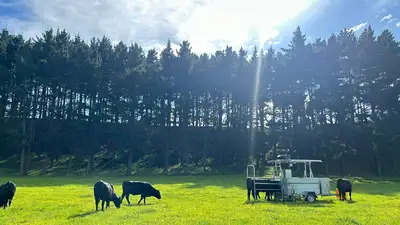
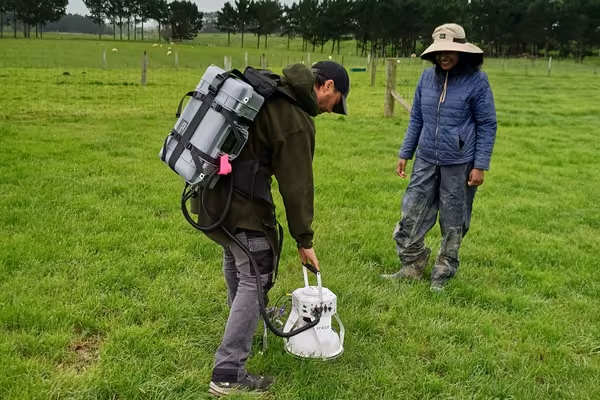
Methane measurement taking place at Keebles farm.
Now based in the Manawatū in Te Kunenga ki Pūrehuroa Massey’s College of Sciences, Dr Almeida has partnered with the Bioeconomy Science Institute AgResearch Group to refine the national inventory, while also training the next generation of scientists in methane measurement and mitigation. Through a collaboration with Lincoln University, she is also improving how methane emissions are measured in grazing ruminants, work she describes as vital for a country where pasture-based systems dominate.
“I’m still relatively new to the New Zealand research landscape, but I’m building strong collaborations with key partners, and I’m excited about the impact we can make together.”
When Dr Almeida joined Massey University, the Whenua Haumanu programme – the most comprehensive initiative on regenerative agriculture in New Zealand – was already underway. Initially sceptical of regenerative agriculture because of the limited science behind many of its claims, she says Whenua Haumanu is filling that gap.
“When I started seeing the results in terms of greenhouse gas emissions, I was genuinely impressed by the scale of reduction achievable in both methane and nitrous oxide. This work provides farmers with another important pathway for emissions reduction. Since there’s no ‘one-size-fits-all’ solution, having management practices as part of the toolbox is incredibly valuable.”
What excites her most is that Whenua Haumanu is farmer-driven, with science layered on top.
“This approach gives us the evidence base to move beyond ideology and into practical solutions. In New Zealand, where agriculture underpins both our economy and our identity, having rigorous science guide change is essential. It gives farmers confidence that they have real, workable options for the future.”
Dr Almeida’s passion for this work stretches back to childhood. At age seven, while watching the Earth Summit in Rio de Janeiro, she first learned about climate change and decided she wanted to become a scientist. Growing up in a rural environment, she understood the social importance of animals and their role in food security. That awareness shaped her university studies, where her goal was clear: to develop tools that would deepen understanding of climate change and help identify solutions.
“For me, working in the GHG/animal efficiency space was a natural path, and I feel genuinely fulfilled by it. This is an issue that knows no boundaries, it requires us to work together as humans to keep living and living well. I’m very grateful to live in beautiful Aotearoa, where I’ve felt truly welcomed. I really admire the New Zealand way of raising cows, it feels natural, connected and right, and New Zealand has the most efficient grazing systems I know of.”
Discover how Whenua Haumanu is nurturing the land through innovative pastoral farming.
Related news
Increasing lamb weaning weights linked to emissions efficiency and improved profitability
New research suggests sheep and beef farmers could improve both profitability and emissions efficiency by increasing lamb weaning weights, with only marginal changes in total greenhouse gas emissions.
Cutting-edge emission tracking technology set to boost sustainable farming research
The College of Sciences’ School of Agriculture and Environment has acquired two portable trace gas analysers, which will allow researchers to measure greenhouse gas emissions from farmed land in real time.
Launch of practical guide to create resilient pastures in a changing climate
A new publication has been launched that offers a comprehensive and up-to-date resource on commercially available grazing pasture species in Aotearoa New Zealand.