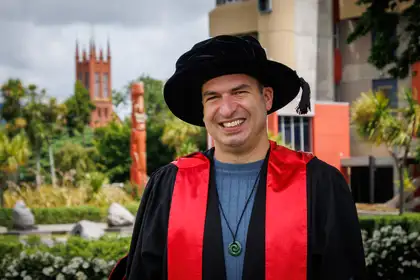
School of Veterinary Science Research Officer Doctor of Philosophy graduate Dr Valter Dos Anjos Almeida
After connecting with School of Veterinary Science Infectious Disease Ecology Professor David Hayman, Dr Almeida joined an ongoing collaborative research project focused on gut microbiome data sourced from African collaborators that had yet to be analysed. He then set out to build the specialised bioinformatics skills needed to unlock its potential.
Using advanced DNA sequencing and metagenomics, he analysed 553 faecal samples and more than 2,400 bacterial genomes, identifying many previously undescribed species circulating within the community.
When the scale of the findings became clear, the experience was both exciting and daunting.
“It felt like opening a door into a completely new microbial world. There was excitement, but also a sense of responsibility. I knew I was working with a complex dataset that needed careful interpretation,” Dr Almeida says.
Studying gut microbiomes in African populations opens new pathways for discovery, revealing bacterial species that had not previously been described. Dr Almeida says this critical opportunity improves international understanding of gut health and disease.
“In places where farmland sits right at the forest edge, the risk of microorganisms moving between wildlife, livestock and people increases. Understanding those risks helps support community health, conservation and long term disease prevention.”
His research also revealed bacteria shared across different hosts, highlighting potential pathways for disease transmission between humans, livestock and wildlife. One finding was particularly striking.
“One Campylobacter species found in human samples was more closely related to those detected in gorillas than in livestock, even though people have more frequent contact with domestic animals.”
Campylobacter is one of the leading causes of diarrhoeal disease worldwide and poses serious health risks, particularly for young children in parts of Africa. Dr Almeida identified five novel Campylobacter species, alongside previously known strains, helping to build a clearer picture of how these bacteria circulate in communities like Buhoma on the northern boundary of the Bwindi Impenetrable National Park.
He also examined bacterial groups such as Treponema and Prevotella. These bacterial groups are typically more abundant in the gut microbiomes of communities practising traditional lifestyles than in Western industrialised populations. Several novel species from these groups were identified and are now being explored further for publication.
As Dr Almeida did not travel to Uganda himself, strong partnerships with African collaborators were central to the project and ensured the research reflected local context and priorities.
The technical challenges were significant. When the sequencing data first arrived, Dr Almeida had little experience analysing such complex files.
“I quickly realised this work required high performance computing and a wide range of specialised software. I had to learn programming languages and become confident working in command line environments. It took time and patience, but those skills are now the most valuable part of my PhD.”
Originally from Brazil, Dr Almeida’s academic journey has taken him across continents and disciplines, from veterinary medicine and pathology to bioinformatics and disease ecology. He is now a research officer in Massey’s School of Veterinary Science, where he continues to work with the Buhoma dataset and support other health related research projects.
“There is still so much more to explore. This work represents only a small proportion of what the data can tell us. I am excited to keep building on it and to keep developing tools that help us understand disease systems more clearly.”
Related news
Listening, learning and leading: Dr Michelle Musakwa’s role in amplifying African voices
Doctor of Clinical Psychology graduate Dr Michelle Musakwa’s research makes an important and timely contribution to mental health research in Aotearoa New Zealand as she shines a light on perspectives missing from the national conversation: the wellbeing narratives and experiences of Black African migrants and refugees.
Exploring kiwifruit’s potential as a natural sleep and mood booster
Dr Alexander Kanon’s PhD research explored whether kiwifruit could be the secret ingredient to supporting better sleep, mood and brain health, with his findings revealing the New Zealand-grown fruit may offer more benefits than previously understood.
Lifelong learning in action: celebrating staff at Manawatū graduation
The November graduation season saw 15 Massey staff join students in Manawatū marking major academic milestones.