Together with her husband, Lisa has spent more than two decades building a career in the dairy industry, working their way from farm management into farm ownership. Since moving from Northland to the Tararua District in 2005, the couple have grown their farming business from sharemilking in Woodville to purchasing their first farm in Dannevirke in 2006, before moving to a larger farm in Pahiatua in 2015.
Now in her 30th season farming full-time, Lisa says the constant variety, challenge and opportunities to keep learning are what first drew her to the agricultural sector and what continue to motivate her today.
Her career has evolved significantly since graduating with a Bachelor of Applied Science in 1996, but after being diagnosed with osteoarthritis in her hip in 2023, Lisa realised it was time to expand both her study journey and future career opportunities.
“The diagnosis pushed me to complete my graduate diploma but also highlighted the need for a hip replacement. Although I kept farming, I realised my body was wearing out and I needed an exit plan if it resulted in an inability to continue working on the farm,” Lisa says.
Returning to study after years in the workforce brought both confidence and uncertainty.
“I was, and still am, a little uncertain of my ability. But having life experience to draw on does help, though it can be harder to move away from established views and ways of thinking. It’s good to learn and grow, and I like to be challenged – this has certainly challenged me,” Lisa says.
She enrolled in the Integrated Farm and Environment Management course in 2025, where she found some aspects aligned naturally with her day-to-day farming experience, while others pushed her outside her comfort zone.
“I’m farming every day, so I had a good knowledge base, but the geology part was more difficult as I had less experience to draw on.”
Lisa says she found value in reconnecting with formal learning and engaging with both lecturers and fellow students. Now completing postgraduate study through a mix of on-campus and distance learning, she says the classroom environment remains her preferred way to learn.
“I enjoy being on the Manawatū campus as I find it easier to learn in a lecture classroom environment, alongside other students. Being able to discuss ideas and draw on other people’s knowledge really helps consolidate learning. However, studying via distance for the second semester is necessary, as even trying to find the time to sit down to get assignments done during calving is difficult!”
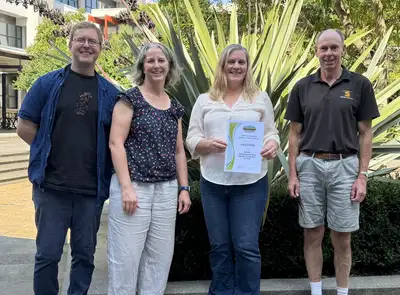
L-R: Dr Callum Rees, Associate Professor Lucy Burkitt, Lisa Lyons and Professor David Horne.
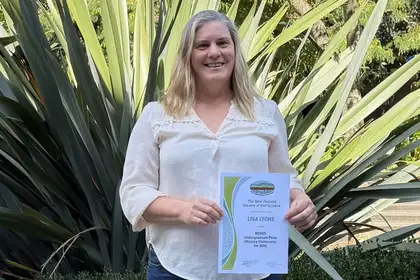
Her academic efforts were recently recognised with the New Zealand Society of Soil Science Undergraduate Prize, which recognises excellence in soil science research, technology and advocacy.
“It’s a real honour to receive, though I still find it difficult to accept that I deserve it!”
Lisa’s study experience has also reshaped the way she approaches farming and environmental management, particularly around freshwater farm planning and sustainability.
“It’s helped me better understand the complexity of farming systems and environmental policy. It’s taken away a lot of the unknown around freshwater farm plans and shown me how they can become an integrated and effective part of sustainable farming.”
Following the completion of her postgraduate certificate, Lisa is considering a master’s degree, though balancing it alongside farming remains a challenge.
“Apart from milking, there is no such thing as a typical day on the farm! For most of the season, it’s only me and my husband, though we employ an international student over the summer for a couple of months as part of their agricultural qualifications.”
This allows Lisa to tutor Primary Industry Training Organisation students completing their level three and four qualifications.
Lisa and her husband share the workload, but there’s always plenty to do – from calf rearing, feeding out and pasture management, to fencing, fertiliser spreading, compliance paperwork, financial planning, winter management, soil care and tending to the stock in their care.
The sheer variety of responsibilities is what Lisa says makes agriculture such a rewarding and versatile industry, with the range of skills developed on-farm coupled with education opening doors in countless directions.
“The opportunities for development and upskilling are limited only by imagination. Someone graduating with an agricultural degree could become a Member of Parliament, a company director, a dairy farm or herd owner, or a leader of a lobby group. It’s about forming a plan, working towards your goals, finding support and continuing to invest in education and personal development.”
Related news
Turning dairy farm roots into industry impact
Born and raised on a dairy farm in Taranaki, Madeleine Poole developed an early passion for the agricultural industry and is now building a meaningful career in the sector after completing a Bachelor of Animal Science.
Research finds New Zealand farmers largely getting phosphorus fertiliser balance right
New research suggests Aotearoa New Zealand farmers are broadly matching phosphorus fertiliser use to the needs of their soils, helping maintain relatively stable nutrient levels across the country’s agricultural land.
International students experience hands-on, future-focused agriculture and environmental sciences through university exchange
Three students from the globally top-ranked agricultural university, Wageningen University, are spending four months in Aotearoa New Zealand for an immersive study exchange, gaining practical experience in environmental and agricultural sciences.