Volcanic ash forecasts help predict where ash may travel and fall during an eruption, giving communities and emergency planners valuable information to prepare and respond. However, uncertainty around an eruption and the information used to produce forecasts can affect their accuracy.
Dr Scott’s work involved testing different models used to forecast where volcanic ash may fall and examining how changes to the information fed into these models could affect the results.
“I identified the factors that most influence forecasts and showed that past eruption data does not always lead to better forecasts. These results can help scientists create more accurate and efficient forecasts for emergency planning.”
Fascinated by the challenge of forecasting natural hazards, Dr Scott says she chose this area because she wanted to contribute research that makes a difference.
“My findings can be used by volcanologists and emergency managers to improve volcanic ash forecasts and better understand their limitations, helping make volcanic hazard forecasts more accurate and useful for real-world decision-making.”
Experiencing two significant earthquake events while growing up in Ōtautahi Christchurch helped shape Dr Scott’s tertiary direction.
“I was in my first year of high school during the Canterbury earthquakes and in my first year of university when the Kaikōura earthquake happened. Both events made me understand that we need to be prepared for natural hazard events as a society to reduce risk and become more resilient,” Dr Scott says.
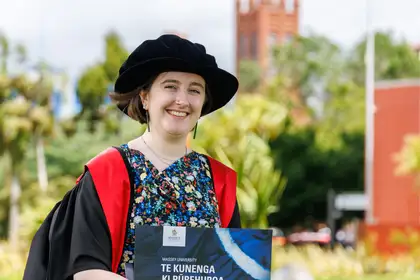
Following a Bachelor of Science in geology and geography and a Master of Science in disaster risk and resilience from the University of Canterbury, Dr Scott began a PhD at Te Kunenga ki Pūrehuroa Massey University, drawn in part by its proximity to the Taupō Volcanic Zone.
While her thesis was primarily computer-based, giving her flexibility to work from anywhere, Dr Scott says a highlight was taking multiple trips to volcanoes with other volcano enthusiasts, both for study and for fun.
She also had the opportunity to present her work at two international conferences, the European Geoscience Union General Assembly in Vienna in 2024, and the International Association of Volcanology and Chemistry of the Earth’s Interior (IAVCEI) Scientific Assembly in Geneva in 2025, giving her the chance to connect with the international volcanology community.
“I had a really enjoyable experience completing my PhD. I was fortunate to have a supportive group of supervisors and close PhD friends who I could go to at any time for questions or just to vent. I decided to only work 9 to 5, Monday through Friday as much as possible so I could recharge for the week ahead, and I continued to play field hockey throughout my study,” Dr Scott says.
Now based in Pōneke Wellington, Dr Scott is currently working for the Ministry of Business, Innovation and Employment, but hopes to return to the natural hazards, disaster risk and resilience, and emergency management space in the future.
Her advice for PhD students?
“Start writing early, even if you have to chuck most of it out! Try to work business hours as much as possible and put your mental and physical health first! It’s key to success in the long run and will hopefully help to avoid burnout.”
Related news
Leading the global conversation on lahar hazards
Dr Anke Zernack has been recognised as one of the world’s leading experts on lahars – destructive volcanic mudflows - having contributed to a Nature Geoscience panel alongside three other international specialists.
Researchers secure funding for pioneering climate and disaster projects
Three projects led by Massey researchers have been awarded funding from the 2024 Ministry of Business, Innovation and Employment Endeavour Fund.
Listening to Taranaki mounga
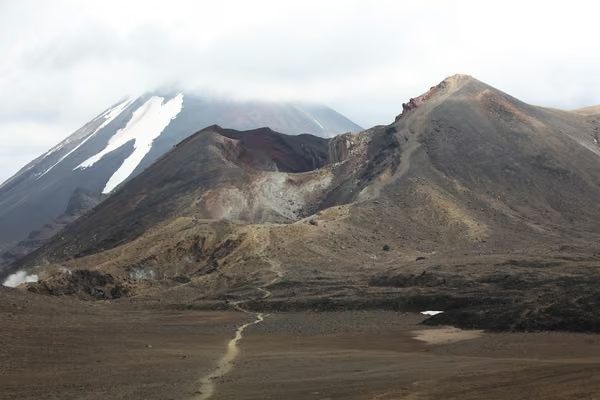
Taranaki mounga is an ancestor, a living being, and an active volcano. The mounga is a pillar or beacon that represents a significant spiritual connection for the eight iwi of the region, and also proposes the potential of a future eruption.