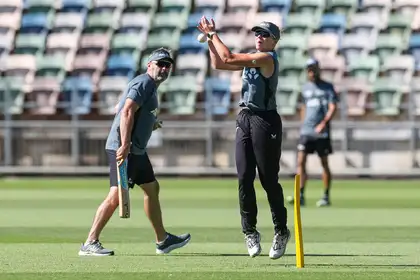
Head Coach Ben Sawyer watches All-Rounder Jess Kerr with Dr Warrick Wood observing in the background.
“That photo nicely reinforces the idea of integrating mental skills. I’m in the background but still involved, as opposed to being entirely separate – perhaps in the ways that we’ve traditionally thought about working with a shrink.”
A lecturer in sport and exercise psychology at Te Kunenga ki Pūrehuroa Massey University, Dr Wood has spent the past decade working as a mental skills coach, supporting athletes to thrive under pressure and navigate the highs and lows of performance. His recent appointment as the travelling mental skills coach for the White Ferns marks a significant step forward for the women’s national cricket team and for the growing recognition of mental skills in elite sport.
“Each provincial team in New Zealand has their own provider, and I’ve worked with Auckland Cricket for 10 seasons, but with the increased emphasis on the psychological aspects of performance and wellbeing. Especially on tour, there’s been a push for the White Ferns to have someone travel with them. I’m extremely grateful to have been offered the role, and I hope it provides some momentum for a permanent position going forward.”
For Dr Wood, the journey into this field was a natural evolution of his lifelong love for sport. He was first an athlete, then a coach, and is now someone who supports others to be their best.
“My goal is to help athletes and support staff have the experience they want within sport, whether that means performing consistently or creating more balance so that sport remains a positive and complementary part of their lives. Everyone is looking for something different and I love this aspect.”
The foundation of his work with the White Ferns so far has been relationship building.
“Given that this was my first tour with the team, I focused mostly on developing relationships with athletes and staff and supporting individuals. As players at this level are so physically and technically proficient, many of the strategies are geared at helping individuals get out of their own way.”
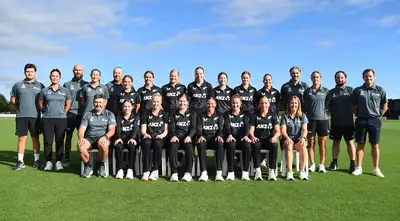
Dr Warrick Wood (third from the left) with the New Zealand women's national cricket team.
That might mean teaching simple breathing exercises, introducing mindfulness practices, or helping players create cue words to centre themselves under pressure.
“It’s about maintaining focus and reducing anxiety. Overthinking is so easy at this level, and it can really disrupt performance.”
Dr Wood emphasises that mental skills and mental health aren’t separate silos and understanding that nuance is crucial.
“This is always a fine needle to thread and there is typically overlap between performance and wellbeing when working with athletes. I always start with outlining my role in the team, as this is important in establishing alignment between expectations and a sense of trust. For instance, some players might only want to work on performance matters, while others might be seeking some wellbeing support.”
Take mindfulness, for example. Dr Wood says it can be really effective for recovery and wellbeing, but also a great performance aid as it nurtures non-judgemental engagement in the moment.
As a male coach working with a women’s team, he’s thoughtful about how he approaches differences in experience and environment but avoids assumptions.
“There’s a lot of research on gendered differences, but much of it is inconclusive. I try to go in without biases or preconceived ideas. Instead, I focus on understanding what’s needed in that specific environment.”
In high-performance women’s sport, he’s observed a growing appetite for education around mental skills and a real openness to embedding the work into team culture.
“The professionalism of women’s cricket is growing rapidly. I think the next step is improving how mental skills are integrated. How we prepare, perform, recover and work together as a team.”
Still, the job isn’t without its challenges. Seeing players struggle, especially off the field, can be tough.
“I love connecting with people, so it’s always hard when someone you care about is going through something. And you do sometimes carry that thought of, ‘What could I have done differently?”
He’s also conscious of the limits of his role and the importance of referring players on when more specialised support is needed. But for Dr Wood, the rewards far outweigh the roadblocks.
“In some environments, overcoming the stigma of doing mental skills work can still be a challenge. And because it’s an emerging field, the roles can be relatively small, so impact can take time.
“Whether it’s young people trying to figure things out or athletes at the highest levels of sport, it’s such a rewarding role.”
Looking ahead, he sees the discipline growing.
“There’s increasing emphasis on both performance and wellbeing, and with the pressure that comes at all levels of sport, I think we’ll see mental skills coaching continue to expand, even beyond sport, into areas like the performing arts or business.”
As for highlights from his time with the White Ferns so far, he says it’s the small moments that stick with him – a fist bump from a player to acknowledge that an idea had worked, or being asked, in front of the whole team, “Are we still meeting for a chat after training?”
“That kind of public acceptance, not just of me, but of mental skills in general really meant a lot.”
Whether it’s a formal sit-down, a walk-and-talk over coffee, or being the last person a batter speaks to before walking out, Dr Wood is proud of the support he’s been able to offer in a range of ways. And while he’s still waiting on the formal feedback, he’s hopeful the journey isn’t over just yet.
“Hopefully, this story is to be continued.”
Related news
Weightlifting and Mana Wāhine: A journey of strength and connection
For her PhD research, Jamie Ogilvy is exploring the intersection of weightlifting and Mana Wāhine values.

30 years of celebrating Sport and Exercise graduands
Sport and Exercise staff and students celebrated another graduation milestone this week at The Regent, with Professor Andy Martin marking 30 years of coordinating student practicums within the programme.
Strong start to new era of Academy of Sport
After undergoing a redesign last year, the Academy of Sport programme has started the year strong with additional opportunities for student athletes.