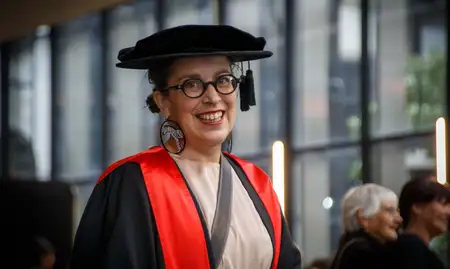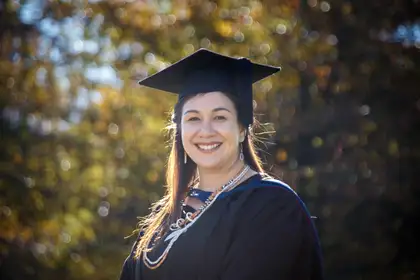
Maria Afeau
After years away from her ancestral village, Maria Afeau returned to Malaita in the Solomon Islands, not just as a visitor, but as a researcher committed to understanding how Indigenous women are leading the fight to conserve their land. Her master’s research within the Development Studies programme explored the efforts of self-appointed female rangers combating deforestation and promoting environmental guardianship in the Leileigela Conservation Area.
Maria says the experience was personally and academically transformative.
“The women I worked with were not only relatives, but leaders in a growing conservation movement, protecting ancestral lands and reshaping how leadership is understood in rural Indigenous contexts.”
Her research, which centred on gender, Indigenous knowledge and environmental protection, focused on the actions of Malaitan women who initiated a grassroots movement to resist unsustainable logging. Despite limited formal support, these women mobilised their communities, including men, to join their conservation efforts.
Maria’s journey back to her father’s village was filled with emotion and purpose.
“It had been 10 years since I last visited. I was nervous, but the warm welcome I received, particularly from the two founding women rangers, was deeply humbling.”
Throughout her fieldwork, she immersed herself in the lives of these women—walking the forest with them, recording their stories and witnessing their deep spiritual and cultural commitment to the land.
“They aren’t just protecting the forest, they are honouring ancestral responsibility and safeguarding the future,” she adds.
Maria hopes her research will support the Leileigela conservation group’s efforts to secure funding and raise awareness about their locally-driven environmental work.
“It’s about bringing visibility to these women, and to models of conservation that are rooted in community, culture and Indigenous leadership.”
Studying from Hong Kong, Maria credits Massey’s flexible programme structure, strong Pacific expertise and mentorship from Professor Regina Scheyvens as key reasons for choosing the university.
“Massey encouraged me to pursue research grounded in my lived experience, which was crucial to the depth and meaning of my study.”
Along the way, Maria was awarded a DevNet scholarship, an honour she describes as both a practical help and a personal affirmation.
“It showed me that research grounded in Indigenous perspectives, especially women’s voices, is valued and necessary.”
Like many postgraduates, she faced moments of challenge — navigating ethical responsibilities, balancing academic rigour and facing isolation during long writing stretches. But the support of her supervisor and the memory of her fieldwork kept her grounded.
Now with her degree complete, Maria is looking to contribute to the development sector in roles that centre inclusive, decolonised and community-led approaches.
“Development must be about supporting people to lead their own change and recognising the strength that already exists in our communities.”
Related news
Championing refugee inclusion through applied linguistics
This week, Dr Hanna Svensson graduated with a PhD in Applied Linguistics from Te Kunenga ki Pūrehuroa Massey University, marking the culmination of a journey that began in 2004 with a Bachelor of Arts.
From experience to excellence: A student’s journey to success
Hirata Titcombe achieved a significant life milestone on 15 April 2025, when she proudly graduated with an Executive Master of Business Administration (EMBA), a journey that brought decades of life and leadership experience full circle.
Doctoral graduate redefines settler identity and land relations through art
Artist and new PhD graduate Dr Rebecca Ora embarked on a transformative journey for her doctoral research with Te Kunenga ki Pūrehuroa Massey University.