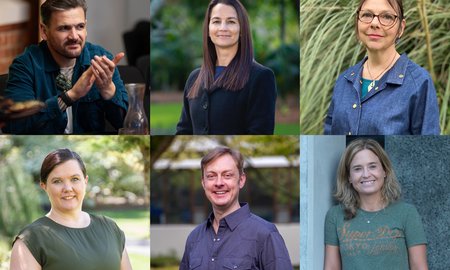
Dr Marjorie Lipsham (left) and Dr Acushla Sciascia.
The Fellowships aim to empower early and mid-career Māori researchers to foster research, science and innovation talent and plant the seeds for the next generation.
Dr Marjorie Lipsham
Te Putahi-a-Toi Senior Lecturer Dr Lipsham received her Fellowship, valued at $800,000, as an early career researcher. Her research, titled He Rau Tauwhiro: The place of kaitiaki in contemporary Māori realities, will build on her doctoral work on kaitiakitanga.
“In our environment, kaitiaki are considered spiritual beings and guardians who are relations to Māori through whakapapa. They take the form of birds, mountains, rivers, taniwha, atua, tūpuna or other manifestations, such as trees. Concentrating on non-human forms, a key aim of my research will be to investigate Māori experiences and understandings of kaitiaki, alongside how they inform our understandings of the environment,” Dr Lipsham says.
With great support behind her, Dr Lipsham says she can’t wait to get started.
“I feel really honoured to receive this Fellowship and to carry out research that makes my heart sing. While it is competitive, the Māori Pacific research space is also a close one and I know others who applied but were not successful. I hope that their amazing kaupapa are recognised in the future as we all have a part to play in the transmission of knowledge.”
Dr Lipsham says she’s most looking forward to speaking with Māori about kaitiaki and their connection to our environment.
“I learned from my kuia that kaitiaki take care of us, protect us and that they are intimately connected via whakapapa. I will start this research with that knowledge, but I hope to extend on these understandings and leave koha for future generations to know who kaitiaki are, what they do and how they inform and guide us in the environment. In this current political context, we will continue the work that is required for our mokopuna.”
Dr Acushla Sciascia
School of Agriculture and Environment Senior Research Officer Dr Sciascia’s Fellowship, valued at $1.2 million, is for a mid-career researcher. Titled Toitū te marae, toitū te hapori – Building whānau resilience through physical and virtual marae, Dr Sciascia’s research will be focused on the adverse effects of extreme weather events and impacts of climate change on Indigenous populations who already grapple with the impacts of colonisation, land confiscation, occupation, racism and discrimination.
The aim of Dr Sciascia’s initiative is to ensure community wellbeing is prioritised and to use a marae-centred approach to help whānau prepare for future events and build resilience.
“For whānau, hapū and iwi, the threat of climate change on our spiritual connection to whenua, wai and taonga is significant. It is a threat to our cultural and spiritual wellbeing that will increasingly impact Māori communities as we become more vulnerable to future environmental events. Given the existing inequities that Māori communities are faced with, their preparedness, response and recovery to natural phenomena are disadvantaged. Their ability to adapt to climate change requires grounded, connected and reflective approaches.”
Dr Sciascia says she is excited for the new opportunities and grateful to the panel for this appointment.
“Nōku te maringanui kua whai wāhi atu ahau ki tēnei kaupapa nui whakaharahara. I’m extremely proud of this achievement. After years of leading National Science Challenges and the Ministry of Business, Innovation and Employment Endeavour Fund, I get the chance to focus on my own research interests which have been built upon my PhD studies and leadership roles in the research, science and innovation space.”
As with her PhD work, Dr Sciascia will be drawing on wānanga in person and online to ensure engagement on topics of resilience, whānau and mokopuna-focused decisions are done with mana and integrity. She says given the current climate, it’s imperative to continue uplifting Māori initiatives.
“Each day since the appointment of the new coalition government, Māoridom have come under attack by the new policies and legislation of this country. There is now no greater time for us as Māori to step into these roles and spaces to continue doing our work, to continue elevating mātauranga Māori both in theory and practice and empowering our hapū and marae to decide what is best for them and their futures. I see this research programme for the next four years as a catalyst to supporting Mana Motuhake and mokopuna-focused decision making around whānau resilience, and this excites me.”
Related news
Massey enjoys continued success from Te Pūtea Rangahau a Marsden
Te Pūtea Rangahau a Marsden, the Marsden Fund, have announced funding for seven Massey research projects.
Mātauranga Māori Disaster Risk Reduction Centre launched
Te Toi Whakaruruhau o Aotearoa, the new mātauranga Māori Disaster Risk Reduction Centre began development in July 2020, as a partnership between the Earthquake Commission (EQC) and Massey University.
How can mātauranga Māori shape our future?
In episode four of Conversations That Count - Ngā Kōrero Whai Take we explore what Mātauranga Māori means in modern Aotearoa.