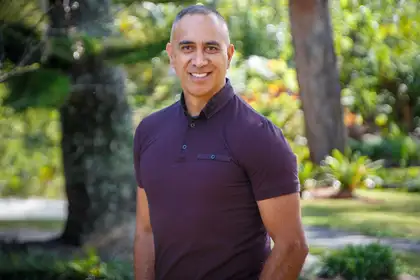
Associate Professor Bevan Erueti has been appointed the new Māori Health Board Director for the CAPHIA.
This appointment reflects Dr Erueti’s commitment to advancing Māori health, embedding Indigenous knowledge into academic spaces, and championing Te Tiriti o Waitangi-led approaches to research, education and public health across Aotearoa New Zealand and Australasia.
As Associate Dean Māori for the College of Health and Associate Professor in the School of Health Sciences, Dr Erueti is a driving force in advancing Kaupapa Māori approaches, enriched by global Indigenous perspectives, and woven with pūrākau (stories) that explore health, identity, and place.
Head of the School of Health Sciences Associate Professor Rachel Page says Dr Erueti’s appointment is a reflection of both his academic excellence and his commitment to meaningful, Te Tiriti-led change.
“Bevan brings incredible depth of knowledge and integrity to his work, and we’re proud to see his leadership recognised at a national and international level. His appointment is not only a personal achievement, but a reflection of the impact he’s having across the wider public health sector.”
Strengthening systems through Indigenous knowledge
With CAPHIA’s trans-Tasman reach, this new role provides a space for Dr Erueti to amplify the value of Indigenous-led solutions and push for greater representation and inclusion at every level of the public health sector.
“I’m hoping to extend this influence by promoting culturally sustaining curriculum design, supporting Indigenous data sovereignty, and fostering collaboration between Māori and other First Nations communities,” Dr Erueti explains.
He says the health system continues to underserve Māori and Indigenous communities, often overlooking deeper historical causes.
“Globally, Indigenous communities are dealing with similar key issues. Systemic inequities in mental health, chronic disease, and access to culturally appropriate services, all of which have been heavily compounded by the trauma of colonisation.”
Backed by years of leadership in curriculum design and research, Dr Erueti is focused on helping CAPHIA member institutions to transition from intent to implementation.
“Thanks to both my faculty and research colleagues, both my leadership in curriculum design and research have provided a foundation upon which, as Māori Director of CAPHIA, I can assist CAPHIA’s member institutions to invest in Indigenous research capacity and embed mātauranga Māori and other Indigenous knowledge systems into public health education.”
He brings direct experience evaluating the impact of iwi-informed and intergenerational approaches to wellbeing, from tamariki to kaumātua.
“My involvement in the evaluation of the Healthy Active Learning initiative has helped evaluate how localised, iwi-informed approaches improve outcomes for tamariki and similarly, the Ageing Well National Science Challenge project I was a part of, explored intergenerational wellbeing for kaumātua- these are just a couple of examples of how Indigenous-led research and curriculum transformation can respond to CAPHIA’s purpose and function.”
Investing in future Māori leaders, grounded in Kaupapa
Dr Erueti believes the future of Māori health depends not just on institutions, but on the students they nurture and empower. Initiatives such as Te Rau Puawai and Pūhoro STEMM Academy — where he has been fortunate to contribute as a speaker and mentor — are examples of how institutions can actively support Māori student success.
“Universities need to be learning sites that are culturally affirming, embed mātauranga Māori in teaching and research, and offer mentorship grounded in Kaupapa Māori values. I hope to see a generation of Māori health professionals who are confident in their identity, fluent in their tikanga, and equipped to lead transformative change.”
For Dr Erueti the appointment is a recognition of a long journey dedicated to systemic change through Indigenous health and education.
“It reflects the culmination of over two decades of work in Indigenous health, education, and research and having the opportunity to share my experiences from the initiatives that have embedded Te Tiriti o Waitangi into curriculum, research, and institutional strategy across Massey.
“Being named to this role by CAPHIA is a recognition of both my experiences and Massey’s collective sustained commitment to Te Tiriti while offering a platform to influence public health education across Australasia.”
Throughout his career, he has worked alongside many colleagues and collaborators committed to kaupapa Māori research and the real-world application of Indigenous knowledge in public health.
“I’ve been really lucky to have worked with some amazing researchers and colleagues at both Massey and in nationally led projects that have exemplified how Kaupapa Māori research can inform policy and practice across diverse health contexts.”
More news
Words that connect: Associate Professor Robert Sullivan becomes New Zealand Poet Laureate
As Aotearoa New Zealand's new Poet Laureate, Dr Sullivan promises to shine a light on connections by bringing poetry into the everyday lives of people across the motu.
Sir Geoffrey Peren Award announcement
Professor Emeritus Ralph Sims CNZM is the 2025 recipient of the Sir Geoffrey Peren Award, Te Kunenga ki Pūrehuroa Massey University’s most prestigious award.
Pioneering fungi research collaborators celebrate 20 years
More than 20 years ago Professor Yihuai Gao began working with Te Kunenga ki Pūrehuroa Massey University to extract the reishi mushroom’s active ingredients for immunity and cardiovascular health.