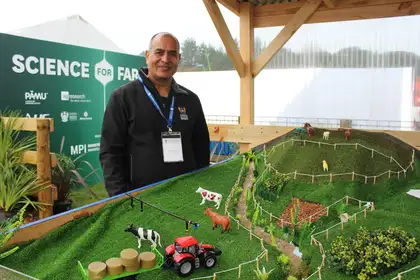
Professor Ranvir Singh at 2025 Fieldays with display of edge-of-field mitigations.
The GFFA, held as part of Green Week in Berlin in January 2026, brings together leaders from politics, business, science and civil society to discuss solutions for global food security. This year’s focus on water highlighted the need for innovative, systems-based approaches to manage water across land, freshwater and marine environments.
Born on a small farm near Delhi, India, Professor Singh has spent his life immersed in water management, from helping with crop irrigation in his childhood to studying environmental engineering in the Netherlands and water quality challenges in the United States. For the past 16 years in Aotearoa New Zealand, he has combined research, teaching and community engagement to improve water use efficiency and water quality in agricultural landscapes.
Taking the stage in front of scientists, policymakers and industry leaders, Professor Singh outlined several key principles for sustainable water management: protecting and optimising water flows within natural limits, measuring outcomes in terms of nutrition per drop rather than just crop yield and designing multifunctional farms that balance productivity with environmental stewardship.
Another critical point he emphasised was the importance of community-led, science-informed catchment collaborations.
“Without people driving the change or taking the steps, we can do whatever science we want but the impact won’t come,” Professor Singh says, highlighting the Catchment Solutions Project as an example of this approach.
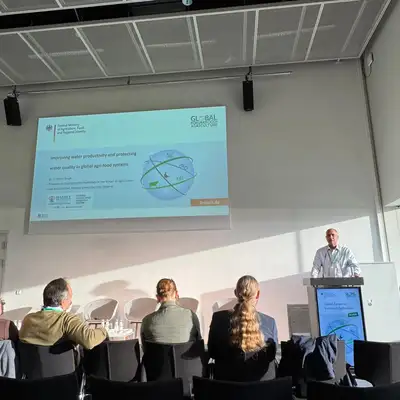
Professor Singh presenting at the Global Forum for Food and Agriculture. Credit: ATB Events/ATB Water Systems.
Translating science into practice with Catchment Solutions
The Catchment Solutions Project (CSP) was a three-year initiative led by Professor Singh and Massey’s Farmed Landscapes Research Centre. Funded through the Ministry for the Environment’s Essential Freshwater Fund, with co-funding from Hawke’s Bay Regional Council and in-kind support from DairyNZ, the project aimed to translate hydrology research into practical tools for farmers, helping achieve measurable improvements in freshwater quality across New Zealand.
CSP worked closely with farmers to understand water quality challenges across catchments, designing interventions that are both scientifically robust and practical. Examples include:
- Woodchip bioreactors, which use natural soil microbes to break down nitrates in drainage water,
- Constructed wetlands, which slow runoff, allowing plants to filter out contaminants before water enters streams,
- Controlled drainage systems, which gives farmers flexibility in managing artificial drainage to reduce nutrient loss.
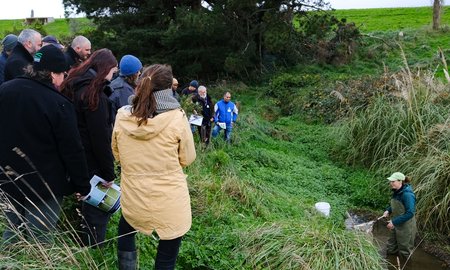
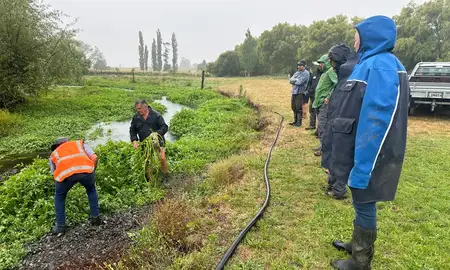
A core part of the project was a collaborative, co-learning approach, bringing together catchment communities – including iwi and hapū perspectives – with scientists, advisors and local stakeholders. Together, they identified key water quality contaminants and their critical flow pathways, and co-designed innovative edge-of-field mitigation structures like detainment bunds, which reduce contaminant loss from farms to waterways.
Over the course of the project, CSP ran masterclasses, workshops and field days across multiple regions. These activities reached dozens of farmers, environmental advisors, council representatives and students, equipping them with practical skills to manage water sustainably while maintaining farm productivity.
CSP also engaged the wider community through education and environmental stewardship programmes, including inviting 30 students from local schools to participate in a planting day downstream of a CSP-built woodchip bioreactor. The students planted 780 native trees while learning about biodiversity, freshwater health and ecosystem function.
“The Catchment Solutions Project demonstrates that meaningful environmental outcomes depend on collaboration, local knowledge and hands-on engagement. By connecting science with communities, we can design solutions that actually work in practice,” Professor Singh explains.
Looking to the future, Professor Singh highlighted during his GFFA keynote that a major goal is to make agricultural landscapes multifunctional – productive, resilient and environmentally responsible – by aligning land use with the land’s natural capacities. He emphasised that this can only happen by supporting people, from farmers to communities to stakeholders, to be the bridge between research and impact.
Building on the success of the Catchment Solutions Project, the team plans to embed its learnings into Environmental Sciences undergraduate and postgraduate teaching, including the 121313 Catchment Solutions course. There are also plans to develop professional short courses for rural advisers and catchment coordinators, continuing to build the capability and capacity needed to translate hydrology into innovative water quality mitigation practices across farms and catchments.
Related news
Workshop showcases detainment bunds as key to sustainable water quality
The second annual Catchment Solutions Project workshop saw over 50 people from across the lower North Island learn about targeted and effective water quality solutions.
Massey experts help farmers fight cow cress and erosion
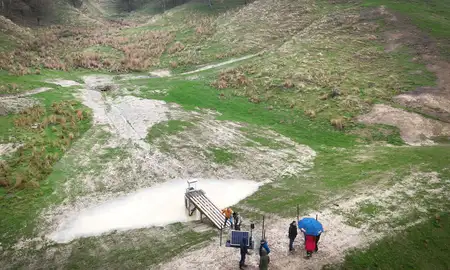
Expert advice from two Massey academics is helping farmers in the Kahahakuri catchment to tackle cow cress invasion and stream bank erosion.
Waterway restoration and protection the aim of Massey-led project
A project aimed at enhancing the rural sector’s capability to improve essential freshwater on farms has been awarded funding from the Ministry for the Environment’s Essential Freshwater Fund.