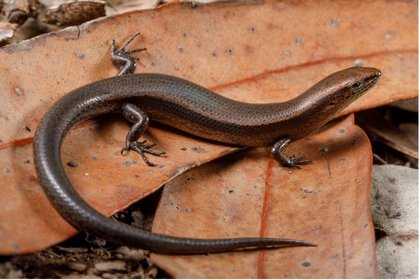
The invasive rainbow skink. Photo: Jules Farquhar
Professor Dianne Brunton from the School of Natural Sciences is part of an international team who have had their research on the behaviour of the Australian lizard species, the invasive rainbow (aka delicate or plague) skink, published in the journal Nature Communications.
The behaviour of pest species that are unintentionally introduced via human activities has been hypothesised to be different to their stay-at-home relatives, but had not been tested in the field. To test the hypothesis, the research team capitalised on the well-documented spread of the rainbow skink across the Pacific region.
The researchers compared the responses of individual lizards to different stimuli. The responses of animals from three invasive populations (New Zealand, Lord Howe Island, and the Hawaiian Islands) were then compared with those from the native population to the same tests. The team demonstrated that the invasive populations were made up of lizards with more exploratory behaviours and more flexibility in their responses.
The main conclusion from their findings is that the invasion process (hitchhiking with humans) can act as a filter by only letting animals with specific behaviours through - behaviours that increase the successful invasion of alien species.
“Our results provide solid evidence supporting the hypothesis that filtering happens during alien species invasions and that specific behavioural phenotypes are favoured over others,” Professor Brunton says.
“This explains why species such as the rainbow skink are particularly successful invaders in places like New Zealand. It’s not just a lack of competition or absence of predators that makes their populations proliferate, but a distinct change in behaviour.”
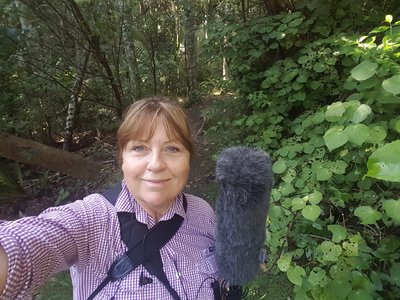
Professor Dianne Brunton
This innovative research, with geographic replication across Australia, was funded by an Australian Research Council grant co-led by Professors Dave Chapple and Bob Wong from Monash University and included collaborators from University of California Davis, and the Swedish University of Agricultural Sciences.
“This research was the result of many years of work and fieldwork by an amazing and diverse group of researchers. I was privileged to be part of it,” Professor Brunton says.
More news
Researchers discover six new species of New Zealand wētā
Six new species and three new subspecies of alpine cave wētā from the southern regions of the South Island have been identified.

New research enables non-lethal monitoring of wētā
New research into the behaviour of tree wētā will enable better monitoring of the species without the need to kill them.

Back in black: the population recovery story continues for endangered black robin
Four members of the Massey whānau were recently involved in the first Chatham Island black robin translocation in 20 years.

Massey exploring the potential for combined solar and pastoral farming
A new Massey University study will explore the potential for combined solar and pastoral farming in New Zealand by grazing sheep around solar panels on a Taranaki farm.
