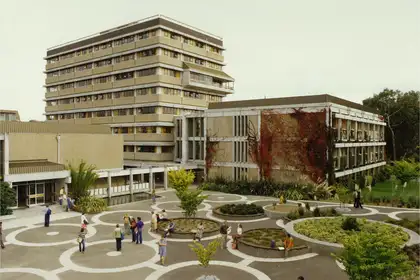
Massey's Manawatū campus in 1976.
Half a century ago, studying for a career in communication looked very different. Students were learning to craft media releases, understand audiences and deliver clear messages in a world shaped by print, radio and television. Campaigns were slower, more linear and often built around one-way communication.
Today, those same foundations extend across social media, digital storytelling, real-time analytics and platform-first content creation. The role of a communicator is more multifaceted; they are strategists, creators and community builders working across multiple channels at once.
The range of jobs for communication graduates has also changed significantly: there are still many roles available in media outlets and communication agencies, but over the half-century, all sectors have recognised the necessity of communicating with their stakeholders, and graduates are now employed directly in the arts, education, health, sports, tourism, government, technology, social justice, and other sectors.
The programme’s origins can be traced back to 1976, when Massey introduced ‘Sociology of the Media’, its first university-level course in communication. From there, offerings expanded rapidly, with organisational communication, public relations and media studies emerging over the following decades. By 2004, Massey launched Aotearoa New Zealand’s first specialised Bachelor of Communication, bringing together communication and media studies across both the humanities and business.
Associate Professor Doug Ashwell, who has taught communication since 2000, says while technology has changed dramatically, the core purpose of communication has not.
He says the ability to connect with others remains central to what employers are looking for.
“How to relate to people and talk to one another, that's what employers still look for. That's what we teach: how to connect to other people.”
Senior Lecturer in public relations Dr Elena Maydell has seen a significant shift in how communication is practised and taught, particularly with the rise of social media.
Where students were once trained to pitch stories directly to journalists, she says the process now often begins with creating content for digital platforms.
“When I first started, we taught students to email or phone journalists. Now most public relations collateral goes first onto social media, so we teach students to build a media centre for a website and make content adaptable to social platforms, then journalists will find you.”
That shift reflects a broader change in the industry, where communication is increasingly immediate, interactive and shaped by audiences in real time. At Massey, this has translated into more applied learning, with students working on real briefs and creating content across formats, including video and digital media.
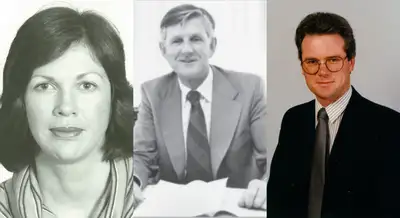
From left: Robyn Leeming, who taught Sociology of Media in 1977. Keith Thomson who was the first person in the country to introduce media studies at university. Steve Maharey taught Sociology of Media in the 1980s (photo from 1990).
Professor Elspeth Tilley, who joined Massey in 2004, says communication has become an essential capability across all sectors. Organisations now expect their people to be able to communicate clearly, quickly and effectively.
“There isn’t an organisation, from government departments to not-for-profits to big business, that doesn’t recognise that it needs to be open and accessible in its information and relationships. Organisations need staff who can do that with speed, accuracy, empathy and panache.”
While the tools and platforms have evolved, the programme has remained grounded in a strong theoretical foundation, ensuring students understand not just how to communicate, but why. Senior Lecturer Dr Ariana Berardi-Wiltshire says language and meaning-making continue to sit at the heart of communication.
“Language is the bedrock of communication, including verbal, non-verbal and embodied communication – the way we move, present ourselves and construct our identity.”
Across five decades, the discipline has expanded alongside technological change, from early broadcast media to today’s digital convergence, where boundaries between platforms continue to blur. New forms such as podcasting, video content and social media storytelling have become central to the creation and sharing of messages.
Despite these changes, the fundamentals remain constant: understanding audiences, crafting meaningful messages and building trust.
“As Massey marks 50 years of communication, our programme’s evolution reflects a simple truth. While the ways people communicate may continue to change, the need to connect, inform and engage, human to human, has never been more important,” Professor Tilley says.
Become a well-rounded, innovative communication specialist who is sought after by employers, with Massey’s Bachelor of Communication.
Related news
A communication career that’s gone into orbit
When a phone call came through from the International Space Station, Massey University alumna Ally Koehler had a moment of confusion. Then it clicked. The voice on the other end was an astronaut, calling from space.
Opinion: Communication graduates have the human skills the world needs most
By Professor Elspeth Tilley

Blending purpose and passion through communication
Despite growing up on a farm in the small Southland town of Otautau, Takunda Mabonga has always been drawn to creativity, connection and storytelling. Now studying for a Bachelor of Communication, he is channelling those interests into a degree that blends purpose with passion.