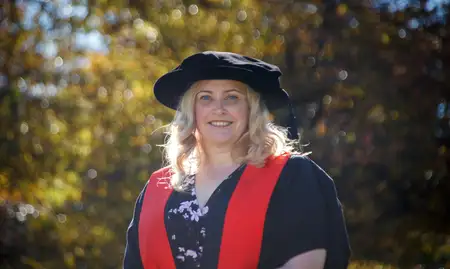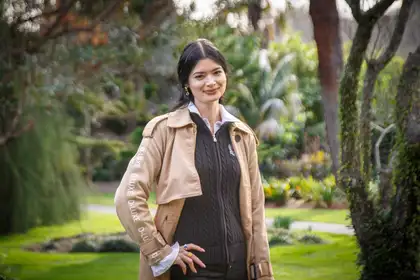
Ellen Dixon graduated in 2017 with a Bachelor of Arts majoring in Linguistics.
Ellen Dixon’s path to global education leadership began well before she stepped into UN committee rooms or UNESCO summits. It started in the lecture theatres at Te Kunenga ki Pūrehuroa Massey University, library study sessions and in conversations with peers and mentors who pushed her to think critically and boldly.
Today, Ellen holds an elected seat on the UNESCO SDG4-Education 2030 High-Level Steering Committee, a body that guides the global mission for quality education for all. Representing civil society alongside government ministers, heads of agencies like the World Bank and organisations like the LEGO Foundation, Ellen is involved in influencing global education policy at the highest level.
Ellen graduated from Massey with a Bachelor of Arts majoring in linguistics in 2017. This is where she first discovered the power of language to shape policy, perception and global dialogue.
“I stumbled into linguistics after taking the course, Language, Discourse and Power. I’ve always loved words and I fell in love with socio- and psycholinguistics. That course influenced the trajectory of my degree,” Ellen says.
Education was a way of life in Ellen’s family. Her mother was a teacher and Massey alumna, and many of her relatives were either educators or passionate advocates for learning. Education wasn’t just a subject; it was woven into Ellen’s everyday life, shaping family debates, dinner-table conversations and her personal experiences.
“By 16, I’d experienced nearly every kind of education system including homeschooling, public, private, Australian and New Zealand, streamed and unstreamed.
“Education was never abstract to me, it has always - consequentially - been a personal experience,” Ellen says.
Her time at Massey was defined by intellectual curiosity and the freedom to challenge, question and explore the intersections between language and power, communication and politics, theory and policy. Though she jokes she was an unconventional student, her lecturers quickly recognised her analytical sharpness.
“I remember being told my linguistics work was starting to look like politics. So I ended up in Dr. Bethan Greener’s class on women in the military and suddenly I was analysing United Nations communication in conflict zones. That opened the door to my Masters in International Relations and Diplomacy.”
From setback to strength: A journey of resilience
Partway through her degree, Ellen contracted a chronic illness that left her struggling to stand, let alone study. It was a Massey doctor who first recognised the signs of myalgic encephalomyelitis (ME), a pivotal moment in her path to recovery.
“That diagnosis helped me manage the illness and keep going. I still completed exams, though I had to cut my workload. It taught me resilience in ways I never expected.”
Despite the setbacks, Ellen excelled and went on to become a Massey Scholar, immersing herself in traditional critical theory, forensic linguistics, policy and intercultural communication. These became the foundations of her later appointments: first in civil society organisations like the Global Student Forum, and then in global institutions like UNESCO, UNESCO IESALC, and UNESCO GEMR.
“Massey taught me how to read the world through language. How to deconstruct policy documents, how to understand intercultural nuance, how to build arguments that translate across borders,” Ellen says.
Ellen describes herself as the embodiment of Massey’s teaching tradition, from Professor Ivan Snook’s educational philosophy to Tony Waho’s advocacy for kura kaupapa Māori. Both of these individuals had originally trained Ellen’s mother when she completed her education degree in the 1980s, from whom Ellen was first introduced to education theory. Her Massey years were a time of both self-discovery and growth.
She didn’t just study at Massey, she lived it. Ellen recalls handing out pamphlets in the MUSA lounge, advocating for events and campaigns on the concourse.
“I was that annoying person always talking to strangers about events on campus. Now I do the same thing, just on a global scale, with policy documents instead of flyers.”
Today Ellen is pursuing a PhD in philosophy, art and social theory at The European Graduate School under theorists such as Professor Slavoj Žižek. l. She also continues to explore radical, alternative models of education, ones that value intergenerational learning and cross-cultural dialogue.
When asked what she’s most proud of, Ellen doesn’t cite awards or titles. She speaks of standing up for the rights of students in conflict zones, supporting youth to cross the border when war in Ukraine broke out in Ukraine, defending pro-democracy and LGBTI+ activists in Türkiye and Egypt and protecting protestors against autocratic regimes across Asia and Africa, including those under arbitrary arrest.
“What matters to me most is ensuring the safety and dignity of young people. That’s what all this is about. That’s why I started and why I’ll keep going.”
Keen to learn how language works and how people use it?
Related news
Massey to host Oceania Hub of the International Communication Association conference
Te Kunenga ki Pūrehuroa Massey University is set to host the Oceania Hub of the International Communication Association’s (ICA) conference from 13 to 16 June.

Championing refugee inclusion through applied linguistics
This week, Dr Hanna Svensson graduated with a PhD in Applied Linguistics from Te Kunenga ki Pūrehuroa Massey University, marking the culmination of a journey that began in 2004 with a Bachelor of Arts.