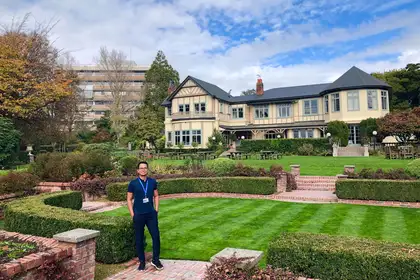
Rafael Seño standing outside the Wharerata on the Manawatū campus.
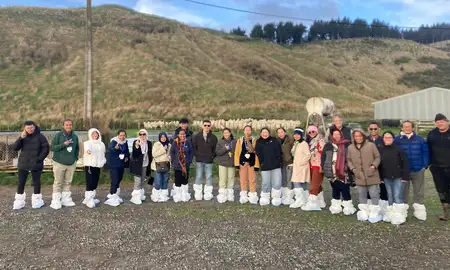
Drawn to the programme’s focus on understanding how food and agricultural products move from farm to consumer, Rafael arrived at Te Kunenga ki Pūrehuroa Massey University’s Manawatū campus eager to deepen his knowledge of agribusiness systems. Through a combination of classroom learning and complementary field trips exploring local agrifood value chains, he gained a practical, ground-level view of how effective value chain management can transform productivity and livelihoods.
Rafael credits the experience with shaping his professional perspective and approach to development work.
“It was an honour to be part of Associate Professor Thiagarajah Ramilan’s class. I still carry with me the insights and inspiration I gained from that experience. The course challenged me to think critically about sustainability and the role of value chains as a tool for market systems development, in ways that continue to influence my work today.”
Since returning to the Philippines, Rafael has translated that learning into action. His professional journey has taken him through organisations such as Agrea Philippines, the Department of Trade and Industry and the Technical Education and Skills Development Authority, where he has contributed to initiatives aimed at strengthening agricultural value chains and supporting local enterprises. In 2022, he co-founded the Kaluppâ Foundation, where he currently serves as Executive Director, leading initiatives focused on regenerative agriculture, community-based training and rural enterprise development.
“Much of what I do now is rooted in the knowledge and confidence I gained at Massey. I remain deeply grateful for the opportunity to learn from the team,” he says.
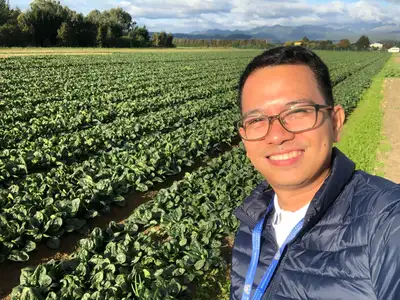
Rafael also serves as a university lecturer in Entrepreneurship at Marinduque State University, where he is committed to equipping the next generation with the skills and mindset needed to drive innovation in agriculture and beyond.
Rafael says he reflects fondly on his time in the 2019 course, from long autumn walks between accommodation and campus, to shared meals in the cafeteria and the camaraderie built through group projects. One particularly memorable experience was presenting on Vietnam’s purple passionfruit value chain, highlighting the complexity and potential of regional agricultural systems.
Another defining moment was being selected to deliver the graduation speech, an honour he describes as unforgettable.
“I’m not even sure if anyone understood what I was saying that day, as my words were blanketed by sobs. Then I saw a classmate crying too and thought, ‘Okay, there’s two of us already!’ It was one of those rare moments where emotion spoke louder than words,” he says.
Looking ahead, Rafael is keen to stay connected with the Massey community. He will participate in online sessions during the 2026 and 2027 programme, sharing his experiences with new cohorts and stakeholders, and hopes to explore future collaborations aligning with broader academic and development goals.
Associate Professor Thiagarajah Ramilan, who leads the course, says it’s incredibly rewarding to see how Rafael’s experience at Massey continues to shape his work.
“His contributions to strengthening agribusiness value chains in the Philippines are highly commendable. What is especially inspiring is his leadership as both a university lecturer and Executive Director of the Kaluppâ Foundation.”
More about the course
The Food and Agribusiness Value Chains short course is led by the School of Agriculture and Environment and coordinated by Te Tumu Whakatipu. It combines classroom learning with field trips and industry visits, giving participants the opportunity to observe best practices and gain hands-on experience across the agribusiness sector. In addition to Massey academics, numerous researchers and agricultural sector experts also contribute to the learning progress.
By the end of the course, participants are equipped to apply their knowledge in their home countries to strengthen agribusiness initiatives, improve productivity, and support more sustainable food value chains across the Association of Southeast Asian Nations (ASEAN) region.
Funded by the Ministry of Foreign Affairs and Trade and Manaaki New Zealand Scholarships, the programme brings together participants from the Philippines, Laos, Timor-Leste, Myanmar, Malaysia, Brunei, Singapore, Thailand, Vietnam and Cambodia. Developed and led by Associate Professor Ramilan Thiagarajah and Professor Nicola Shadbolt, it has empowered more than 200 participants since 2017, strengthening their capacity to lead agricultural development and drive impact in their communities.
Learn about short courses and professional development at Massey.
Related news
Increasing lamb weaning weights linked to emissions efficiency and improved profitability
New research suggests sheep and beef farmers could improve both profitability and emissions efficiency by increasing lamb weaning weights, with only marginal changes in total greenhouse gas emissions.
Short course provides platform for innovation and intellectual exchange
A group of more than 30 participants from the Philippines will return home with new connections and a deeper understanding of Aotearoa New Zealand’s sustainable dairy systems.
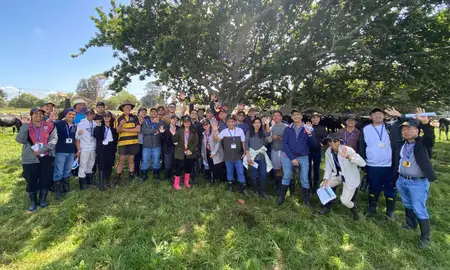
Agribusiness course utilises field trips to study local value chains
Officials and managers from southeast Asian countries took part in the course, which allows participants to observe best practices and gain practical knowledge they can use for their own country's specific needs.