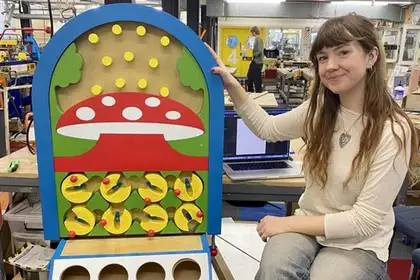
Frances le Mesurier designed Cap Collector for primary school children.
The Te Kunenga ki Pūrehuroa Massey University Bachelor of Design graduate developed Cap Collector a recycling bin with a game where primary school students place a bottle cap into the machine and then operate a series of springs and dials to guide the cap toward the correctly labelled slot.
The playful, interactive system uses bold colours and shapes inspired by retro arcade games and familiar game graphics.
Massey News spoked to Frances about the inspiration behind her Cap Collector.
What led you to the idea of making your Cap Collector?
“When I started researching this, I discovered how poor recycling habits often come down to design and a lack of waste management education, both in the design of the bins themselves and in the lack of education around them. The design of a rubbish bin hasn’t really changed since it was invented, but our environmental concerns have. So why aren’t we designing bins that make people want to recycle and interact with them?
“My idea was to create something for primary schools, since they’re such central parts of communities. I wanted to design something fun and educational where kids could collect bottle caps at home, bring them to school, and use them as game pieces in a recycling-based game. The goal is to teach recycling through play and make bins a point of engagement rather than avoidance where recycling can feel fun and exciting rather than a chore.
“The hope is that once collected, the caps can be sent to plastic recycling facilities to be turned into new products. Ideally, these facilities could then give back to the schools or communities, creating a small circular economy.”
Tell us about the research you conducted around recycling in schools.
“From my research at a public high school in Auckland, I found that recycling education is almost non-existent. There were barely any recycling bins, and the few that existed looked like they hadn’t been changed in over 20 years.
"Of the students I surveyed I found only ten percent said they recycle at school, 12 percent said bins are easily accessible and just seven percent found it easy to recycle at school."
These numbers showed that even if students want to recycle, they’re not given the tools or opportunities to do it.
“My secondary research focused on current environmental programmes in New Zealand schools, understanding how they’re run, what works, and where they struggle. I also researched public bin design, signage, and how poor graphics or unclear labelling can discourage correct recycling.
“I did a lot of reading on student behaviour and learning patterns, especially how children form habits and respond to rewards and incentives.”
What are your dreams for this project past the prototype stage?
“My dream is to shift the mindset around recycling and bins. I want to challenge the idea that bins are dirty, boring, or disconnected from the people who interact with them. Through design, I want to show that recycling can be fun, interactive, and educational, especially for young kids.
“If we teach children early on that recycling is a positive, rewarding habit, they’ll grow up with stronger environmental values. I want my project to help kids understand that looking after the environment means it will look after you in return.
“Ultimately, I hope this idea inspires future school recycling systems that blend design, education, and community, creating a new generation that sees sustainability not as a chore, but as something creative and exciting.”
You can see more of Frances’ Cap Collector here.
Interested in Industrial Design?
Related news
Success at Dyson Design Awards with groundbreaking fruit measuring device
Massey Industrial Design graduate Dr Zené Krige has been named runner-up in the James Dyson Design Award New Zealand for her fruit measuring device, Foresight.

Massey retains top two ranking at Red Dot Design Awards
For the third consecutive year, Te Kunenga ki Pūrehuroa Massey University has been ranked second among universities in Asia-Pacific at the prestigious Red Dot Design awards in Singapore.
Massey creativity shines at Best Design Awards
Capturing the sound of soil, a sanitary management solution for public toilets and a device to monitor blood oxygen in animals undergoing surgery are just some of Massey's eight gold-winning entries in the 2025 Best Design Awards.

Kākāpō egg incubator wins global recognition
With just 238 birds alive today, some of the new eggs laid by the critically endangered kākāpō must be transported to the safety of incubation facilities.