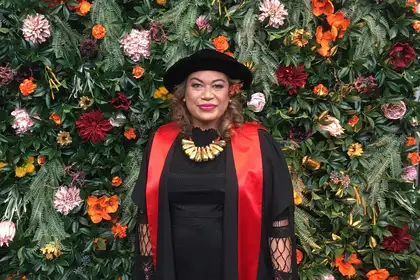
Dr Angie Enoka
Her journey began when she arrived in New Zealand from Samoa as a scholarship student in the late 1990s. Studying communication and journalism opened her eyes to the power of storytelling and the responsibility communicators have in shaping how communities are understood and represented.
"Communication has always been about people for me. It’s about whose stories are told, whose voices are heard and whose experiences are recognised," Dr Enoka says.
After working as a journalist, Dr Enoka returned to study at Massey while working full time. She enrolled in postgraduate Communication Management and quickly developed a passion for research.
That research continues to influence her approach today particularly the importance of recognising that communities aren't simply the subject of conversations but active contributors in shaping decisions that affect them.
Her academic performance and research potential led to an unusual opportunity. Rather than completing a Masters first, she was encouraged to progress directly into a PhD.
It was an opportunity she embraced, despite the challenge of balancing doctoral study with a full-time career.
"Completing a PhD while working full time required discipline, resilience and sacrifice. There were many moments where it would have been easier to stop but I was driven by a bigger purpose," Dr Enoka says.
That purpose was closely connected to her experience as a Pacific communicator.
While working with the Recognised Seasonal Employer scheme, Dr Enoka noticed a disconnect between the stories she heard directly from Pacific seasonal workers and the way they were portrayed in the media.
That observation became the foundation for her doctoral research, which examined the portrayal of Pacific seasonal workers in New Zealand print media.
Her research explored whose voices were included, whose stories were missing and how Pacific communities could be represented with greater dignity, accuracy and respect.
"Massey provided an environment where my lived experience, cultural identity and research interests could come together."
Her time at Massey was also shaped by the people around her. Supervisors Professor Elspeth Tilley and Professor Frank Sligo provided academic guidance and encouragement, while Massey's Pacific community helped create a sense of belonging during the demanding years of postgraduate study.
Dr Enoka says Professor Sligo played an important role in encouraging her to pursue postgraduate study after meeting her at an information evening.
"He took the time to understand my circumstances and supported me to see possibilities I had not fully imagined for myself."
That encouragement stayed with her as she moved through a career spanning journalism, communications and public sector leadership.
Today, Dr Enoka leads Māori and Pacific Communications at the Ministry of Education, where she works to support Māori and Pacific perspectives being reflected in how the Ministry communicates and engages with communities across Aotearoa.
The role draws on the same principles that shaped her research.
"My academic journey has shaped the way I approach leadership today with curiosity, empathy and a commitment to ensuring diverse communities are represented authentically."
Dr Enoka says good communication begins before a message is written.
"It has taught me that communication starts with listening. It’s about understanding people, respecting different perspectives and creating opportunities for genuine talanoa, meaningful conversations built on trust, respect and connection.”
She believes that human connection will become even more important as artificial intelligence (AI) and other technologies continue to change how people communicate.
“AI can help us process information faster and support how we communicate but it can't replace empathy, cultural understanding, judgement and the human relationships that sit at the heart of effective communication.”
Reflecting on her own journey, Dr Enoka says becoming the first Samoan fa’afafine (transgender woman) to graduate with a PhD in Media Studies from Massey is both an honour and a responsibility.
She hopes her story demonstrates that there is a place for Pacific people and diverse communities in academia, leadership and spaces where important decisions are made.
“Achievement is never a journey taken alone. I carry with me my family, my Samoan heritage, my fa’afafine identity and all those who supported me.”
Massey’s Bachelor of Communication will position you at the forefront of a rapidly changing world, giving you the human skills in connecting, creating and thinking critically that organisations in every field are actively seeking. Find out more here.
Related news
Bachelor of Communication takes alumni from Massey to the movies
When Ellen Drower attends events like the Oscars and BAFTAs, she's working alongside Hollywood publicists to showcase the Kiwi artists and technicians behind some of the world's biggest films.
A communication career that’s gone into orbit
When a phone call came through from the International Space Station, Massey University alumna Ally Koehler had a moment of confusion. Then it clicked. The voice on the other end was an astronaut, calling from space.
Exploring the world through communication
Nikki Harris has always been passionate about language, culture and bringing people together. That passion, combined with a curiosity about media and storytelling, led her to pursue a Bachelor of Communication.