The mission, called Hēki, involves a superconducting magnet technology developed by researchers at the Paihau-Robinson Research Institute in collaboration with domestic and international partners. It was launched aboard a rocket from Florida and has now arrived at the International Space Station (ISS). The superconducting magnet technology is designed to accelerate plasma and generate efficient thrust. Superconductors have zero resistance and produce strong thrust, making it highly efficient in the challenging environment of space, where every watt counts.
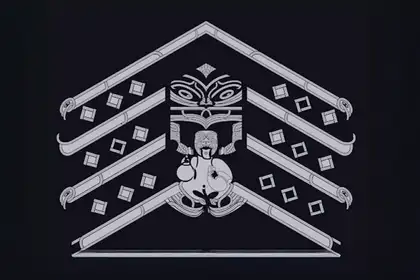
The protective cover of the magnet experiment was etched with a Māori design created by Mr Arapere, marking a world-first integration of Māori visual culture with space science. His design symbolically accompanies this pioneering scientific experiment, extending Māori artistic expression into new frontiers.
Associate Professor Pauline Harris, Rongomaiwahine, Ngāti Kahungunu ki Wairoa, Ngāti Rakaipaaka, a member of the wider research team, reflected on the significance of this milestone.
“It is wonderful to see Māori art embedded within a leading-edge scientific mission. Reweti’s contribution ensures that as we advance into space exploration, Māori culture and creativity remain integral to these journeys.”
Inspiration and cultural significance
Mr Arapere spoke about what inspired him to take part:
“I am inspired by our tūpuna, the Māori star navigators, and by working alongside our Māori astronomical science leaders. This journey has helped move our knowledge from being seen as myth, to being recognised as reality. When Dr Harris asked me to join this kaupapa, I agreed when I heard how many of our whanaunga were involved — not just from my marae, Tokorangi, but also our wider Māori and Pacific whanaunga across Te Moananui-a-Kiwa. The future is Indigenous!”
He says the work was deeply personal.
“I see the cover artwork as a visual karakia, and I have dedicated it to my uncle, Graeme Everton, who passed away but was part of the wider project. He always told me he wanted us as Māori to go into space.”
Embedding Māori perspectives in space science
Dr Harris, who led the Māori component of the wider project, says her team’s work was focused on embedding Māori voices and values into the space sector.
“We explored the aims, aspirations, opportunities, issues, and concerns of aerospace from a Māori worldview. It is important that space research is about more than science – it’s about who we are and how we carry our values with us as we explore beyond Earth.”
Mr Arapere’s artwork drew on cosmological narratives, including the story of how the kōkako bird received its blue wattle as a gift from Tāne-mahuta. The Hēki mission is connected to Kōkako, a revolutionary electric plasma thruster that is being designed to transform satellite propulsion.
The names of project team members — including Mr Arapere, Dr Harris, Dr Hēmi Whaanga, Kirsty Doyle, Juliet Nelson, Ockie Simmonds, Graeme Everton, and Leo Watson — are etched onto the cover, meaning they, along with the technical team, will symbolically spend months orbiting Earth aboard the ISS.
Dr Harris says having the names and artwork travel beyond Earth reflects a vision where mātauranga Māori is part of humanity’s journey into the cosmos.
“It’s really important that we discuss and embed our narratives and perspectives into space activities, as this will help shape a space industry that reflects our values,” she adds.
Her team is also developing international collaborations on education, capacity and capability development, innovation potential, and space ethics.
A fusion of science, art and identity
The experiment was launched from Cape Canaveral, Florida, on Northrop Grumman’s 23rd ISS cargo resupply mission (NG-23) and arrived at the ISS roughly 60 hours later. Data from the mission will help validate the superconducting technology for future propulsion research.
This collaboration demonstrates the potential for Indigenous knowledge, creativity, and scientific research to intersect, producing outcomes that not only advance science but also affirm cultural identity on a global stage.
Related news
Celebrating creativity: Matatau 2024 exhibition showcases graduating Māori visual artists
This event highlights the creativity and perspectives of the talented graduates, inviting the community to engage with their artistic journeys.
Māori visual arts professor named a Laureate
Professor Robert Jahnke ONZM, Ngai Taharora, Te Whānau a Iritekura, Te Whānau a Rakairo o Ngāti Porou, from Whiti o Rehua School of Art has been named a 2023 Arts Foundation Te Tumu Toi Laureate.