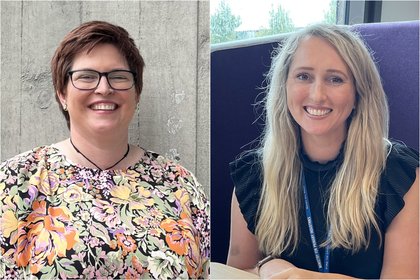
Eileen-Rita Folwell (left) and Fin Lambermon.
“Such a great diploma it keeps you wanting more." That’s the verdict of the first students from the Ministry for Primary Industries (MPI) to undertake Massey’s Diploma in Border and Biosecurity (DipBBiosec).
Fin Lambermon and Eileen-Rita Folwell were both quarantine officers when they joined the initial cohort of MPI employees to take the DipBBiosec course. Three and a half years of part-time distance study later, both have since moved into new roles at MPI.
Ms Lambermon is now a Relationship Manager with the Government Industry Agreement (GIA) Partnerships in Readiness and Response Services, working with primary industries. Ms Folwell is a Senior Adviser for Biosecurity Engagement in MPI’s Diagnostic and Surveillance Services team.
The two graduates are full of praise for the diploma and the way that the various papers were taught.
“When I was working in quarantine, some of the earlier papers especially helped give me an appreciation of the bigger picture of what we operate under and why we do what we do,” Ms Lambermon says.
“In my current role, some of the other papers I have done more recently, such as Organisational Behaviour and horticultural papers, have really helped me understand the industries I'm working with. So the diploma has been super applicable in both roles I’ve been in.”
Ms Folwell concurs.
“In my role as quarantine officer, I felt I had a skill gap not coming from a scientific background, unlike a lot of my colleagues. Although we are supported and work alongside world class labs and diagnostic teams, when you’re on the ground discussing pests and disease and symptoms of disease, you feel a responsibility. You are representing MPI and you want to have those conversations with confidence.
“Now that I’ve moved into a different role, the papers that supported those core science papers – Organisational Behaviour, and another good one is Management, Analytics and Decision Making – those papers really supported that transition away from the front line.”
Ms Lambermon says that her first few papers brought home to her the difficulties many other countries face in maintaining control of people and goods at their borders. She particularly recalls being shown a video of Moroccan and Spanish border officials at Melilla, an autonomous Spanish city on the north coast of Africa, bordered by Morocco.
The video showed desperate African asylum seekers trying to enter Melilla.
“The officials were trying to keep them out and resorting to violence,” she says.
“It really opened my eyes and drove home to me how lucky we are here to operate as we do. We have the natural advantage of being an island nation so we can protect ourselves from a lot of the risks which pose a danger to other countries.”
Ms Folwell recalls being initially a little intimidated at the thought of her Essentials of Law paper.
“I was quite scared of the paper at first, but it wasn’t scary at all. I loved it. The enthusiasm with which it was taught was quite contagious.
“We work within a regulatory framework under the Biosecurity Act, and at the time I was helping teach legislation to new quarantine officers. The paper offered such an interesting way to look at how to read law and how to use the language of law, as well as an exploration of the Treaty of Waitangi.”
Working in border control is a passion for both. Biosecurity never sleeps, they say, and they represent the people of New Zealand as they carry out their duties.
Both graduates are now contemplating continuing their studies.
“My challenge was not understanding how engaging the content of the diploma would be. I was working full-time, but I really wanted to spend time on my study," Ms Lambermon says.
“So while it was a relief to finish the diploma, it keeps you wanting more. I’m wondering, do I enrol in something next year and turn it into a degree?”
Ms Folwell says that you don’t work for MPI because it’s just another job.
“The diploma taps into that passion. The selection of papers offered has widened since we started, as more students have joined. They’ve taken the student feedback and added in content like food safety.”
Would they recommend the diploma to others in their own and related fields? One hundred per cent, they say.
“It’s not mandatory, but I think it should be. That’s how good it is,” Ms Lambermon says.
“I have touted it with my industry partners like the biosecurity managers for horticultural industries, importers and the shipping industry. Even though they are expert in their fields, there’ll be something to help them.
“Ko Tātou, it takes all of us to produce good biosecurity.”
Find out more here:
Related news
Opinion: The biosecurity implications of opening our borders
Dr Germana Nicklin and Teaching Fellow Dee McDonald discuss the potential biosecurity implications of reopening our borders.
Exploring climate change from beneath
Self-declared ‘fish nerd’ Dr Irene Middleton is a marine ecologist with a passion for educating and connecting people with the ocean and its creatures for the purpose of conservation.
Agrifood sector is tech-savvy but not ready for major disruption
A new report has found that New Zealand farmers have been quick to adopt smart farming techniques, but few are preparing for major technological disruption.