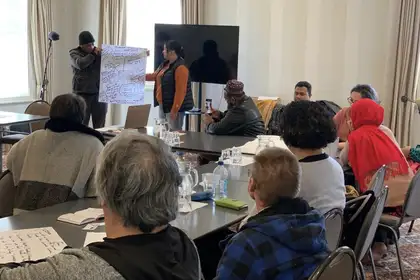
Community researcher and study co-author Venessa Pokaia sharing the community-driven prevention model that emerged from the community advisory group in Highbury, Palmerston North.
Led by Professor Mohan Dutta and a team from Massey University’s Centre for Culture-Centered Approach to Research and Evaluation (CARE), the research, co-designed with community advisory groups, draws from 77 in-depth interviews with predominantly Māori and low-income disabled individuals to explore the systemic roots of violence and the community-led paths forward.
Disabled people remain significantly overrepresented as victims of family and sexual violence, yet are often omitted from research, communication campaigns, policymaking and law-making processes. The study reveals how disability is not just an individual condition but a deeply structural, intersectional phenomenon shaped by erasures that strip away agency, especially for Māori who bear a disproportionate burden.
The study reveals local strategies emerging from participants themselves: approaches that counter communication inequality and root prevention efforts in community realities, rather than defaulting to top-down models.
According to Dr Dutta, this culture-centred method of building "voice infrastructures" from advisory groups to co-creation of research design is key to disrupting structural violence.
“This work underscores the power of listening to disabled communities, particularly attending to voices that are systematically disenfranchised, to co-create meaningful interventions that challenge structural violence. It’s a step toward justice and equity in Aotearoa by centring community voice.”
Funded by Te Puna Aonui – the Joint Venture Business Unit for the Elimination of Family and Sexual Violence – the research was designed to directly inform national violence prevention policy for diverse communities, ensuring strategies are shaped by the people most affected. By embedding community leadership into the policy design process, the findings are already influencing government discussions, advocacy and prevention frameworks.
This study directly supports Massey’s commitment to the United Nations Sustainable Development Goals, especially Gender Equality, No Poverty, Reduced Inequalities and Peace, Justice and Strong Institutions. By linking local voices to national decision-making, CARE’s work demonstrates how university research can create tangible policy change while advancing equity, inclusion and social justice.
“By linking local voices to national decision-making, this research delivers on the Sustainable Development Goals and creates real pathways to equity and justice,” adds Dr Dutta.
Embedding community leadership into violence prevention policy is essential to achieving Sustainable Development Goals of Gender Equality, Reduced Inequalities, No Poverty and Peace, Justice and Strong Institutions.
Related news
CARE to host renowned intellectual for Activist in Residence Programme
Historian and journalist Dr Vijay Prashad will be speaking as part of the Center for Culture-Centered Approach to Research and Evaluation (CARE)'s Activist in Residence Programme.
CARE to host renowned academics in its Applied Communication Lecture Series
The Center for Culture-Centered Approach to Research and Evaluation (CARE) at Te Kunenga ki Pūrehuroa Massey University is hosting an international speaker series titled Future Directions of Applied Communication Research.