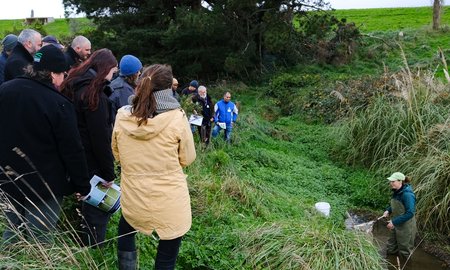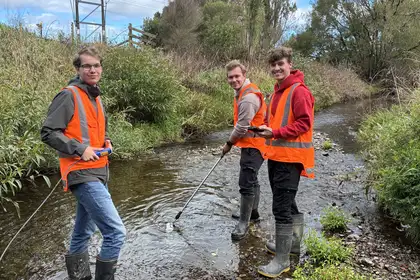
Sytse de Boer, Yvar van Helvoort and Nils Gosselink stand in the cool Turitea Stream, wearing fluro vests and gumboots, each holding equipment used to collect and test water samples. When asked what they’ve enjoyed the most about their time studying in New Zealand so far, their answers are unanimous: the hands-on experience.
The three students are all working toward a Bachelor of International Land and Water Management. As part of their studies, they have travelled from the Netherlands to New Zealand to join Te Kunenga ki Pūrehuroa Massey University’s School of Agriculture and Environment, contributing to the Catchment Solutions research programme.
“It’s very applied, and it’s been great being out in the field and experiencing it ourselves. It makes it much easier to understand how things work. Back home, most farming happens inside barns, so seeing all the pasture and how interventions are implemented here is really eye-opening,” Nils says.
“Farmers here seem willing to take action for the future. It’s a different perspective from what we’re used to in the Netherlands,” Yvar adds.
They are exploring projects ranging from wetlands and detainment bunds to woodchip bioreactors, under the supervision of Massey’s Professor Ranvir Singh and Wageningen’s Associate Professor Jos van Dam, who supervised Professor Singh’s PhD, completed in 2005 at Wageningen University.
“The exchange aims to provide visiting interns with a unique chance to combine theoretical knowledge with applied research for targeted and effective water quality solutions in rural catchments. Students here can see how novel edge-of-field water quality mitigations work on the ground, interact with local farmers and understand environmental challenges in context of farming,” Professor Singh explains.
The students, who knew each other from the Netherlands, say the practical approach to learning at Massey has been a stand-out feature.
“Our study at Wageningen is practical, but here it’s way more hands-on. It’s a lot more about talking to farmers rather than being at a desk. You look at how interventions work and how you can improve them. Back home, we focus more on planning and implementation at the right place with the right people,” Sytse says.
The three students have also observed differences in farming culture compared with their home country.
“In New Zealand, farmers have a lot of land and seem more willing to work towards long-term sustainability. It’s encouraging to see how they approach challenges,” Yvar says.
While they’re adjusting to the more relaxed pace of New Zealand, they say they’ve enjoyed their time with the Catchment Solutions team.
“It’s been great so far, and everyone is really nice and helpful. They’re happy to share their knowledge, and there’s a strong focus on learning through the process and understanding how to approach research, rather than just completing the proposal,” Yvar explains.
“There’s more emphasis on figuring out how to do it right, rather than simply getting it done,” Sytse adds.
Nils says building relationships with farmers has been another valuable part of the experience.
“They encourage us to talk directly with local people and farmers to understand their real challenges. Sometimes you think you have a solution, but the farmers point out it’s not an issue for them, and you need to focus your efforts elsewhere.”
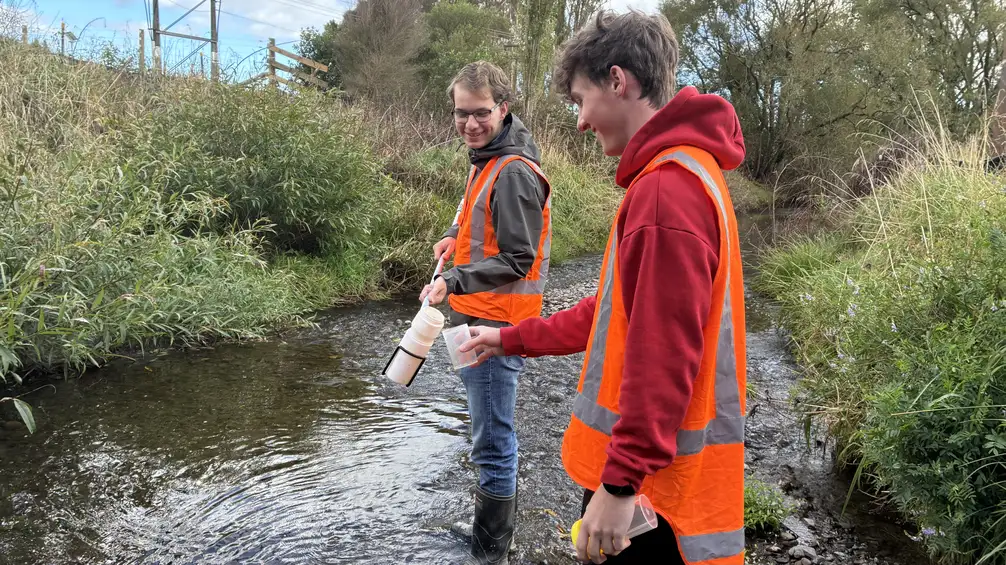
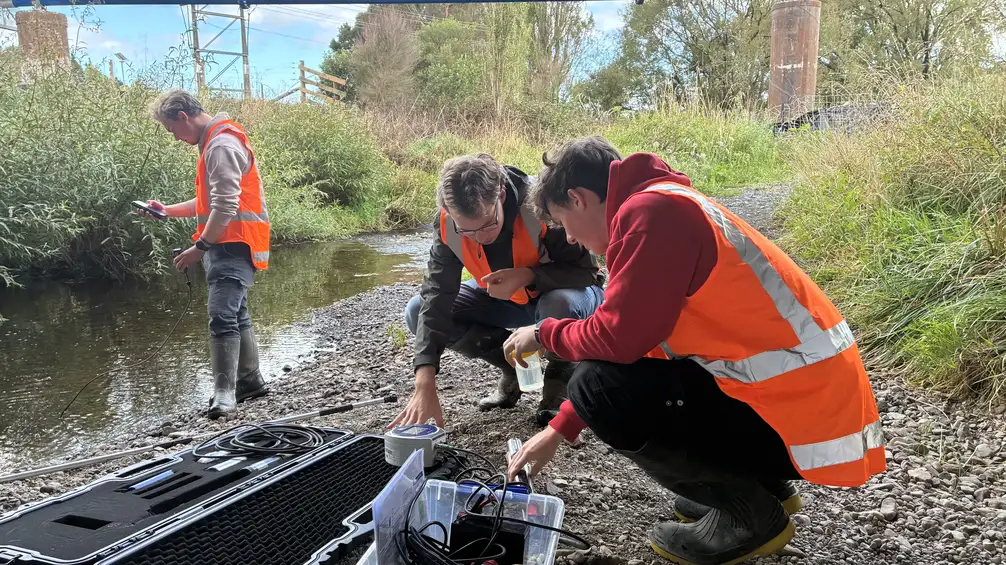
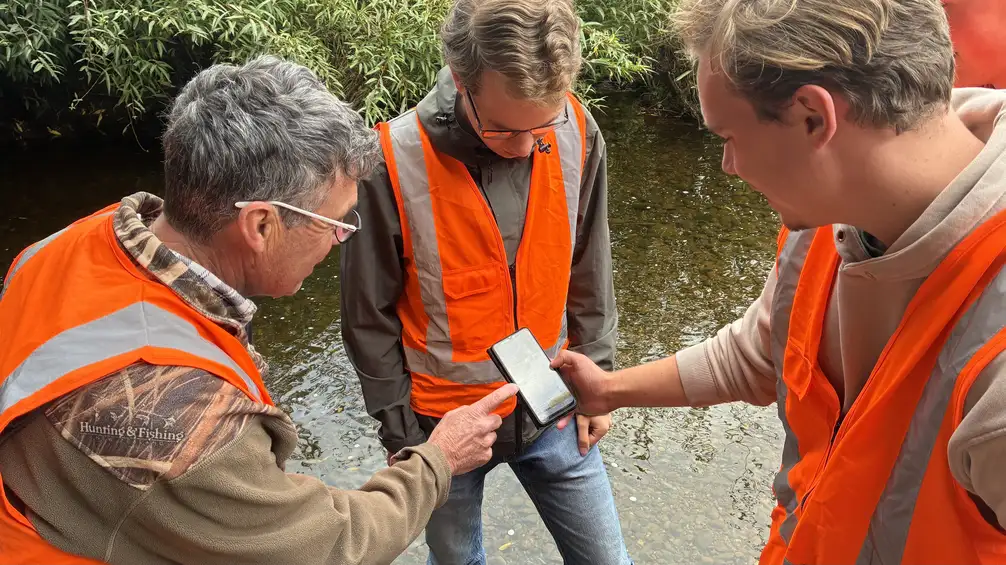
Outside their research, the three have explored some of New Zealand’s landscapes, including a trip to the South Island. Alongside having friends who had previously completed exchanges in New Zealand, they say they had always been keen to visit.
“It’s really beautiful, and a once-in-a-lifetime opportunity. It’s a good excuse to be gone for half a year on the other side of the world, and because we’re doing it in correlation with our thesis, it’s a nice way to end our study,” Yvar says.
They say their experience is shaping their approach to research and giving them insights for their future studies.
“Having an internship abroad is great for future employers. It’s a nice way to connect practical research with our thesis work," Nils says.
For other students considering international study, Yvar encourages them to take the opportunity.
“Go with the flow and experience as much as you can – you learn a lot more that way.”
This visiting internship is a key activity under the Strategic Cooperation Agreement between Massey and Wageningen University and Research (WUR). Massey and WUR have been working together for more than 40 years, contributing collaborative solutions to food, agriculture and environmental issues that are of global scale. Practical, two-way international experience through student exchange and internships builds research capability in both New Zealand and the Netherlands and underpins Massey’s engagement with significant national and international science initiatives.
Related news
Engagement key to turning science into action for smart water strategies
At the recent Global Forum for Food and Agriculture (GFFA), environmental hydrology expert Professor Ranvir Singh delivered a keynote address, sharing highlights from his research with a clear message that without engagement, even the best science will never reach its potential.
Globally grown: From Feilding to the Netherlands and back again
Alex Dickson’s undergraduate degree looked a little different to most, as she spent the middle of her three years of study at Wageningen University in the Netherlands.
Waterway restoration and protection the aim of Massey-led project
A project aimed at enhancing the rural sector’s capability to improve essential freshwater on farms has been awarded funding from the Ministry for the Environment’s Essential Freshwater Fund.