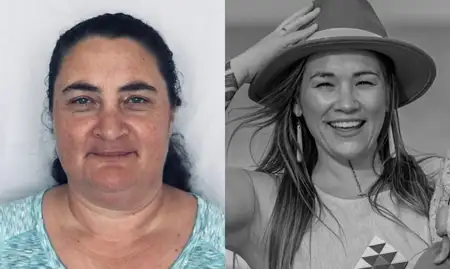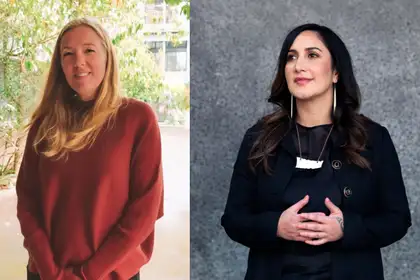
Dr Nicole Lindsay and Associate Professor Pikihuia Pomare.
In a quiet clinic room, a whānau sits – overwhelmed, anxious, taut with unspoken pain. You hear the beckoning of a karakia; ancient, intentional, full of breath and spirit. Slowly, the room settles. Shoulders drop. Eyes soften. The atmosphere shifts.
Registered Clinical Psychologist Associate Professor Pikihuia Pomare, Te Rarawa, Ngāpuhi, Ngāi Te Rangi, Ngāti Pūkenga, has long witnessed the power of karakia in practice. She, and Dr Nicole Lindsay are co-leading a new research project exploring how karakia supports emotional, spiritual, and physiological wellbeing. Their work recently received funding from the Health Research Council of New Zealand.
Karakia is a practice that links generations, connects people to place, and offers strength in times of vulnerability. However, Dr Pomare says karakia is often overlooked and undervalued in health settings in Aotearoa New Zealand.
“Māori experience disproportionate ill health and mental health due to high levels of psychological distress that occur within an historical and contemporary contexts of discrimination, colonisation and socio-economic adversity. This highlights the need for better understanding of the value of mātauranga Māori, including rongoā [traditional Māori healing] such as karakia in Māori mental health, to contribute to positive Māori mental health outcomes,” she says
Through previous research, Dr Pomare and Dr Lindsay found karakia had tremendous therapeutic potential for addressing issues of mental wellbeing.
“Māori service users engage with and respond better to Māori centred processes [tikanga] and practices that are relevant, accessible and tailored specifically to their individual and whānau needs,” Dr Pomare says.
As part of their current research, they are working alongside karakia practitioner and Te Pūtahi a Toi Lecturer, Te Rā Moriarty, Ngāti Toa Rangatira, Ngāti Koata, Rangitāne, Ngāti Kahungunu, and two community-based cultural experts. This collaborative approach is essential to ensure the research upholds the mana and tapu of karakia and reflects tikanga Māori at every stage.
“This rangahau [research] aims to elevate mātauranga Māori by advancing understanding of wairua-based [spiritual-based] healing practices so that these practices can be meaningfully integrated into health care services to promote wellbeing, enhance hauora Māori, and help reduce inequities over time,” Dr Pomare says.
The belief in deep interconnection is not only central to te ao Māori but also reflected in philosophical and emerging scientific thought. Through their research, Dr Pomare and Dr Lindsay, alongside neuropsychologist Dr Corinne Bareham-Waldock, are exploring how kaupapa Māori principles can sit alongside neuroscience and consciousness studies. This opens space for dialogue between Indigenous knowledge systems and Western scientific frameworks.
“It’s very important to give credence to, and honour, the subjective over and above the need for objective verification. With intangible topics like wairua or spiritual experiences, science can only scrape the surface. We simply do not have the tools or technologies, or perhaps even the mental capability, to fully understand the essence of these phenomena.
“In saying that, with technological advances, as well as an increasing willingness to explore such phenomena, we are sometimes afforded a glimpse beneath the surface,” Dr Lindsay says.
Their research not only challenges Western paradigms of healing but also calls for greater respect and integration of Māori knowledge in health services. This approach seeks to shift the healthcare environment into one that embraces holistic wellbeing; acknowledging the spiritual alongside the physical.
“While karakia is increasingly recognised as an important cultural practice and incorporated into many formal and informal settings in Aotearoa, the craft of karakia is neither widely understood nor appreciated among the wider public, healthcare professionals or the scientific community. Incorporating karakia into health services can help create a more holistic, respectful, and supportive environment that improves patient outcomes, and upholds the principles of Te Tiriti o Waitangi” Dr Lindsay says.
The researchers say at the centre of this kaupapa is a simple truth: living beings are not separate from their wairua, culture, or each other. Karakia reminds us, through breath, intention and connection, that everything is linked.
Related news
Associate Professor Bevan Erueti appointed Māori Health Board Director for CAPHIA
Associate Professor Bevan Erueti, Taranaki, Te Ati Haunui-ā-Papārangi, Ngāti Tūwharetoa, has been appointed the new Māori Health Board Director for the Council of Academic Public Health Institutions Australasia (CAPHIA).
New appointment targets inequities in Māori health
Dr Angelique Reweti, Ngāpuhi, has been elected to the Executive Council of the Public Health Association of New Zealand (PHANZ) and as Chairperson of the Māori Caucus.
Researchers awarded Māori Health Research Emerging Leader Fellowships
Two Te Kunenga ki Pūrehuroa Massey University researchers from the SHORE & Whariki Research Centre have been awarded Emerging Leader Fellowships from the Health Research Council (HRC).