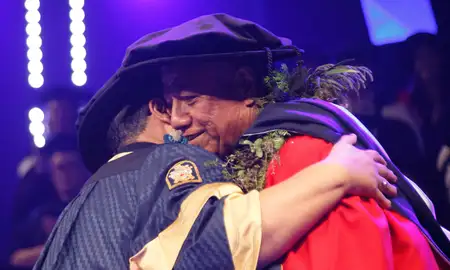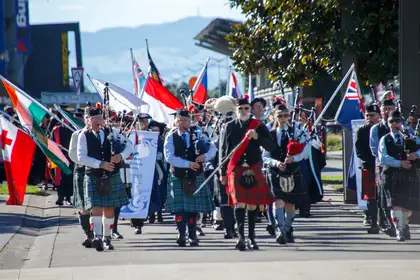
Among them is School of Social Work Lecturer Dr Ange Watson and Postdoctoral Researcher Dr Shannen Mills, who both graduated with a Doctor of Philosophy.
Dr Ange (Andrea) Watson – Te Āti Awa, Ngāti Mutunga, Taranaki Tūturu
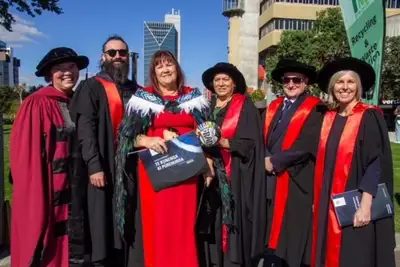
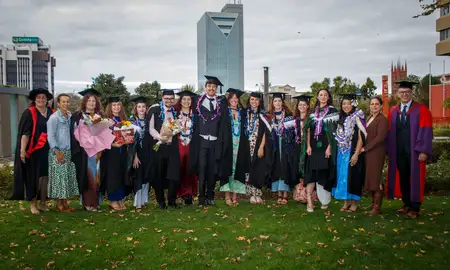
Dr Watson (third from the left) celebrates her graduation with fellow colleagues from the School of Social Work, College of Health.
Dr Watson’s journey with Massey began in the mid-1970s, not as a student or academic, but as a cleaner. That first job would be the start of a lifelong relationship with Massey, one that has spanned nearly five decades and culminated in her earning a Doctor of Philosophy in Social Work.
“Back then, I never imagined I’d one day be a lecturer, let alone complete a PhD.”
It wasn’t until 2002 that Dr Watson enrolled as a mature student, aged 39. In 2021, she joined Massey as a full-time lecturer in the School of Social Work. By then, she had already embarked on her doctoral research. It was a six-and-a-half-year journey that she says was both professionally transformative and personally challenging.
“My PhD explored how the growing-up experiences of Māori social workers shape their social work practice. What I found was their lived experiences play a huge role in how they connect with and support whānau they work alongside.”
Dr Watson’s research uncovered how social work is deeply embedded in te ao Māori and is often naturally practiced within whānau, hapū and iwi. She argues that contemporary Māori social work can be traced back to the Parihaka peace resistance movement, which she identifies as the earliest recorded example of Māori-led social and community work in Aotearoa.
“I also interviewed the whānau of Māori social workers and they shared how they would often turn to their social work trained whānau member for support, guidance, and access to networks and resources.”
From her doctoral work, Dr Watson developed the He Whāriki Haumaru model, a framework grounded in Māori values such as aroha, mokopuna ora, and whānau aspirations.
“It’s a model which reflects how social work naturally happens within whānau. It includes things like clear communication, unity, connection, and resilience. These aren’t abstract concepts, they’re lived practices.”
Now, she brings those insights directly into the classroom.
“I ask my students to reflect on their own childhoods. What shaped them, their roles in whānau, their challenges and strengths. We use the Te Kāhui Mounga ki te Toka Tūmoana framework from my research to make those connections. It’s about recognising how our personal histories inform our professional identities.”
Her study journey was also shaped by significant personal moments.
“My father passed away just after I finished my Master of Social Work, and during my PhD I lost my mum, my colleague and supervisor Dr Michael Dale, and my cultural consultant Ihaka Noble, Papa Bam. But there were joyful moments too. My youngest mokopuna, Romeo, was born during that time. Life and death walked with me through this journey.”
Looking back, Dr Watson is proud of how far she’s come.
“Not a bad effort for someone who started at Massey as a cleaner in the 1970s. This journey hasn’t just been about academic achievement. It’s about whānau, identity, and the power of lived experience.”
Dr Shannen Mills
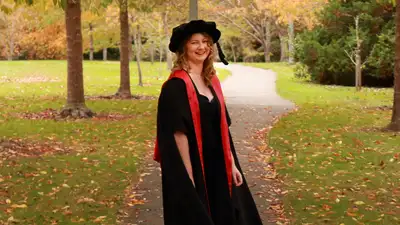
Dr Mills walks amongst autumn leaves on the Manawatū campus.
Dr Shannen Mills’ fascination with volcanoes began on a high school hike across the Tongariro Alpine Crossing. What started as a school trip soon sparked a career in volcanic research.
“We were part way through the hike, and I just fell in love with the landscape. When I got home, I googled what jobs I could do to work in that kind of environment, and that’s when I discovered I could become a volcanologist.”
Her doctoral studies focused on a critical aspect of volcanic behaviour: how volcanoes respond after large collapse events. Using Mount Taranaki as her case study, she examined volcanic fall deposits from 20,000–30,000 years ago, a time when two major edifice collapses reshaped the landscape.
“These collapse events involve a large section of the volcano breaking off and sliding down the slopes. That changes the volcano’s height and mass, and I wanted to understand how that impacts the magmatic system below.”
Her research revealed a direct relationship between the volcano’s structure and its inner magmatic processes.
“We found that changes in the height of the volcano can affect the style, size and composition of future eruptions. That’s a crucial insight for volcanic hazard models. It helps us better predict the potential risks following collapse events.”
The findings have already laid the foundation for her ongoing research at Massey.
“My current work continues along that line, looking at historic eruptions to better understand how volcanoes behave over time.”
While the science is complex, Dr Mills credits her support system for helping her through the years of study.
“This achievement wouldn’t have been possible without the support of my family, friends, and supervisors. They were there through all the challenges, and I’m so grateful.”
This year’s graduating staff members also include:
- Dr Jessica McLean – Doctor of Philosophy
- Jade Zhou – Executive Master of Business Administration
- Meka Faamanu Mapuilesua – Master of Management Financial Economics
- Steve De Grey – Master of Veterinary Science
- Associate Professor Thomas Odom – Master of Veterinary Science
- Raven Almquist – Bachelor of Veterinary Science
- Tamara Anderson – Bachelor of Veterinary Science
- Ethan Elliott – Bachelor of Veterinary Science
- Stephanie Rigg – Bachelor of Veterinary Science
- Lawrence Whittington – Bachelor of Engineering (Hons) Mechatronics
Congratulations once again to all our graduating staff. Your hard work inspires our community and reflects the vibrant, innovative spirit of Massey.
Related news
VetMAP students celebrate graduation milestone
The first cohort of Māori and Indigenous Pacific students supported by the Veterinary Māori and Pacific (VetMAP) initiative graduated this week, marking a proud milestone for both the students and the programme.
Celebrating Wellington staff success: Seven graduates, two doctorates
Graduation season has arrived and Te Kunenga ki Pūrehuroa Massey University is proud to acknowledge seven staff members who have crossed the stage in our Wellington ceremonies.
Renowned artist Sopolemalama Filipe Tohi receives recognition for his contribution to Pacific art and culture
Sopolemalama Filipe Tohi has been awarded an Honorary Doctorate of Fine Arts (honoris causa) in recognition of his outstanding contributions to both the Pacific and global art scenes.