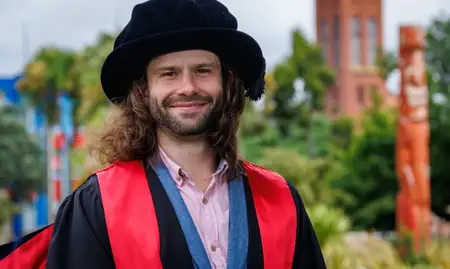
School of Psychology Professional Clinician and Doctor of Clinical Psychology graduate Dr Michelle Musakwa
Very little research in Aotearoa has focused specifically on the mental-health experiences of Black African migrants and refugees. Dr Musakwa’s study is one of the first to centre these voices directly, offering insight that broadens and enriches New Zealand’s understanding of wellbeing.
Dr Musakwa’s path into psychology began long before her doctoral journey. She migrated from Zimbabwe to Aotearoa in 2005 with her family — a transition that shaped her worldview, her values, and ultimately, her research identity.
“Those early experiences shaped much of who I am today. I’ve always been drawn to understanding people and supporting them through the more challenging chapters of life.”
Her doctoral topic emerged from years of listening to friends, family, church members and community groups. Noticing the rich, diverse ways African migrants conceptualise wellbeingas these conversations revealed stories of identity, cultural pride, spiritualityand connection.
“I knew many Black Africans who struggled with mental health but did not engage with formal services. These experiences highlighted the need to understand how African migrants and refugees conceptualise mental health, cope with challenges and engage with support systems.”
Dr Musakwa’s upbringing also powerfully influenced her direction.
“My parents were intentional about preserving our cultural identity. When it came time to choose a doctoral topic, it felt natural to bring these worlds together,” she explains.
“Growing up in Zimbabwe, mental health was rarely spoken about, and when it was, it often carried stigma. As I grew spiritually and academically, I began to see mental health as holistic, shaped by emotional, spiritual, physical, and social factors.”
This awareness guided her research approach: reflective, open, and grounded in deep respect for the people who shared their stories with her.
“Africans may share some cultural commonalities, but they are not a monolith. Ultimately, letting the individual participant guide the process is what helped people feel safest and most respected.”
Listening to participants became one of the most defining parts of the research. Dr Musakwa describes these conversations as profound.
“Part of sharing views on mental health means that participants share their vulnerabilities in hopes that they may influence how Black Africans are seen within this space. This takes courage and selflessness. As a researcher, it added weight to the importance of capturing the narratives of participants in a way that encourages change and promotes cultural competence for clinicians.”
Their insights strengthened her commitment to cultural competence and reflective practice. Her message to clinicians is to create space for the complexity and richness people bring.
“I hope clinicians recognise the diversity of experiences Black Africans bring such as migration, racism and discrimination, cultural and spiritual beliefs, and family dynamics that shape their understanding of mental health.”
Dr Musakwa’s doctoral journey was deeply shaped by her Christian faith, which sustained her through moments of difficulty and reminded her of the importance of amplifying African voices within academic spaces. She also carried with her the memory of her father and the significance the research held for her wider community.
“I always knew my father, who passed away during my doctoral journey, would have been proud to know the voices of his people can be represented! I am motivated and excited to see Black African voices represented in the mental-health space. Even though we are a small population, there is a clear need for awareness and attention to our experiences.”
Related news
Exploring kiwifruit’s potential as a natural sleep and mood booster
Dr Alexander Kanon’s PhD research explored whether kiwifruit could be the secret ingredient to supporting better sleep, mood and brain health, with his findings revealing the New Zealand-grown fruit may offer more benefits than previously understood.

Safeguarding New Zealand fur seal/kekeno through assessing population trends and threat factors
Dr Alasdair Hall’s fascination with marine mammals began long before his research into Aotearoa New Zealand’s fur seal/kekeno population, work that has improved understanding of how the species is faring and the challenges present.
New brain research paves the way for future treatment of neurological disorders
New research has uncovered a process in the brain that could pave the way for future treatments of neurodevelopmental and neurodegenerative disorders, such as Alzheimer’s disease.