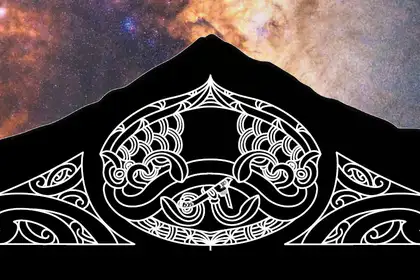
Credit: Pahi O’Carroll.
This understanding has shaped Transitioning Taranaki to a Volcanic Future He Mounga Puia research programme and researchers, who came together under the korowai of Taranaki mounga to better understand the mounga, study its past behaviour, and understand what signs the mounga may present before it reawakens.
“We started by acknowledging the mounga as a tūpuna,” says Māori researcher Dr Dee Sciascia of Māpuna Consultants and Te Kunenga ki Pūrehuroa Massey University.
“You can’t understand volcanic risk in Taranaki without understanding the whakapapa of the mountain, whenua and awa, the kōrero tuku iho and mātauranga held by whānau, hapū and iwi who hold ancestral connections to the mounga and have done so for generations.”
Through hui, wānanga, and the development of new rauemi, the five-year research programme raised awareness among hapū and iwi that Taranaki mounga is alive and may erupt again in our lifetimes.
This growing understanding has already shifted decision-making.
Hapū have sought volcanic risk assessments when building on and around the mounga and are considering how science and their own mātauranga can inform future thinking and planning to ensure that kōrero, taonga and people are looked after.
“That’s a direct outcome of this kaupapa,” Massey's Professor Jon Procter says.
“It’s not just technical knowledge, it’s relational. It’s the conversations, the whakawhanaungatanga, the trust that’s been built over time.”
A major contribution of the programme has been showing how mātauranga Māori and Western science can sit side by side, both informing decisions around volcanic risk.
Taranaki uri were supported to explore and bring forward pūrākau, waiata, karakia, toi Māori, kōrero tuku iho, and oral histories.
These narratives were woven together with eruption scenarios and scientific modelling, creating a more holistic picture of what future volcanic activity may look like for tangata whenua.
“Those kōrero have always been there. What’s different now is that they’re being recognised as part of the risk landscape and scientists are becoming aware and respectful of existing, living knowledge systems with regard to the mountain,” Dr Sciascia says.
“Our stories are important insights that science can learn a great deal from. Our stories hold great mana.”
As part of the programme, network modelling was used to assess how volcanic phenomena could impact road access and connectivity across Taranaki.
Researchers segmented the roads into 1km sections, modelled multiple eruption scenarios, and identified areas at higher risk of isolation.
Findings showed that by the end of a large eruption scenario, twelve marae would be isolated, and eight marae would lose access to essential services such as fuel, food, and medical supplies.
This isolation poses a significant challenge, as marae often serve as gathering points for whānau.
“Marae are more than buildings, they're cultural beacons of ritual and practice for our people,” Dr Sciascia says.
“When marae are isolated, communities are isolated. This research shows we must plan for how we support and maintain these spaces during long-term disruption.”
This weaving of knowledge systems stands as one of the programme’s most distinctive contributions and has offered a model for how science programmes across Aotearoa can embed different forms of knowledge meaningfully and respectfully, privileging both mātauranga Māori and science.
The programme also created space for emerging Māori researchers to lead and contribute, producing monographs, creative works, academic outputs, and new ways of framing science.
“We’ve challenged traditional models of research,” Professor Procter says.
“Too often, mātauranga Māori is tacked on at the end. Here, it has started to be intertwined. And it’s made the science better.”
“Taranaki mounga provides us with so many learnings from its past and how our tūpuna navigated previous volcanic events, and it’s up to us now to prepare our whānau for the future,” Dr Sciascia says.
“That means making decisions grounded in our ways of knowing, being and doing, privileging whānau/hapū approaches, recognising our mounga as an ancestor (and legal person) and in the lived realities of the people who will be most affected.”
To support whānau and hapū in turning this knowledge into action, researchers co-developed bilingual brochures written by and for uri of Taranaki, sharing volcanic insights in both te reo Māori and English.
These rauemi offered a culturally grounded starting point for kōrero and planning, helping whānau connect with their tauheke mounga.
With a 30–50 per cent chance of eruption in the next 50 years, researchers say the time to prepare is now.
“This programme has laid a foundation,” Dr Sciascia says.
“But the real mahi is in how we carry this forward, and how we embed mātauranga Māori into everyday planning, science, and response.”
StoryMap
Check out this StoryMap shares mātauranga and science about the volcanism of Taranaki mounga to support whānau planning and preparedness.
This article was originally shared by Illuminate Science.
Related news
Pūtōrino e Rua: Learning from Mātauranga Māori to expand understanding of natural hazard events in the Rangitīkei
Pūtōrino e Rua, a collaborative project investigating a historic landslide in the Rangitīkei Valley, has reached its first year milestone.
Ruapehu Volcano listed as one of the world’s best demonstrations of geologic features
Ruapehu Volcano has been named among five Aotearoa New Zealand sites on a list of 100 geological world heritage sites .
Chilean delegation learn about Te Tiriti aspirations
International dignitaries from Chile recently visited Te Kunenga ki Pūrehuroa Massey University to find out more about our aspirations to be Te Tiriti led.