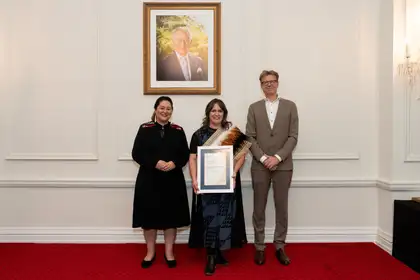
Governor-General of New Zealand Her Excellency the Right Honorable Professor Dame Cynthia (Cindy) Kiro, Dr Angelique Reweti and Centre for Public Health Research Director Professor Jeroen Douwes.
“Elevating lived experience - the stories, the realities, the solutions - is not just part of the research. It is the research. And it is those voices that guide every step of the work we do,” Dr Reweti, a Senior Lecturer in the School of Health Sciences at Te Kunenga ki Pūrehuroa Massey University, says.
Dr Reweti’s work is anchored in the relationships she shares with her own whānau and hapū. Through Reweti whānau hui and the Ngā Hapū o Te Ahuahu project, she has seen how reconnecting people to whenua, whakapapa and cultural identity supports wellbeing in ways formal health systems overlook.
One of her key initiatives is Wāhi Kōrero, an online platform where whānau can anonymously share experiences of care that was unavailable or difficult to access, or moments when cultural or emotional barriers made seeking support challenging. These stories rarely show up in official health data, yet they are essential for understanding where the system is not meeting the needs of communities.
“More than 800 people have trusted us with their stories of missed care, whakamā, and the everyday barriers that prevent them from seeking help. The honesty and vulnerability in those stories show us the health system through their eyes - the emotional labour of navigating services, the fear of judgment, the feeling of not being welcomed or understood.”
These insights challenge long-held institutional assumptions about personal responsibility in health.
“These stories make the invisible visible. They help us see unmet need not as a personal failure, but as a failure of the system to meet people where they are.”
The impact of this work is already evident. Findings from Wāhi Kōrero contributed to the redesign of child growth and development services through Kahu Taurima, a health initiative to support whānau from pregnancy through the early childhood years. They are helping shape services that are more grounded in trust, respect, and relationships.
“That is what transformation looks like - when the system starts listening and acting on what communities have been saying all along.”
It is this groundbreaking work that has earned Dr Reweti the Health Research Council’s inaugural Te Ata Hāpara Award, a recognition arriving at a time when trust in health institutions sits at the centre of national debate.
“This award is meaningful because it recognises that Māori ways of knowing are valid, rich and essential to the future of public health. And it is not something I receive alone. My whānau, hapū, and community are right beside me in this mahi. Their support, guidance and aroha ground everything I do. So, for me, this award is really a reflection of collective effort and a recognition of the people who continue to hold and carry this knowledge forward.”
Dr Reweti carries this philosophy into both her research and teaching.
“I think it is important to acknowledge that we are part of a long continuum of whakapapa. There is a real energy and boldness among early career Māori researchers today, but we stand on foundations built through the hard work, advocacy and resilience of those who came before us.”
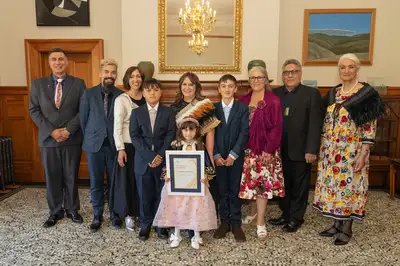
Dr Reweti with her whānau. L to R: Kemp Reweti, Koenraad Vivian, Chantelle Christensen, Seth Reweti, Angelique Reweti (centre), Dixie Reweti, Isaiah Reweti, Carlysle Vivian-Robins, Dr Savern Reweti and Darlene Joyce Reweti.
Navigating institutions not designed for Māori remains a challenge, but Dr Reweti says meaningful change requires a constant act of carving out space with persistence and collective strength.
“We are still working within systems that were never designed for us. What we are pushing for now is research shaped by values, whakapapa and community, rather than institutional convenience. Indigenous research is no longer a niche topic. It is increasingly recognised as essential to building an ethical, equitable responsive health system for everyone.”
Dr Reweti sees a bright future in the next generation of Māori researchers.
“What excites me most is the courage of our emerging researchers. They are not waiting for permission to do things differently. They are working across art, technology, environment and health to design new ways of thinking about wellbeing – work that is creative, collective and grounded in whakapapa.
“The future of Māori health research is bright because it is in the hands of people who are connected to their communities, guided by those who paved the way, and committed to change that uplifts everyone.”
Related news
New Human Nutrition major opens doors for aspiring health professionals
Te Kunenga ki Pūrehuroa Massey University’s new Bachelor of Health Science (BHlthSc) Human Nutrition major launching in 2026 is set to change the game for students keen to pursue nutrition but who may not have the usual chemistry or biology prerequisites.

Associate Professor Bevan Erueti appointed Māori Health Board Director for CAPHIA
Associate Professor Bevan Erueti, Taranaki, Te Ati Haunui-ā-Papārangi, Ngāti Tūwharetoa, has been appointed the new Māori Health Board Director for the Council of Academic Public Health Institutions Australasia (CAPHIA).
New appointment targets inequities in Māori health
Dr Angelique Reweti, Ngāpuhi, has been elected to the Executive Council of the Public Health Association of New Zealand (PHANZ) and as Chairperson of the Māori Caucus.