'Headland' gives voice to aspiring writers alongside established authors, from Aotearoa New Zealand and abroad.
In a literary landscape increasingly defined by closures and cutbacks, the endurance of Headland is something to celebrate. Now reaching a milestone of 24 issues, this Aotearoa New Zealand-based literary journal has stayed true to its mission: giving a platform to new and emerging voices in fiction and creative nonfiction, both locally and globally.
Founded in 2015, Headland began as an entirely independent journal to provide a place for writers to begin and to belong. Today, it finds support through Te Kunenga ki Pūrehuroa Massey University’s School of Humanities, Media and Creative Communication. It continues to be shaped by staff and alumni of the university’s Creative Writing programme, in particular Editor-in-Chief Dr Thom Conroy, a Senior Lecturer in creative writing.
Dr Conroy is no stranger to editing journals and admits it’s been a passion for a long time. His love for literary journals began back in the early 2000s when he was a PhD student at the University of Ohio where he edited the journal Quarter After Eight – which still exists today.
“I love editing for Headland because we give writers a chance to join their own voices to a wider conversation about literature and storytelling in Aotearoa. What’s especially exciting to me is our emphasis on new and emerging writers, who increasingly find it challenging to get published,” Dr Conroy says.
A unique space in the literary ecosystem
Headland stands out for its focus on writers at the start of their careers. While many journals feature the familiar names of established authors, Headland reserves space for those who haven’t yet been heard. The journal provides an opportunity for authors to be published for the first time.
“We especially value unpublished writers and we try to make sure that every issue includes someone who has never been published,” Dr Conroy says. That commitment is backed by a rigorous editorial process. Submissions are blind-read by the editorial team, and then then longlisted and voted on by consensus. No single editor can approve a piece based on personal preference alone.
The process is described as democratic and deliberate, which equates to every accepted piece to reflect something meaningful to the entire team.
Headland is blessed with a gifted team of mostly volunteer copy editors led by Chief Copy Editor Amanda Hurley as well as a paid Managing Editor, Sam Oakley who is a former Master of Creative Writing student. The volunteer staff help to make each issue possible by undertaking every editorial function from selecting work to social media marketing to copy editing to managing a lively blog series.
Ms Oakley, who has been working with the publication since 2024 says there has been an increased number in submissions since she’s been involved.
“It’s normal now for us to receive over 250 submissions. Each issue, I’m learning something new and it's great fun working with such a wide range of authors.”
One of Massey’s alumna, Paskifa author and a current Headland editor Gina Cole joined the editorial team in 2021. She explains how much she has enjoyed the opportunity to work with a group of dedicated writers and editors.
“I am constantly surprised and delighted at the amount of incredible writing that is submitted to the journal. Headland's online platform allows us to publish excellent writing quickly across a diverse range of genres, from unpublished to established writers.”
Evolving and expanding
In the past decade, Headland has grown not just in quality but in reach. Issue 23 saw over 9,000 unique visitors to the website, with readers from New Zealand, Australia, the United States, the United Kingdom, Ireland, India, Nigeria and beyond.
With each issue, the team pushes toward a wider and more inclusive platform. Since issue 17, contributor photos have been added alongside their work to make the reading experience more personal.
Diversity is more than a buzzword at Headland, it’s carefully weaved into each issue. The journal has published early work by writers like Becky Manawatu (Ngāi Tahu, Ngāti Māmoe, Waitaha) Airana Ngarewa (Ngāti Ruanui) and others from underrepresented communities, including migrants and LGBTQ+ writers. Special issues have been guest-edited by luminaries such as New Zealand Poet Laureate Robert Sullivan and dedicated to themes like Māori writing and speculative fiction.
Dr Conroy’s vision for the online journal includes themed-issues on multicultural writing and climate change; a possible return to longer-form essays on urgent global issues like authoritarianism and human rights; and even the possibility of visual art galleries in future editions — time and resources permitting.
As the journal looks to the future, one thing is clear: Headland isn’t just surviving, it’s growing, adapting and continuing to give space to the stories that matter.
Headland Issue 24 is out now, featuring new fiction, creative nonfiction and reflections from some of the globe's most compelling voices.
Learn how to express yourself with words
Related news
From shorthand typist to published author
'The Cinderella Service', written by Master of Creative Writing graduate Lynda Taylor, offers readers a unique window into New Zealand’s wartime history, as well as a powerful story of courage, growth and the unsung heroines of the home front.
Writing the seen and the unseen - Susanna Elliffe wins the Laura Solomon Cuba Press Prize
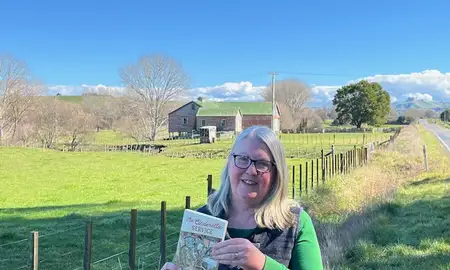
From childhood dreams of becoming a zookeeper or an actress to working in libraries and now publishing a collection of short stories, the path of creative writing Master’s student Susanna Elliffe has been shaped by imagination and persistence. With Relic Party set for release in 2026, her stories – strange, lyrical, unsettling and deeply human – are poised to invite readers to see the world anew.