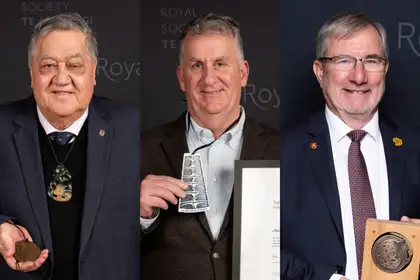
From left: Distinguished Professor Graham Hingangaroa Smith, Emeritus Professor Andy Shilton and Distinguished Professor Emeritus Paul Spoonley.
Te Puāwaitanga Research Excellence Medal - Distinguished Professor Graham Hingangaroa Smith
Distinguished Professor Graham Hingangaroa Smith, Ngāti Apa, Ngāti Kahungunu, Te Aitanga a Hauiti, Kāti Māmoe, has been awarded the 2026 Te Puāwaitanga Research Excellence Medal. This is presented in recognition of research that has made an eminent and distinctive contribution to Te Ao Māori and Indigenous knowledge.
Professor Smith was awarded this medal for laying the foundations of Kaupapa Māori theory, transforming Māori education and research and for pre-eminent contributions to Indigenous scholarship globally. Through his doctoral research, he distilled a theory of transformation that now guides research, policy, and practice across universities, wānanga, and government agencies.
Professor Smith helped drive political changes, including to the Education Act 1989, that significantly expanded the number of Kura Kaupapa Māori. He also oversaw the establishment of Ngā Pae o te Māramatanga, the Māori Centre of Research Excellence, and cofounded a network that has supported many Māori to complete doctorates.
Professor Smith was the Deputy Vice-Chancellor Māori at Te Kunenga ki Pūrehuroa Massey University from 2019 to 2020. He currently serves as Te Toi Ihorei ki Pūrehuroa Distinguished Professor at Large, a role in which he helps the university understand and react to what Māori students, staff and whānau want, and move toward its aspiration to be Tiriti-led.
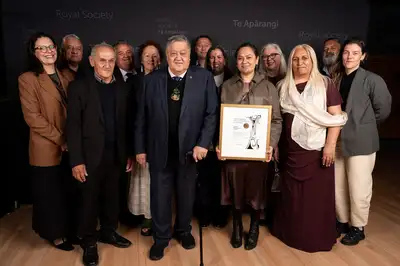
Professor Smith (centre) with whānau and friends at the award ceremony. Photo credit: Royal Society Te Apārangi | Rebecca McMillan Photography.
Professor Smith says, “My vision is that every Māori child has a genuine chance to receive an education that not only gives them learning success, but it also provides for and fits them for their cultural aspirations and wellbeing, gaining skills that will positively contribute to building New Zealand’s unique bicultural foundation alluded to in the Tiriti o Waitangi.”
Very recently, Professor Smith received an honorary Doctor of Letters degree from Thompson Rivers University (TRU) in Canada, in recognition of his more than four decades of transformative leadership in Indigenous education, scholarship and self-determination. This is the highest honour offered by TRU. It reflects the significant impact of Professor Smith’s formative Kaupapa Māori theory of education and his contribution to Indigenous scholarship internationally.
Tahunui-a-Rangi Innovation Medal - Emeritus Professor Andy Shilton
Emeritus Professor Andy Shilton has been awarded the Tahunui-a-Rangi Innovation Medal for inventing a low-cost technology for disinfecting liquids using ultraviolet (UV) light.
UV light is used for chemical-free disinfection of liquids because it can disrupt the genes of microbes, but is only effective in liquids it can easily penetrate. Professor Shilton invented Supercritical UVTM, a technology that forces liquid beneath ultraviolet lamps in a fast-moving supercritical flow just millimetres thick, inactivating more than 99.9 per cent of harmful bacteria – even in wastewater light can barely penetrate.
Developed at Massey and commercialised in 2021 through spin-out company NovoLabs, the technology has now treated many billions of litres of wastewater around Aotearoa New Zealand, helping to restore the health of waterways.
Professor Shilton’s company is now expanding into Australia, Europe, North America and South America, and into the food, beverage, agriculture and horticulture sectors.
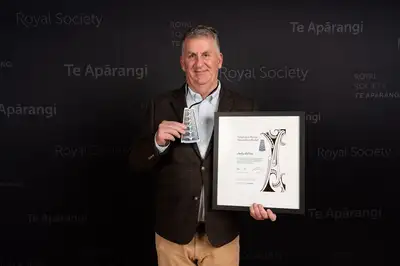
Professor Andy Shilton with the medal. Photo credit: Royal Society Te Apārangi | Rebecca McMillan Photography.
Professor Shilton had spent years researching environmental technologies and was teaching students about supercritical flow hydraulics when he had his breakthrough idea.
“I realised that combining those hydraulics with UV light could be brilliant at killing bacteria and viruses in hard-to-treat liquids, where the light can’t reach them effectively.
“Billions of litres of effluent are still discharged into New Zealand waterways without effective disinfection, mostly because the existing options cost too much for hard-to-treat wastewater.
“Our communities and industries have been stuck choosing between chemicals, expensive membranes, or no disinfection at all. I realised that by simply changing the way the liquid flows it could allow UV light to reach every drop with enough intensity to disinfect it cheaply and effectively.”
He says that winning this award means a great deal to him.
“It marks an important milestone for the NovoLabs team, our customers, and New Zealand deep tech.
“It recognises the journey from research in a Massey Uni shed to technology that helps protect waterways and is reaching export markets around the world.”
Massey’s Director Commercialisation and IP Dr Dan Carlisle says Professor Shilton is a hugely deserving recipient of the Tahunui-a-Rangi Innovation Medal.
“Over several decades he has been at the forefront of research and innovation in the disinfection field, with a focus on turning great science into solutions that make a real difference. It is fantastic to see him now building on that legacy through NovoLabs and taking a Massey innovation from Manawatū to markets around the world.”
Durie Medal - Distinguished Professor Emeritus Paul Spoonley
Distinguished Professor Emeritus Paul Spoonley has been awarded the Durie Medal, for New Zealand’s pre-eminent social scientist. The medal recognises his research on identity, ethnicity, migration and political extremism that has informed policy and public debate in New Zealand and overseas.
Professor Spoonley’s early research on Niuean migration, the extreme right and identity among Pākehā set the direction of his career. He has also worked with Māori in Hawke’s Bay to build social and economic capital in 14 marae-based communities, and with Jewish communities to understand and counter antisemitism. He co-developed a definition of social cohesion that was endorsed by Cabinet and has shaped government policy.
After the 2019 Christchurch mosque attacks, he co-directed He Whenua Taurikura, the National Centre of Research Excellence for Preventing and Countering Violent Extremism, and helped lead a project for the Police Commissioner on police-community relations. More recent work has been on demographic and social change for Koi Tū Centre for Informed Futures.
A trusted public commentator, he is the author or editor of 29 books. Internationally, he co-chaired or chaired two major research and policy networks: Metropolis International and UNESCO’s Asia-Pacific Migration Research Network.
Professor Spoonley is an Honorary Research Associate with Massey’s College of Humanities and Social Sciences and previously served as Pro Vice-Chancellor of the College.
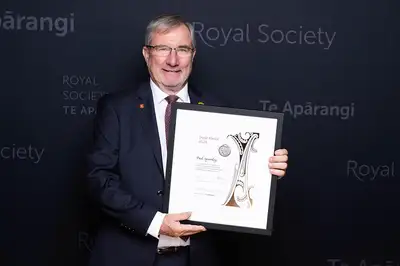
Professor Paul Spoonley. Photo credit: Royal Society Te Apārangi | Nigel King.
Acting Deputy Vice-Chancellor Research, Distinguished Professor Gaven Martin says, "As a former Vice-President and Academy Chair of the Royal Society Te Apārangi, I know just how hard it is to earn the level of recognition awarded to our esteemed colleagues. These researchers are the best of the best. Each has had a long and distinguished career, making contributions of national and international significance. What these medals cannot fully capture is how much they have given to Massey University through their teaching, mentoring and leadership.
"Andy Shilton has brought scientific ingenuity and practical engineering together to take an inspired idea to market. His ultraviolet disinfection technology tackles wastewater that conventional UV systems struggle to treat, and has already been used to treat billions of litres. It is a wonderful example of research developed at Massey making a tangible difference to the health of our waterways, with applications reaching well beyond New Zealand.
"Paul Spoonley has, for decades, been one of New Zealand’s foremost social scientists, helping us understand ourselves as a people and the society we are becoming. His work on identity, migration, ethnicity and political extremism has shaped public debate and government policy. He has brought both scholarly depth and a clear public voice to some of the most difficult questions facing our country.
"Graham Hingangaroa Smith has helped lay the foundations of Kaupapa Māori theory, transforming Māori education and research and influencing Indigenous scholarship worldwide. In a very real sense, he helped write the book. His leadership in the growth of kura kaupapa Māori and in supporting generations of Māori scholars has helped give practical expression to the aspirations of Māori for their language, culture and education.
"I am enormously proud to call these remarkable people our colleagues, and I know that pride is shared across Massey University."
Related news
Professor Vicki Karaminas honoured with the Humanities Aronui Medal for contributions to fashion studies
The Humanities Aronui Medal is awarded annually for research or innovative work of outstanding merit in the humanities.

Riddet Institute Director awarded Pickering Medal for work on iron deficiency solutions and food innovation
Leading researcher and Director of the Riddet Institute, Distinguished Professor Harjinder Singh FRSNZ, has been honoured with the prestigious Pickering Medal by the Royal Society Te Apārangi.

Distinguished Professor Gaven Martin awarded Jones Medal for groundbreaking mathematical work
Distinguished Professor Gaven Martin FRSNZ has been awarded the Jones Medal by the Royal Society Te Apārangi in recognition of his contributions to mathematics.