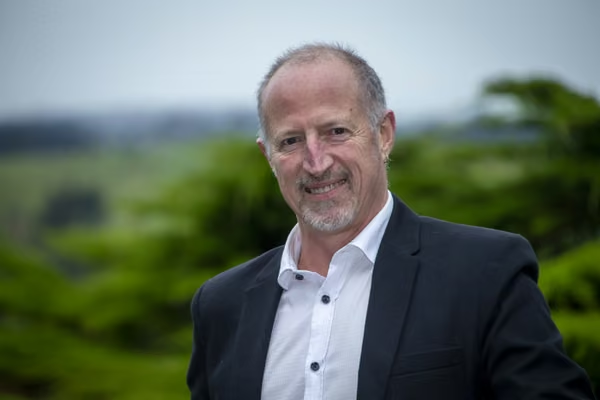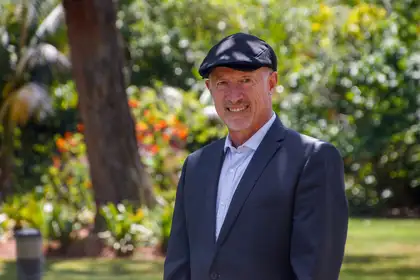
Professor Bruce Glavovic.
Professor Glavovic is one of about 650 ocean experts selected from 86 countries to contribute to the Third World Ocean Assessment (WOA III), a United Nations-led assessment examining the state of the world’s oceans and humanity’s relationship with them.
The report is arguably the most significant assessment to date of the state of ocean and its governance implications.
The assessment is helping shape how the world understands and responds to socio-environmental change, and examining the pressures facing marine environments and humanity writ large, including climate change, biodiversity loss, pollution and sustainable ocean use.
Professor Glavovic contributed to chapters examining the drivers of change affecting the ocean and the governance of marine biodiversity, with a particular focus on how societies can make effective decisions in response to ocean sustainability challenges.
“Even the best scientific knowledge will only make a difference if it can be translated into effective and enduring action for just and sustainable ocean development,” he says.
Professor Glavovic’s contribution builds on his decades of work at the intersection of science, policy and practice, including previous involvement in major international assessments such as the Intergovernmental Panel on Climate Change (IPCC), the Intergovernmental Science-Policy Platform on Biodiversity and Ecosystem Services (IPBES), and the forthcoming UNESCO-IOC Global Ocean Science Report III.
Yesterday’s launch of WOA III is particularly relevant for Aotearoa New Zealand, which has one of the world’s largest exclusive economic zones.
“New Zealand is often thought of as terrestrial nation renowned for its landscapes and primary production, but in reality we are a major ocean state. Our ocean is central to our identity, wellbeing, economy, culture and future prosperity.”
The assessment suggests that ocean health not merely ecological; it is also about culture, identity, justice, governance, food security, livelihoods and the kind of future we want to create for people and the planet,” he adds.
“The ocean is not separate from society; it is woven into and inseparable from it.”
Professor Glavovic says the work reflects Massey’s commitment to research that connects science with real-world challenges.
“Addressing complex issues such as climate change, biodiversity loss and ocean sustainability requires more than disciplinary expertise. It requires the ability to work across different knowledge systems, collaborate with communities and contribute to practical solutions.”
Professor Glavovic adds that climate change, biodiversity loss, pollution and overexploitation are all serious ocean-relevant challenges. But these are symptoms of something deeper.
"The greatest challenge facing the ocean is that many societies continue to behave as though we are separate from it. We have become extraordinarily good at extracting value from the ocean while forgetting that our own wellbeing is inseparable from the wellbeing of the living systems that sustain us. The ocean is telling us something profound. The crises we see in marine environments reflect deeper crises in our relationships with nature, with one another, and with future generations. The challenge is not simply to manage the ocean better. It is to rediscover how to live as part of the living world rather than apart from it."
Related news
Bridging oceans and communities with Mana Tūāpapa Future Leader Fellowship
Behavioural ecologist and conservation scientist Dr Philippa Brakes has been awarded a Mana Tūāpapa Future Leader Fellowship from Royal Society Te Apārangi.
Professor Bruce Glavovic receives 2024 Chinese Academy of Sciences Distinguished Scientist Award
Professor Glavovic has been honoured with a prestigious award granted to foreign scientists by the Chinese Academy of Sciences President’s International Fellowship Initiative .