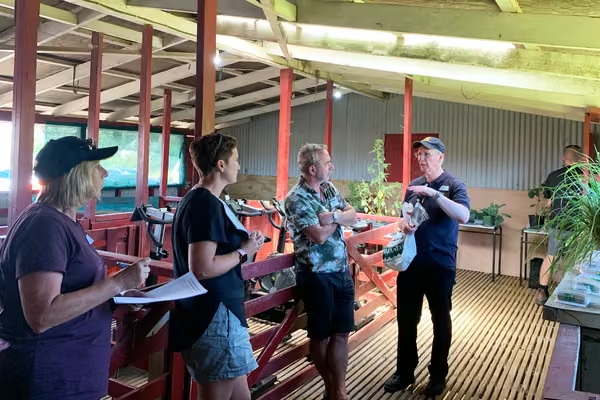
The primary industries form the largest part of the New Zealand economy, generating billions of dollars each year through exports and revenue. Nearly 80 per cent of all businesses in New Zealand are directly or indirectly connected to the primary sector. Demand for graduates to join these businesses has never been higher, but a capability gap remains, making pipeline development a critical part of the solution.
Te Kunenga ki Pūrehuroa Massey University’s School of Agriculture and Environment has joined forces with members of the Horticulture and Agriculture Teachers Association (HATA) and the T.R. Ellett Agricultural Research Trust to create a series of seven micro-credential courses to upskill and provide professional development opportunities for secondary school teachers. Through this partnership, Massey has developed academically rigorous, fit-for-purpose courses informed by educators with firsthand understanding of the demands of secondary school teaching.
Head of the School of Agriculture and Environment Professor Paul Kenyon says the rapid growth of agriculture, horticulture and agribusiness subjects in secondary schools has highlighted the need for greater teacher support and professional development.
“At Massey, educating the next generation of agriculture, horticulture and agribusiness leaders is one of our longstanding strengths, so supporting the teachers inspiring those future students is a natural extension of that role. At least 200 secondary schools now teach agriculture, horticulture or both to some level, and more than 100 teach agribusiness. The challenge is that demand has outpaced the number of teachers with specialist training in these areas, highlighting a clear need to support and upskill educators teaching these subjects.”
The courses have been developed by teachers, for teachers, with contemporary, research-led content that is directly relevant to the challenges secondary school teachers navigate each day. Designed to be flexible and self-paced, the courses fit around the commitments of working teachers.
Subjects covered include soils, plants and agronomy management, agribusiness and the New Zealand primary products value chain, animal production systems, horticulture and vegetable systems, and animal anatomy and physiology for improved performance. Another course explores cultural perspectives of science, including an introduction to the relationship between science and Te Ao Māori.
Courses are offered throughout the year across all three of Massey’s teaching semesters including the summer semester, allowing teachers to build their knowledge over time while balancing professional commitments. Each completed course contributes five credits towards further tertiary study, including the Certificate in Science and Technology, with credits recorded on the teacher’s academic transcript. For more information, see Study Certificate in Science and Technology – CertScTech.
Massey’s 10-week courses also provide practical materials and resources that can be readily adapted for secondary school teaching and learning.
The first four of the seven new courses have now been piloted by teachers and refined by Massey staff, with the first two having launched officially in April 2026. Teachers who took part in the pilot courses said they valued the opportunity to explore new perspectives within their subject areas and appreciated being able to balance the short-course study alongside their existing school commitments.
Feedback surveys rated the courses highly for their engaging content and effective structure, with participants also recommending them to colleagues.
“I really enjoyed being the student for a change. The content was interesting, the resources were useful and the course was easy to engage with. It was great to be exposed to new ideas and perspectives — all while being able learn in my own time,” a teacher from St Paul’s Collegiate School says.
Professor Kenyon praises the team involved in the design and refinement of the courses.
“This was a genuine collaboration aimed at creating meaningful change in the education sector. With members of the HATA team helping ensure the courses were aligned with the curriculum, alongside the support from T.R. Ellett Trust, staff were able to deliver a tangible and improved outcome for teachers.”
“We value our colleagues in secondary schools and the important role they play in educating future students. Massey wanted to support them in their own learning journey and ensure they had access to research-led knowledge and resources they could use in their classrooms,” he says.
Sciences First Year Dean and Professional Development Course Lead Professor Chris Anderson shares the sentiment.
“This project has been a real success and hugely rewarding in terms of the results we’ve seen. We have already received strong interest in the courses and have also been approached by organisations such as Primary ITOs that are considering enrolling their staff.
“The fact the courses are making a difference to teachers nationwide is a credit to the team, who have worked incredibly hard on the project. We hope this support ultimately contributes to a strong future for New Zealand’s primary industries, which will need innovative students and graduates to help address challenges such as climate change, food security and disrupted global supply chains.”
The next series of micro-credential professional development courses begin on 20 July 2026, with enrolments accepted from 1 June. To register or find out more information, please email ag@massey.ac.nz.
Details are available on the short courses and micro-credentials website for the first four courses:
Related news
New courses to upskill agriculture teachers to launch next year
A new collaborative initiative to upskill secondary school teachers in agriculture-related subjects is set to launch next year to meet unprecedented demand.
Massey leading tertiary education and research for NZ’s primary industries
By Professor Paul Kenyon
Partnering to encourage young people into the primary industries
Encouraging high school students to pursue a career in the primary industries was the aim of a recent educational day with a group of North Island high school teachers.