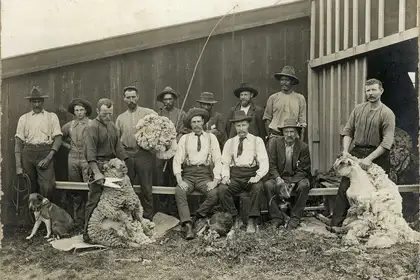
Photograph is part of the Coates Family of Ruatuna Collection
The Coates Family of Ruatuna Collection documents 123 years of family, farming and community life in Kaipara and contains more than 3,500 items, including letters, diaries, farm ledgers, stock books and photographs.
The Coates Family of Ruatuna Collection joins other nationally and internationally significant documentary heritage on the UNESCO Memory of the World Register, including Te Tiriti o Waitangi, the Women’s Suffrage Petition and the first book published in te reo Māori.
The collection centres on the Coates family, particularly Gordon Coates, one of Aotearoa New Zealand’s prominent political figures and Prime Minister from 1925 to 1928.
Dr Claasen, from the College of Humanities and Social Sciences, was one of the independent experts asked to provide testimony supporting the collection’s nomination.
His relationship with the collection began while researching his 2017 Massey University Press book Fearless: The extraordinary untold story of New Zealand’s Great War airmen.
Dr Claasen says Gordon Coates’ younger brother William was one of the first people to capture his attention during that research.
Among the papers at the family’s historic Ruatuna homestead he found correspondence between Gordon and William and their parents, Edward and Eleanor, and sisters during the First World War.
The letters chart the markedly different wartime experiences of the brothers. Gordon served as a decorated army officer on the Western Front, while William served in Egypt before eventually gaining a commission with the Royal Flying Corps.
William died from wounds received during air operations over the Western Front in 1917.
Dr Claasen says the circumstances in which the family’s correspondence can still be viewed make the collection particularly remarkable.
“As an historian reading this letter at the same kitchen table, with family looking down upon you from framed photographs, is a powerful experience.
“The connection between people, place and documents is what makes the Coates Papers, Ruatuna, so remarkable. It is rare to have such a fulsome set of materials chronicling the lives of such a significant family, it is rarer still to have it held and curated in the very house they lived in.”
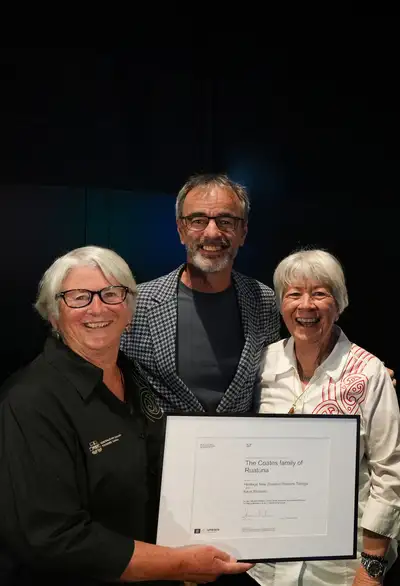
Left to right: Property Host Ruatuna Mary Stevens, Dr Adam Claasen and Director Regional Services, Heritage New Zealand Pouhere Taonga Pam Bain.
Dr Claasen says experiencing the material in its original setting distinguishes Ruatuna from many other nationally significant historical collections, which are housed in central archives or libraries.
He makes the case for the collection and its Ruatuna home to be recognised as national taonga with both historical and community significance.
Heritage New Zealand Pouhere Taonga Director Regional Services Pam Bain says inscription on the UNESCO Memory of the World Register is a robust process requiring testimony from at least two independent experts.
She says Dr Claasen was approached because of his existing knowledge of the collection and experience using the Ruatuna papers in his research.
“Dr Claasen’s testimony was important for the submission as he recognised the unusual nature of the collection, the wide range of material that contributes to our understanding of the Coates family and the local community and, in particular, the context in which this material is located and available to the public. His testimony was intuitive and powerful and was strong in its support for the nomination.”
Dr Claasen says the collection provides an intimate picture of more than a century of life in Aotearoa New Zealand.
While official records document much of Gordon Coates’ political career, the material at Ruatuna reveals the family and community influences that helped shape him.
The collection also illustrates relationships with local tangata whenua. Dr Claasen says these community connections informed Gordon Coates’ later relationships with Sir Āpirana Ngata and Te Puea Hērangi, as well as investigations into Māori land confiscations that following the New Zealand Wars.
Dr Claasen says contributing to the successful nomination was also an opportunity to acknowledge those who had supported his own research.
“That I played a part in the successful recognition of the collection with the UNESCO Memory of the World is very satisfying and well-deserved recognition for the staff who curate the collection and Heritage New Zealand Pouhere Taonga. My involvement was a way of saying thanks for their generous input and assistance to my work.”
He says the project also demonstrates the close relationship between university research and the organisations responsible for protecting and sharing the country’s heritage.
“University researchers and museum and archive curators work in a symbiotic relationship that links scholarship and the material preservation of materials and public engagement. Both work together to promote public engagement with the past through publications and exhibitions.”
Related news
W.H. Oliver Lecture highlights Rangitāne history and the legacy of a pioneering historian
A full house gathered at the Palmerston North City Library last week as historians, researchers and members of Rangitāne came together for the 14th W.H. Oliver Lecture.
Your Family, your history: New book challenges kiwi narratives
Professor Richard Shaw is urging New Zealanders to reflect more deeply on their own family histories and their connection to colonisation, with the release of his latest book, 'The Good Settler – Essays from other people’s lands', recently published by Massey University Press.