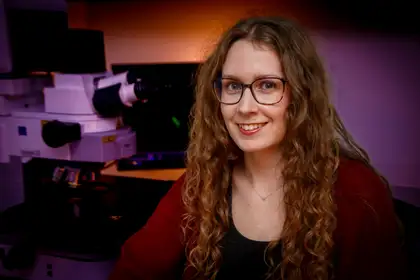
Dr Hannah Hawley.
Dr Hannah Hawley, a molecular biosciences technician from the School of Food Technology and Natural Sciences, has been researching the brain for five years and says she’s “fascinated by its intricacies and resilience”.
In brain disorders like Alzheimer’s disease, proteins form harmful clumps in brain cells, leading to issues with brain development, trouble moving, shorter lifespans, and memory loss. Hannah’s research will use fruit flies to test genetic and drug-based methods to break up these clumps and reduce their damaging effects.
The goal is to help restore brain development and slow down degeneration in people with neurological diseases. Although the work is early-stage, it could lead to future therapies.
“The findings may help us better understand how brain cells malfunction in conditions linked to aging and memory loss. It is very much proof of principle work at this stage, but we’re excited to see where it takes us,” Dr Hawley says.
She’s always had a keen interest in science. “I was a bit of a nerd as a child. I loved to read and find out things, make hypotheses and then test them with experiments.”
Dr Hawley attended Palmerston North Intermediate Normal School and Palmerston North Girls’ High School and was involved at both schools in the CREST programme run by the Royal Society Te Apārangi.
“I had some neat teachers that fostered my interest and really encouraged me to get involved,” she says.
“I entered several projects in the Manawatū Science and Technology Fair. After that, I came to Massey on an Academy of Sport Scholarship for my undergrad as I used to compete internationally in archery. I had to retire due to injury, but I stuck around to do postgrad studies.”
Dr Hawley is being mentored by Dr Helen Fitzsimons and Associate Professor Andrew Sutherland-Smith, both of whom have also received funding from the Neurological Foundation during their careers.
The Foundation’s Head of Research and acting CEO Dr Sarah Schonberger, acknowledged that times are tough for Kiwi researchers right now.
“The need for innovation in healthcare and disease prevention is increasing at exactly the same time that investment is shrinking,” Dr Schonberger says. “We are so grateful that our generous supporters are able to make a real difference by helping fund bold, brilliant New Zealand research like Hannah’s, which holds so much promise for important breakthroughs.
“When at least one in three Kiwis will be affected by a neurological condition in their lifetime, the work of these researchers is crucial to advancing healthcare and improving people’s quality of life.”
The expert committees that reviewed the early career fellowships were impressed by the calibre of the applicants, including Dr Hawley, and were excited by the research that is currently happening in New Zealand.
The Neurological Foundation is the biggest non-government funder of neurological research in Aotearoa New Zealand. Last year, the Foundation injected more than $5 million into research.
This media release was first published by the Neurological Foundation of New Zealand.