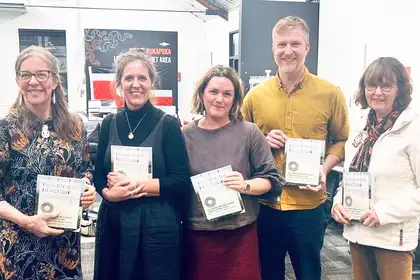
From left: MP Celia Wade-Brown, Masterton District Councillor Stella Lennox, Professor Kelly Dombroski, Thomas Nash and Greater Wellington Regional Councillor Adrienne Staples at the Wairarapa guidebook launch.
Transitions in Action: An Urban and Regional Guide for Te Upoko o te Ika Wellington documents a raft of future-focused actions already transforming the capital including car-sharing, not-for-profit electricity supply to address energy hardship, co-housing and suburban vegetable growing.
The guidebook is co-authored by a multidisciplinary team including Professor Kelly Dombroski and Social Entrepreneur in Residence Thomas Nash from Massey University’s School of People, Environment and Planning, Amanda Yates from Auckland University of Technology and Gradon Diprose from Manaaki Whenua Landcare Research. The guidebook presents an ambitious yet grounded vision for transforming the region through community-driven, place-based innovation.
Launched in March, Transitions in Action is a dynamic field guide to the future. Drawing on the stories of over 30 initiatives across the wider Wellington region, the guidebook maps how communities, iwi, local businesses and organisations are already reshaping the fabric of urban life in response to climate change, inequality and housing pressures.
A Massey-driven contribution to urban transformation
Professor Dombroski and Mr Nash’s contributions to the guidebook reflect the university’s ongoing commitment to research that supports real-world impact.
Professor Dombroski’s work centres on care, economies and urban ecologies. She has long been interested in how everyday practices and community relationships can generate large-scale change. Her role in the guide was to trace how such care-based transformations are already occurring across housing, transport, energy, food systems and beyond.
“Transitions aren’t linear. What we’re seeing in Wellington is a web of interlinked, often grassroots-led efforts that are already demonstrating alternative futures. This guide doesn’t prescribe a single pathway – it highlights multiple routes forward, rooted in local knowledge, mana whenua leadership and the mauri of place.”
For Mr Nash, the work provided an opportunity to elevate examples of economic and governance models that challenge extractive norms.
“We’re seeing a new generation of enterprises in which doing good is not a Corporate Social Responsibility add-on, it’s baked into core operations. These initiatives show us what it means to build resilience, equity and environmental care into the DNA of how our cities and regions function.”
The six transition arenas
The guide is structured around six ‘transition arenas’ identified as crucial leverage points for regional change: transport, community, economy, energy, environment and housing.
Within each arena, the authors showcase real-world examples of transformation already taking place:
- Transport: Initiatives like Mevo’s car-share network reduce car dependency while expanding equitable access to low-carbon mobility.
- Community: Organisations like the Common Unity Project in Lower Hutt demonstrate how localised food production, education and circular economies can rebuild social fabric.
- Economy: Enterprises such as Toast Electric are reshaping the energy market by prioritising affordability, community ownership and decarbonisation.
- Environment: Projects working to regenerate urban rivers and coastlines embody a mauri-first approach to ecological care.
- Housing and Energy: Community-led housing developments, off-grid infrastructure and co-housing models offer scalable alternatives to speculative urban development.
These examples represent a pattern of what the authors call ‘living transitions’ – shifts that are emergent, iterative and relational, rather than linear or top-down.
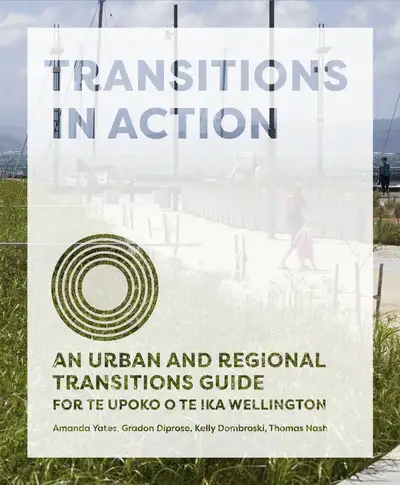
The guidebook.
Place-cased and mauri-centred
A core strength of Transitions in Action is its anchoring in te ao Māori concepts, particularly mauri – the vital essence that connects people, land and life. Rather than viewing housing, transport and energy in isolation, the guide adopts a systems approach grounded in mauri enhancement. This lens enables the authors to centre intergenerational wellbeing, collective stewardship and reciprocity in their analysis.
Professor Dombroski says, “A focus on mauri helps us think beyond metrics and targets to consider the lived experience of places and communities. It asks is life flourishing here? Are relationships – between people, land and institutions – being nurtured or depleted?”
This approach aligns with Massey’s wider strategic emphasis on kaupapa Māori-led research and sustainability science.
A resource for change-makers
Supported by the Building Better Homes, Towns and Cities National Science Challenge, the guide is available for free online and is designed to be used by a wide range of audiences, from policymakers and planners to community organisers, iwi and educators.
Mr Nash says the hope is that the book inspires more coordinated thinking and doing amongst and between communities and regions in Aotearoa New Zealand. He also invites other regions to produce their own versions of the guide, profiling similar businesses and organisations working towards this transition in their regions.
“The future is not something we wait for. It’s something we create together as people, organisations, businesses, mana whenua – right now – with the tools and knowledge we already have.”
Read Transitions in Action: An Urban and Regional Guide for Te Upoko o te Ika Wellington (PDF).
Related news
Transforming Wellington the aim of new field guide
A field guide to transforming Wellington into a sustainable place of wellbeing for people and the environment is being produced by the School of People, Environment and Planning.
Opinion: Our economy is inseparable from our environment and students deserve to learn that
By Social Entrepreneur-in-Residence Thomas Nash