A study led by Te Kunenga ki Pūrehuroa Massey University’s Food Experience and Sensory Testing (Feast) Laboratory, in collaboration with Lincoln University and Bragato Research Institute, explored how different levels of key aroma compounds influence consumer preference and the typical style of some of New Zealand’s most popular white wines.
At the centre of the research are varietal thiols, volatile sulphur compounds best known for delivering tropical fruit, citrus and green aromas within the wine. In the right balance, thiols are part of what makes Marlborough Sauvignon Blanc famous worldwide, contributing to freshness and appeal. But like seasoning in a meal, more is not always better.
“While winemakers can influence thiol levels through decisions such as yeast selection and grape-processing techniques, at high levels, these aromas can become overpowering. Until now, it hasn’t been clear where consumer enjoyment peaks,” principal investigator Dr Amanda Dupas de Matos explains.
To investigate, Lincoln University co-principal investigator Dr Leandro Dias Araujo produced nine white wines across three varietals - Sauvignon Blanc, Chardonnay and Pinot Gris – each made at low, medium and high thiol concentrations. An expert panel at the Bragato Research Institute, led by Ngarita Warden, developed a detailed sensory lexicon, providing a structured way to describe the wines’ aromas, flavours and overall character.
Regular white wine drinkers evaluated the wines at Massey University’s Feast Laboratory over two tasting sessions, one week apart. In the first, participants tasted the wines blindly, without knowing the varietal. In the second, they were told the grape variety before tasting again.
The results revealed there was a clear sensory ceiling for Sauvignon Blanc. Wines with high thiol levels were perceived as less typical than those with lower concentrations and were sometimes mistaken for Chardonnay when tasted blind. High-thiol Sauvignon Blancs also triggered negative descriptors such as ‘sweaty’ and ‘cooked vegetable’.
“These findings suggest there is a point behind which the signature character of a variety begins to lose its identity,” Dr Dupas de Matos says.
When participants knew they were tasting Sauvignon Blanc, expected descriptors like ‘herbaceous’ and ‘citrus’ appeared more frequently, although some negative reactions such as ‘bored’ persisted.
For Chardonnay, thiol concentration did not significantly change perceptions on whether the wines tasted like their grape variety. When tasted blind, Chardonnay wines were associated with positive attributes such as ‘passionfruit’, ‘citrus’, and emotions like ‘interested’ and ‘secure’. Once identified as Chardonnay, perceptions often shifted in a more negative direction.
“This was an interesting finding as it points to a lingering image problem rather than an issue with the sensory profile of the wine itself,” Dr Dupas de Matos explains.
In Pinot Gris wines, differences in thiol levels did not affect whether people thought the wine tasted typically Pinot Gris, and knowing the grape variety had little effect on how they experienced the wine.
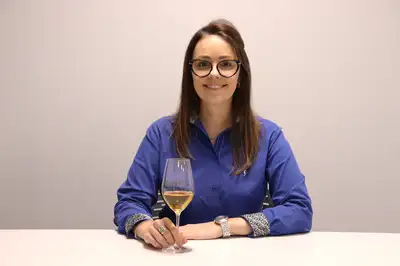
Senior Researcher at Feast Dr Amanda Dupas de Matos.
Dr Leandro Dias Araujo is leading the chemical characterisation of the wines to link aroma composition and concentration with consumer responses.
Together, the findings offer practical insights for an industry navigating both economic pressures and environmental change.
“By understanding how consumers respond when white wine styles are pushed to their limits, we can map the sensory white wine space and support winemakers to navigate fine-tuning aroma levels that enhance enjoyment without overwhelming the palate,” Dr Dupas de Matos says.
ABOUT FEAST
The Food Experience and Sensory Testing laboratory is a hub for sensory and consumer research, training and consultancy. Feast drive consumer and sensory science forward by challenging traditional thinking, creating innovative research and expertise renowned worldwide. Located on Massey University’s Manawatū campus in Palmerston North, Feast has New Zealand’s only wall-to-wall projected immersive space for consumer sensory product testing. Using this technology, Feast can study human behaviour and perceptions in various settings, including a café, supermarket, and more.
Related news
Massey researcher wins $100k to research thiols in white wine
Senior Research Officer Dr Amanda Dupas de Matos will explore how thiols in white wine affect consumer perceptions and wine typicality.
Pop the bottle: turning green into gold for Kiwi winemakers
Turning wine grapes destined to rot on the ground into value-added products is the focus of a new research project led by Dr Amanda Dupas de Matos, Consumer Sensory Researcher in the Food Experience and Sensory Tasting laboratory , aimed at helping winemakers reduce the amount of grapes going to waste.
Pivot Award for juniper berry research
The juniper berry - synonymous with gin - is the focus of Massey University research to evaluate and identify suitable strains and propagation methods with potential to give New Zealand-made gins a unique sensory signature.