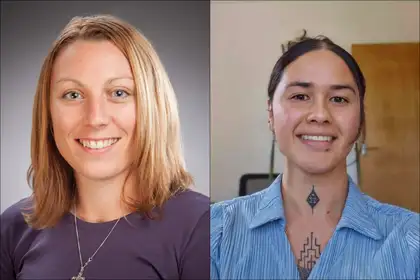
Senior Lecturer Dr Corinne Bareham-Waldock and Ebony Komene
A study exploring how brain monitoring technology could better support people with serious brain injuries took an unexpected turn.
Psychology Senior Lecturer Dr Corinne Bareham-Waldock says the change in direction came after recognising Māori are overrepresented in traumatic brain injury statistics.
"When I discovered that Māori are overrepresented in the traumatic brain injury population, I realised that I first needed to establish a culturally safe electroencephalogram protocol to work with patients in Aotearoa."
Following this realisation, the research shifted to understanding Māori experiences of neuroimaging and working alongside Māori to co-design practical guidance that could improve healthcare for whānau across Aotearoa.
As discussions with research collaborator and lead author Ebony Komene from Waipapa Taumata Rau University of Auckland progressed, the researchers began looking for existing guidance on culturally safe neuroimaging.
"We were surprised to find there were no guidelines available for health practitioners or researchers conducting neuroimaging in Aotearoa," Dr Bareham-Waldock says.
That discovery prompted the team to investigate Māori experiences of neuroimaging and identify opportunities to better support patients and their whānau.
Rather than researchers developing recommendations independently, the project was undertaken in partnership with Te Whare o Te Amorangi, Māori researchers and Māori participants, who worked alongside the wider research team to co-design the final framework. Their lived experiences and perspectives helped shape the recommendations.
"The aim is for whānau voices to be heard. It is important to ensure that the guidelines capture lived experiences to ensure the authenticity of the recommendations."
For one participant, the research offered an opportunity to help others avoid the experiences their own whānau had faced following a brain injury. They told the researchers they wished guidance like this had existed when their whānau member was receiving care.
The resulting framework provides practical guidance for healthcare professionals before, during and after neuroimaging. It encourages practitioners to build relationships with patients and whānau, communicate clearly throughout the process and create opportunities to incorporate tikanga, such as offering karakia, inviting whānau to be present where appropriate and ensuring participants understand each stage of the procedure.
Dr Bareham-Waldock says the recommendations have relevance beyond neuroimaging.
"We hope health practitioners find the guidelines helpful to better understand Te Ao Māori and the cultural needs and considerations surrounding health practices, not just neuroimaging."
The framework encourages a whānau-focused approach that can help Māori feel safer, better informed and more supported throughout their healthcare journey. The recommendations recognise that improving healthcare experiences is not only about increasing access to services, but also about building trusting relationships between healthcare professionals, patients and whānau.
Dr Bareham-Waldock says the research also demonstrates the value of genuine partnership.
"We have an obligation to partner with Māori under Te Tiriti. I think all health and research practices should therefore be co-designed with Māori. It should have been done this way in the first place."
The team hopes to transform the framework into a practical teaching resource for health programmes, including nursing and radiology, while recognising the principles can be applied across many areas of healthcare.
"The key really is Whakawhanaungatanga [relationship building]. The goal isn't to find one approach that works for everyone. It's to build healthcare and research systems that support Māori aspirations while creating space for different communities to define and pursue what matters most to them.”
Related news
Research highlights how teachers use data to improve learning
Teachers across Aotearoa New Zealand are using a range of information to support student learning, but new research suggests a stronger collaboration and shared approach could help schools make better use of data.
Learning from communities to better serve communities
Future clinical psychologists at Te Kunenga ki Pūrehuroa Massey University are learning directly from Pasifika communities as part of a unique annual event designed to strengthen culturally responsive mental health care in Aotearoa New Zealand.
The need for lived experience in psychology education
To eradicate mental health stigma and discrimination, people who have lived experience of mental distress should be included in the training and education of mental health providers, but this isn’t always the case.