
The world’s biggest challenges, such as climate change, food insecurity and community resilience can’t be solved by one person or skill alone. It takes everyone, working and bringing together diverse points of view. These new qualifications draw on expertise from across Te Kunenga ki Pūrehuroa Massey University.
The new qualifications offer students the opportunity to personalise their study. They can combine and explore their favourite subjects with experts from across the sciences, business, health and social sciences at Massey. Students will also develop complementary skills and extend their expertise within a chosen area of focus. The qualifications also include project-based learning to develop the skills needed to create positive change in an increasingly complex world. This flexibility ensures that an individual student’s qualification reflects their career goals and aspirations.
Graduates of the Impact and Innovation qualifications will develop a set of highly transferable skills that are increasingly valued in today’s employment environment. This includes the ability to collaborate in teams across disciplines and cultures, think critically and systemically about complex issues and approach solutions with creativity and adaptability.
Building on Massey’s position among the world’s top 100 universities, and first in Aotearoa New Zealand, for sustainability impact in the 2026 Times Higher Education Impact Rankings, the new qualification will prepare graduates to address the environmental, social and economic challenges facing communities in New Zealand and beyond.
Bachelor of Impact and Innovation
The Bachelor of Impact and Innovation is a three-year, project-based degree that combines academic learning with hands-on experience tackling real-world issues.
Students will work collaboratively to investigate complex challenges, develop and test solutions and receive ongoing feedback as they refine their ideas. Projects will explore topics such as community wellbeing, technological innovation, sustainability and ethical decision-making.
The degree offers three majors:
- Food Systems – exploring sustainable, equitable and resilient food futures
- Climate Action – developing practical solutions to climate change, from emissions reduction to adaptation planning
- Resilient Communities – examining how communities can adapt and thrive in the face of social, environmental and economic change.
Students will also have significant flexibility to personalise their studies through courses drawn from across the university, with their degree culminating in a major project focused on an issue they are passionate about.
Learning beyond the classroom
Associate Professor Nicola Brown who helped develop the qualification says industry and community engagement is a defining feature of the qualification.
“Students will participate in co-designed projects with organisations, communities and industry partners, gaining valuable experience in real-world settings. Through these experiences, they will develop skills in ethical decision-making, stakeholder engagement and project management, allowing them to respond confidently to emerging challenges.
“Many of tomorrow’s careers don’t exist yet, but the Impact and Innovation qualification is designed to prepare students not just for a job, but for a future where adaptability, creativity and collaboration will matter more than ever.”
Graduates will be well placed for careers in sustainability, policy, community development, social innovation, programme delivery, central and local government, non-profit organisations and industry. They will also possess the adaptable skills needed to take on new career pathways.
Postgraduate study
The Postgraduate Diploma of Impact and Innovation and Master of Impact and Innovation are designed for graduates seeking to lead change in complex environments and work across traditional disciplinary boundaries.
Students can specialise in:
- Climate Futures – exploring climate action from global policy and finance to Indigenous knowledge and community-led responses
- Future Food – examining the future of food systems through science, business, sustainability and consumer perspectives
- Planetary Health – investigating the connections between environmental change and human health
- Circular Economies – available from 2028.
The master’s programme further develops advanced transdisciplinary skills and includes a substantial applied component through a final project, work-integrated learning placement or independent research report.
Graduates will leave equipped to work across sectors, cultures and communities, applying their knowledge to develop solutions that create meaningful and lasting impact.
Interested in shaping a more sustainable and resilient future? Explore the programme webpages to learn more about study options, majors, entry requirements and career pathways:
Bachelor of Impact and Innovation
Related news
Massey’s Bachelor of Science to include a Sustainable Climate Systems Major in 2026
A new applied science major focused on creating real, sustainable solutions to climate change will be added to the Bachelor of Science this year, helping prepare tomorrow’s climate leaders for a changing world.
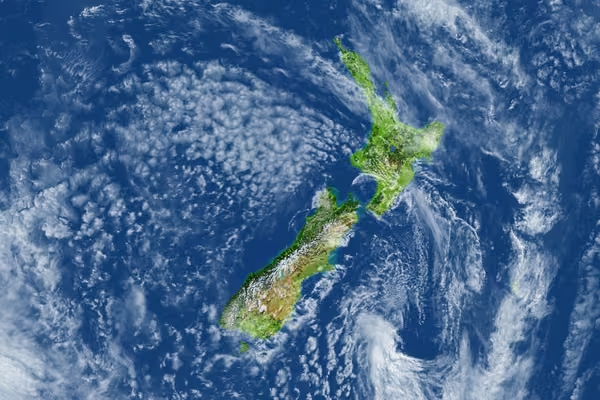
Propagating success with updated degree offering new pathways for horticulture careers
Te Kunenga ki Pūrehuroa Massey University’s Bachelor of Horticultural and Plant Systems has been introduced as an updated qualification designed to help students harness the power of plants, shape the future of sustainable plant-based food systems and meet the needs of Aotearoa New Zealand’s thriving horticultural industries.
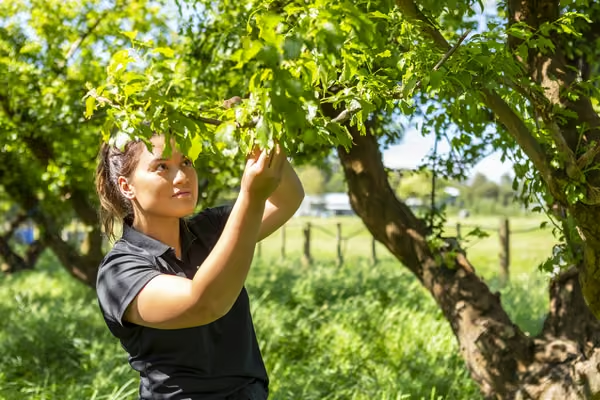
New artificial intelligence major set to launch in 2026
A new major spotlighting artificial intelligence (AI) will be added to the Bachelor of Information Sciences in 2026, helping prepare tomorrow’s technology leaders for a changing world.