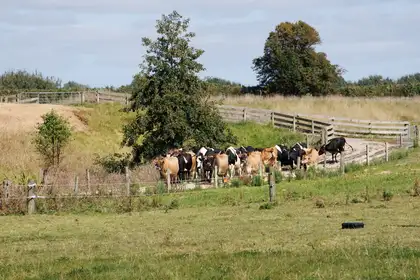
Remove dairy, sheep and beef herds from grazing pasture across New Zealand and our farms, exports and rural communities would look completely different. Production animals, from pigs and poultry to sheep and dairy cows, drive our primary output and underpin much of our national prosperity.
Outside New Zealand, agriculture is often imagined as mixed farming or cropping-heavy, but here it is overwhelmingly animal-based. Animal production science helps keeps the system thriving.
Most of New Zealand’s farmland is grazing land; our landscapes and climate aren’t suited to large-scale grain crops. That means decisions about animal nutrition, genetics, reproduction, health and welfare are not peripheral considerations for us; they are fundamental to how most farms operate and succeed. Understanding the animal is essential to understanding the farm.
Animal production science has been one of the most powerful drivers of productivity in modern agriculture. Research into genetics, nutrition, growth, reproduction, meat science and health has enabled farmers to produce more food with fewer resources. Productivity per animal and per hectare have increased in all our ruminant systems and our understanding and management of animal health has improved dramatically. These gains are the result of decades of sustained investment in applied animal production science, grounded in real farming systems.
You cannot reduce emissions without understanding animal nutrition. You cannot improve welfare without evidence-based insights into behaviour and health. You cannot design resilient farming systems without integrating the animal, the pasture and the environment. Animal production science needs to work alongside the disciplines of pastoral science, agronomy, soil science and farm management if we are to manage our ruminant production systems and environments effectively.
Animal production science underpins many of New Zealand agriculture’s biggest challenges, from reducing greenhouse gas emissions and nutrient losses to improving productivity, animal welfare and climate resilience.
Encouragingly, the next generation is recognising this, with strong demand for agricultural and animal science programmes. We’ve seen a significant increase in students enrolling in these subjects at Te Kunenga ki Pūrehuroa Massey University this year. Postgraduate demand is particularly strong, with over 290 students pursuing diverse research projects that reflect the complexity of modern farming systems and a strong appetite for practical, on-the-ground solutions.
More students are choosing flexible, distance-based study options, providing a cost-effective way into higher education while continuing to work in the regions and industries they want to be part of. They don’t have to step away from agriculture to study it; they are studying while living it.

Professor Paul Kenyon
We have also designed professional development courses for secondary school teachers, recognising that agricultural capability must be built not only on farms and in universities, but throughout the education system. Providing teachers with the tools to foster interest and passion for agriculture early will help develop the next generation of agricultural leaders and problem solvers.
Massey occupies a unique space, with the country’s only veterinary school embedded alongside agricultural and animal production science expertise, as well as food technology, creating a powerful ecosystem for teaching, research and industry engagement. Massey’s animal science group is one of the largest in the southern hemisphere focused on pastoral production systems, ensuring productivity, animal health and welfare are considered together, rather than in isolation. The school aims to teach how the animal industries can increase both productivity and profitability, but in a sustainable and responsible manner.
To ensure New Zealand’s pastoral food systems remain productive, sustainable and resilient, we must continue to invest in animal production science, train the next generation and recognise the central role animals play in shaping our agricultural future.
Professor Paul Kenyon is the Head of the School of Agriculture and Environment, and a Professor in Sheep Husbandry at Te Kunenga ki Pūrehuroa Massey University.
Related news
Opinion: How to breed ewe hoggets successfully in today’s high lamb price environment
By Professor Paul Kenyon
New courses to upskill agriculture teachers to launch next year
A new collaborative initiative to upskill secondary school teachers in agriculture-related subjects is set to launch next year to meet unprecedented demand.
Massey leading tertiary education and research for NZ’s primary industries
By Professor Paul Kenyon