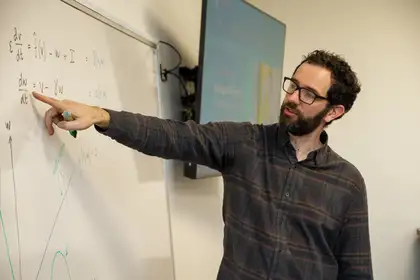
Dr Richard Brown.
Recent reporting on the gender divide in university mathematics highlights a reality those of us who teach first-year courses recognise well: women and gender-diverse students remain underrepresented, and the adverse social climate reported by students, including the fear of speaking up lest they ‘look dumb’ in front of male classmates, is real.
As someone who has taught first-year mathematics since 2009, largely to engineering cohorts, I am well-acquainted with these social dynamics. In many typical courses, male students tend to dominate discussions in the classroom or at the tutorial table, while other students seem to modify their behaviour or hold back.
However, the wider picture at Te Kunenga ki Pūrehuroa Massey University offers interesting insights. Enrolment data for 2025 shows that 61 per cent of students taking first-year courses that meet mathematics requirements identify as female, with early 2026 data suggesting a similar pattern. While participation in individual courses varies, women are well-represented across our introductory offerings.
One course in particular offers an intriguing case study.
I have taught Biophysical Principles since its inception in 2020. It is the core mathematics and physics course for students hoping to enter Massey’s highly competitive veterinary science programme. Because the pre-veterinary student cohort has a strong female majority, the class is around 80 per cent female.
While the enrolment of students in this course may not reflect the trend of female underrepresentation observed elsewhere, it provides a valuable glimpse into how classroom dynamics shift when the demographic balance changes.
In this course, I rarely observe the exclusionary behaviours we associate with gender and mathematics. I don’t see female and non-binary students holding back. If anything, I see the reverse: male students adjusting their behaviour to fit the collaborative tone and dynamics of a predominantly female class. As a father of two teenage daughters, I’d love for this to be representative of the learning environments they experience.
But even if we get the classroom environment right, we face another distinct challenge: students still bring their “maths trauma” with them from high school.
We have to fight the persistent narrative that mathematics is inherently unpleasant, or limited to a select few. Many students arrive at university believing maths is a subject to endure rather than to explore, a necessary evil on the road to their degree. This attitude is commonly cemented by students’ experience of assessment at high school.
Changing that perception before students reach us is critical. At Massey, we run various outreach activities to show that mathematics can be creative and engaging, such as the Massey STEM Day for Year 12 and 13 students, and the M3S Competition for NCEA Level 2 students.
But the most impactful outreach experiences happen with younger students during campus visits from Year 10 classes. We set up a classroom where we combine games with non-trivial mathematical insights. The most common feedback we get is genuine surprise at how much the students, and their teachers, enjoyed the session.
That reaction reminds us that students’ attitudes towards mathematics, and who belongs in a maths classroom, are not fixed. They shift depending on the culture of the classroom, and the stories we tell students about what the subject actually is.
Changing participation in maths is not just about who enrols, but about the environments we create and the expectations we set long before students arrive at university – helping them see maths not just as a requirement, but as an opportunity.
Dr Richard Brown is a Senior Lecturer in Mathematics in the School of Mathematical and Computational Sciences at Te Kunenga ki Pūrehuroa Massey University.
Related news
Using artificial intelligence to unlock how the brain recalls memories
A recent study combining neuroscience and artificial intelligence (AI) sheds new light on how memory-related regions of the brain communicate, laying important groundwork for future research into memory disorders.

New artificial intelligence major set to launch in 2026
A new major spotlighting artificial intelligence (AI) will be added to the Bachelor of Information Sciences in 2026, helping prepare tomorrow’s technology leaders for a changing world.

Distinguished Professor Gaven Martin awarded Jones Medal for groundbreaking mathematical work
Distinguished Professor Gaven Martin FRSNZ has been awarded the Jones Medal by the Royal Society Te Apārangi in recognition of his contributions to mathematics.