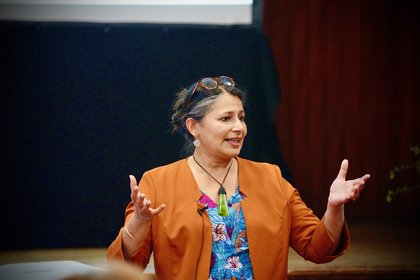
Associate Professor Sita Venkateswar.
Where one stands shapes what one sees. As an anthropologist of South Asia who has lived and worked in Aotearoa New Zealand since 1997, as Tangata Tiriti — a person here by virtue of Te Tiriti o Waitangi — I read the visit of Indian Prime Minister Narendra Modi through the lives that have unfolded across the forty years since an Indian leader last stood on New Zealand soil, my own among them.
Across those decades the relationship has been carried not by leaders but by people: students and migrants, nurses and farmers, shopkeepers, software engineers and scholars, and an Indian community grown into one of this country's largest. This visit does not create the relationship; it recognises one that people have spent decades building, and that is precisely why it matters.
Recognition, though, is only a beginning. The real test is whether a historic visit becomes a historic turn. Relationships are sustained the way all relationships are — kanohi ki te kanohi, face to face, at regular intervals rather than once in a generation. A five-year partnership roadmap with an annual leaders' review would make the next meeting a matter of calendar rather than history — perhaps the single most consequential thing this visit could leave behind.
The Free Trade Agreement gives the visit its practical horizon: preferential access for 95 per cent of New Zealand's exports over time, 57 per cent tariff-free from day one. But let me offer a caution from three decades of working in and with India. Market access is a legal fact; market success is a relational achievement, and the distance between them is measured in patience and cultural literacy. Having built a Massey–Kolkata scholarly exchange since 2002, I say this from experience: what makes such things work is the slow accumulation of trust. India is not one market but many, and the firms that flourish are those that learn the particular — an understanding New Zealand must invest in as deliberately as it invests in logistics.
The areas of greatest potential lie beneath trade and will outlast it: knowledge, relationship, and the young. The Treaty of Waitangi policy space the agreement protects should be read as an invitation, not a footnote — and the most far-reaching possibility is a meeting of knowledge traditions, kaitiakitanga in dialogue with India's own long traditions of commons stewardship, which on this side must be Māori-led if it is to be substantive rather than ceremonial.
One example already sits within the agreement: a formal pathway for rongoā practitioners to engage with India's AYUSH systems. What makes these traditions kin is not equal antiquity but a shared understanding that health is a relationship among people, land and water, and that such knowledge is held in trust. Yet a framework is only a promise. Its keeping will depend on whether rongoā practitioners themselves — as kaitiaki, not stakeholders consulted after the fact — lead the design of any exchange, and, as Sir Mason Durie reminds us, whether its effectiveness remains a matter for healers to determine. Trade in goods will fill the headlines; whether this agreement also becomes a vessel for knowledge exchanged with care may prove its deeper legacy.
Agriculture offers the same test: most of India's farmers work smallholdings, and the question is whether new technologies arrive as the smallholder's instrument or over her head. Both countries carry answers — New Zealand's flagship agricultural institution is farmer-owned, and India gave the world Amul — and the collaboration worth having is farmer-owned, affordable, and co-developed rather than merely delivered.
The partnership sits, too, within a wider ocean. The late Tongan scholar Epeli Hauʻofa taught us to see the Pacific not as scattered islands but as a sea that connects. New Zealand's value to India here is not as a gateway to Oceania; the Pacific is not a gateway but a neighbourhood of sovereign peoples, whose priorities must shape any engagement that reaches into it.
A relationship is only as honest as its record-keeping. Both governments have told us how they wish to be measured; judge the partnership by who it reaches. Publish the data, report outcomes every six months, and say plainly what has been delivered and what has not. In my discipline, the test of any arrangement is not its declarations but its consequences in particular lives. The ancient word for this was practical wisdom; the modern word is accountability; the oldest of all is flourishing. Transparency is not the garnish on a partnership. It is the soil in which trust grows.
I opened an essay twenty years ago with a Māori adage: te haro o te kahu — look beyond the horizon, to the expansive view seen through the eyes of the hawk. That is the gaze this moment asks of both capitals: past the news cycle of a single visit, toward what these societies might build across a generation. And I closed that essay with another, which I offer now to New Delhi and Wellington alike: kanohi ki kanohi, pokohiwi ki pokohiwi, ka whawhai tonu atu — face to face, shoulder to shoulder, striving together without end.
The ground has been prepared, some of it over forty years, some of it over centuries. Now it must be tended.
Associate Professor Sita Venkateswar’s research documents the ways academic practices can be responsive to social inequities. She is a doctoral supervisor in the School of People, Environment and Planning at Te Kunenga ki Pūrehuroa Massey University.
Related news
Exploring diversity within Aotearoa New Zealand’s Indian diaspora
A national survey exploring diversity within the Indian diaspora in New Zealand is about to be launched by two Massey researchers.
Research focus on Taranaki’s sustainable food producers
Massey researchers have been collaborating with local sustainable food growers in dairy stronghold Taranaki amid pressures to diversify the nation's farming practices.
Urban farming the focus of $100,000 research award
An urban farming initiative is at the centre of the first $100,000 Pivot Award, a premier research award aimed at enabling innovation in Taranaki's agriculture sector.