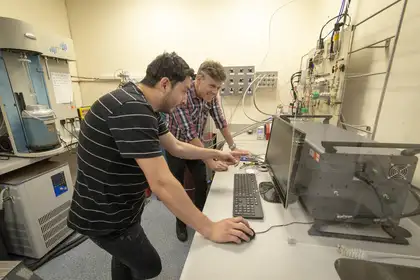
Massey PhD student Omid Taheri and Shane Telfer
What a moment for those of us who love metal-organic frameworks (MOFs) with the 2025 Nobel Prize in Chemistry being awarded to three pioneers in the field: Richard Robson, Susumu Kitagawa, and Omar Yaghi.
I feel honoured to have these outstanding scientists as colleagues. Susumu was a kind and generous host when I visited Kyoto for a couple of months in 2007, just as I was getting into MOF research and growing my team at Massey. And when I chaired the MOF-2018 conference in Auckland, we had the pleasure of bringing Richard and Omar together to open the event, and have Susumu deliver the after-dinner speech.
What are MOFs? Crystalline sponges with networks of tiny pores. Rather than being dense and impervious, like a salt crystal for example, MOFs can host molecules in their pores. The allows them to do cool stuff like separate mixtures (by selectively capturing one molecule), catalyse reactions, and deliver payloads by slowly releasing trapped molecules.
The design of MOFs is where chemistry meets art. They are truly beautiful crystalline structures, with their functional properties that stem from the building blocks that are used to construct them. Chemists, our three new Nobel laureates and many others inspired by them, have been able to design MOFs with spectacular properties by getting these building blocks to assemble in the right way. As the Royal Swedish Academy of Sciences which dedicates Nobel prizes, states in its media release;
“MOFs may contribute to solving some of humankind’s greatest challenges, with applications that include separating PFAS (fluoroplastics which resist nearly all chemicals and solvents) from water, breaking down traces of pharmaceuticals in the environment, capturing carbon dioxide or harvesting water from desert air.”
MOFs have been my research passion for the past 20 years because they combine two things that I love: making new stuff in the lab (technically known as synthesis) and blasting things with X-rays to determine their atomic structures (technically known as crystallography). Derek Lowe expresses it beautifully “I don’t think I’ve ever had more fun in the lab than when I was doing this, honestly.” It’s been a privilege for my team to contribute in a small way to this field, and to see one of our discoveries, MUF-16 (MUF = Massey University Framework), commercialised for CO₂ capture via Captivate Technology. Our own research truly stands on the shoulders of these giants.
Professor Shane Telfer is a Professor in Chemistry in the School of Food Technology and Natural Sciences, Te Kunenga ki Pūrehuroa Massey University.
Related news
Massey researcher named in prestigious UK science award
Professor Shane Telfer from the School of Food Technology and Natural Sciences is part of a global science group who have won the prestigious UK Royal Society of Chemistry prize for creating a new type of glass.