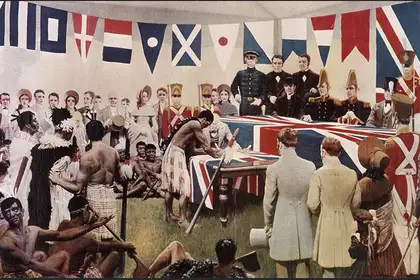
Marcus King, Reconstruction of the Signing of the Treaty of Waitangi 1840, 1939, photograph of painting.
Imagine waking up one morning and finding yourself on billboards across the nation promoting a political campaign that is the antithesis of everything you believe in. Well done, then, to Hobson’s Pledge (HP), which has put Rotorua kuia Ellen Tamati in exactly that position by using an image of her in its campaign against the retention of Māori wards and constituencies. It’s a telling episode, and it reflects appallingly on the moral compass of those associated with HP.
Well, that told us a lot
HP cannot be ignorant of how challenging the forthcoming referendum on Māori wards and constituencies, which central government has forced on local communities, is for Māori. Nonetheless, it was quite happy to use a ‘generic’ image of a wāhine Māori carrying moko kauae and attribute a political position to her that is diametrically opposed to the one that she actually holds. Quite happy to create and disseminate the impression, by using first person statements as if they were her own words, that Mrs Tamati had chosen to participate in its campaign against Māori wards and constituencies.
The manipulation, lack of respect and carelessness are breathtaking. Any organisation with even a modicum of integrity would have ensured that the person behind the image did, in fact, agree with the political statement being put into their mouth. Which surely shouldn’t have been all that hard to do, given HP spokesperson Don Brash’s insistence that there are Māori out there who are opposed to the retention of Māori wards and constituencies. So why not approach them to front HP’s campaign? If they actually exist, that should have been easy enough.
Epic fail
HP’s conduct is the sort of sloppy behaviour that we don’t accept from students at our wānanga, schools, universities and polytechs. Playing fast and loose with the truth; misattributing words; distorting or failing to check your sources. Making stuff up. It’s not quite plagiarism, nor exactly cheating, but it’s shabby and unacceptable. Try this sort of thing where I work and you’d be lucky to get away with a D grade.
Learn some history
Behind all of this sits a deeper issue, which concerns the veracity of the so-called pledge which HP clings to. Ironically, the claim that Lieutenant Governor Hobson allegedly made following the signing of Te Tiriti o Waitangi in 1840 ‘He iwi tahi tātou’, translated as ‘We are now one people’, is perhaps the only aspect of the debate around te Tiriti that the sort of person attracted to HP is dead keen on. The rest of it, tino rangatiratanga etc not so much.
Obviously, Hobson did not foresee all of the ways in which Māori would subsequently be treated differently; the confiscation of land; removal of property rights; suppression of language (and voting rights); treatment as second-class citizens in their own land etc.
Moreover, the only verifiable evidence that Hobson ever uttered those words ‘He iwi tahi tātou’ is from a book written by the mission printer William Colenso, The Authentic and Genuine History of the Signing of the Treaty of Waitangi. However, this account was published in 1890, fully half a century after the treaty signing, and when Colenso himself was 80. No other surviving historical source corroborates Colenso’s claim, including the document compiled at the request of the New Zealand Parliament 25 years earlier, by William Baker, a translator for the Native Department. Hobson might or might not have said what Colenso put into his mouth. We have only the recollections of one 80 year old man, 50 years after the event, to rely on.
Curiously, neither Colenso nor anyone else seems to have had anything to say about what the other people in the room at the time, including the dozens of Māori Rangatira, had to say about the matter. It is odd (and unscientific) that the views of just one of those assembled should be recorded for posterity and strange that this person’s view on the matter has since been given such a clear run. It’s what you might call confirmation bias.
Which brings us all the way back to HP’s shabby conduct. HP is terribly enthusiastic about treating all people equally, but not above weaponising ethnicity, which is what makes us distinctive, when it suits their misguided purposes. I’m so looking forward to the use of some ‘generic’ farmer’s image when, consistent with its support for the principle of all people being treated equally, HP releases its campaign against rural wards. The lobby group’s misappropriation of a kuia’s photo clearly demonstrates that we are not one people at all. Some people have the resources to bankroll a campaign that is dishonest and lacks integrity; others have to deal with the hurt such mendacity causes. I doubt that this is what Hobson had in mind.
Professor Richard Shaw teaches politics in the College of Humanities and Social Sciences at Te Kunenga ki Pūrehuroa Massey University. He is a regular commentator on political issues and has published six books about New Zealand history and politics.
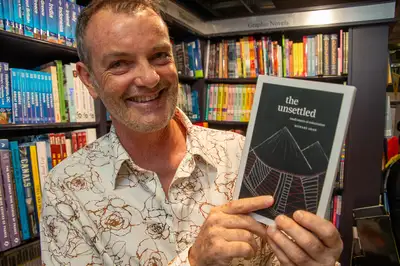
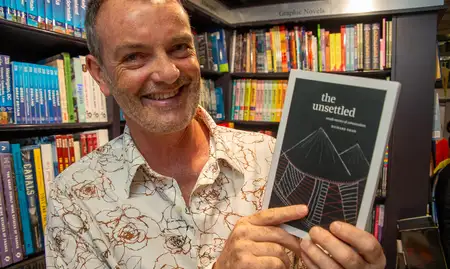
Professor Shaw with his latest book, the unsettled.
Related news

The Unsettled: Small stories of colonisation
Professor Richard Shaw’s latest book explores the historical and emotional territories of New Zealanders coming to terms with the ongoing aftermath of the New Zealand Wars.