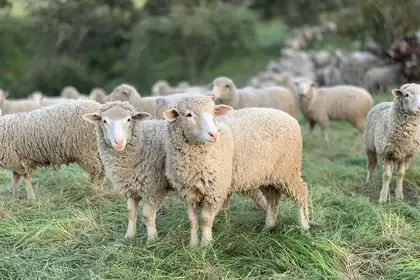
With lamb prices at record highs, many farmers are considering breeding their ewe hoggets for the first time. While this can increase the total number of lambs weaned and boost farm revenue, it doesn’t automatically mean greater profitability. Success depends on careful planning and management.
If you’re thinking about breeding hoggets, now is the time to have well-developed plan to maximise the chance of pregnancy and healthy lambs.
Key considerations for successful hogget breeding:
- Target weight and condition: Hoggets should be close to 70 per cent of their expected mature weight before mating, or at minimum 65 per cent. You can use the four-tooth ewe weight as a proxy for mature weight. Body condition scores of 2.5 or above are also recommended. Monitoring liveweights and adjusting feed levels now can make a significant difference.
- Animal health: Work with your local veterinarian to ensure a robust animal health plan, including vaccinations, is in in place.
- Encouraging cycling: Encourage cycling by introducing vasectomised “teaser” rams 17 days before breeding. Well-grown hoggets may benefit from an even earlier teaser exposure, for example, 34 or 51 days before mating. It is advised to use a teaser-to-hogget ratio of 1:100.
- Ram introduction: Use mature rams in smaller paddocks, at a ratio of 1:50, since hoggets are shy breeders. Avoid ram genotypes that produce very large lambs, as hoggets have an increased risk of birthing difficulties.
The most common challenge with hogget breeding is ensuring sufficient feed. Hoggets need to continue growing during pregnancy, gaining at least 130 grams per day to maximise lamb survival and maintain their suitability for rebreeding as two tooths.
Te Kunenga ki Pūrehuroa Massey University modelling shows that, in many cases, farmers can adjust mature ewe numbers to maintain feed availability and still improve profitability by breeding hoggets. However, research also indicates that if mature ewe weaning percentages are below 150 per cent, it may be better to focus on improving mature ewe performance before introducing hogget breeding.
Our research at Massey underscores the importance of evidence-based decision-making in agriculture. While high lamb prices are tempting, breeding ewe hoggets can be a profitable way to increase farm productivity but only if done carefully, with proper feed, animal health and overall farm management.
Professor Paul Kenyon is the Head of the School of Agriculture and Environment, and a Professor in Sheep Husbandry at Te Kunenga ki Pūrehuroa Massey University.
Related news
New courses to upskill agriculture teachers to launch next year
A new collaborative initiative to upskill secondary school teachers in agriculture-related subjects is set to launch next year to meet unprecedented demand.
Minister Andrew Hoggard visits College of Sciences on Manawatū campus
Last Friday, the Minister for Biosecurity and Food Safety and Associate Minister of Agriculture, the honourable Andrew Hoggard, visited Massey’s Manawatū campus, hosted by the College of Sciences.
Massey leading tertiary education and research for NZ’s primary industries
By Professor Paul Kenyon