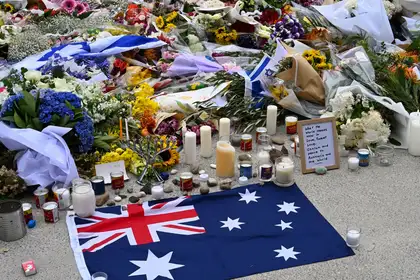
The attack on Jewish participants at a Hanukkah celebration at Sydney’s Bondi Beach is a tragic reminder of the risk public mass killings present to modern societies and the near impossible challenge of preventing all of them.
Any mass killing regardless of the perpetrators’ motives is a challenge to the state. Law enforcement and intelligence agencies purport to deliver a safe, secure and peaceful environment for their citizens. A careful and conscientious effort is undertaken to deliver on this promise – but it is a promise that simply cannot be completely fulfilled.
Security is the acceptance that we are safe, regardless of whether we are. It is the illusion that police and intelligence agencies have the resources, people and knowledge to perfectly triage the genuine threats from the milieu of potential risks that exist. These often present as people resistant to authority, socially ill-fitting and often criminally violent. Others lurk in the darker encrypted spaces of the internet or in more open ones posting extremist and violent views using pseudonyms. These people occasionally surface to be more than their rhetoric but most of the time their risk to society is minimal.
Vastly more dangerous are the quiet and careful planners who watch for our vulnerabilities and are mindful that the police and intelligence agencies are looking for them. They are careful not to draw attention to themselves and work hard to circumvent the security measures deployed against them. Ultimately, they know the state’s limits in this regard – we cannot fully secure urban shopping centres and we cannot fortify a beach.
One of the Bondi perpetrators had failed to keep his head down. He was flagged for further investigation some years ago but was deemed not to be a concern at the time. Omar Mateen, perpetrator of the Orlando attack in 2016 was twice on an FBI watchlist and twice discounted as a potential threat before killing 49 people. Accurately divining a person’s future intentions is a devilishly difficult undertaking to pull off.
This week a man was sentenced for plotting a mass killing in Hawkes Bay last year. Similar interceptions of IS inspired plots in Germany and Poland in recent days demonstrate that searching for prospective threats is an effective means to stop them. However, the killings in Sydney demonstrate it simply does not work all the time.
The IRA riposte following the failure to kill British Prime Minister Margaret Thatcher in 1984 sums up the security challenge “We (the IRA) only have to be lucky once. You (the security services) will have to be lucky always.”
Successful plot interceptions get reported once or twice and then are easily forgotten. The success of the security services in these cases is understated, and the consequences avoided. They produce no graphic imagery and no memorable story. A mass killing on the other hand creates a media sensation, the event prompting day after day of copy, amplifying the act of terrorism.
Acting in the public interest to report an event, the media becomes the chronicler of the plot and with that an essential part of it.
Terrorism is a political challenge casting a brutal light on the limitations of the state to protect its citizens. It is a challenge politicians cannot resist. Israeli Prime Minister Benjamin Netanyahu pounced on the occasion to further his long running criticism of Australia’s policy on Gaza. Australian opposition politicians have accused its government of not doing ‘enough’ to curb antisemitism. The definition of ‘enough’ is not given, and detail on exactly what ‘enough’ will comprise is conspicuously lacking. The celebrations by certain individuals and groups in Australia after the 7 October 2023 attack on Israel were appalling, crass and incited anti-Israeli/Jewish feeling. But we need to think very carefully before proscribing speech, or topics of speech – and in determining the punishment to be meted out for it. In Russia prison terms are given for criticising Vladimir Putin. Is that the extent we want to go to?
Australia has also determined to review its gun regulations, which are already among the most restrictive in the world. Making it tougher on the vast bulk of law-abiding gun owners is unlikely to have any effect on terrorism occurrences in the future. The Lindt cafe attacker in 2014 acquired his firearm illegally. The Bondi attackers possessed improvised explosive devices. Firearms were not their only option.
There is no question the attack at Bondi was an atrocity. That one of the victims had survived the Nazi holocaust in Europe only to be killed at a beach in Australia in 2025 is a grim testament to the brutal tragedy that has taken place. But as one lone voice in Congress, Barbara Lee, warned in 2001, making rash decisions in the emotional aftermath of such a tragedy can have far reaching and unintended consequences.
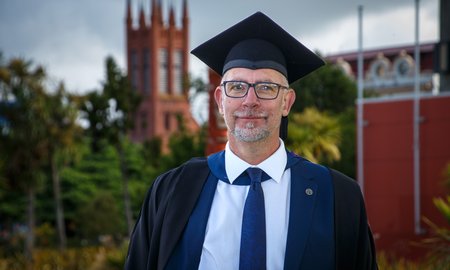
Dr John Battersby is a Senior Fellow in the Centre for Defence and Security Studies at Massey University, he teaches and researches in intelligence and counter-terrorism. He is Managing Editor of National Security Journal.
Related news
Opinion: The new bogeyman of Chinese foreign interference
By Dr John Battersby

Opinion: Why the SAS stepping in to find Tom Phillips shouldn’t shock anyone
By Dr Rhys Ball
A Master of International Security journey inspired by legacy
Master of International Security graduate Senior Sergeant Mark Currin found inspiration in his father's military career in the Royal New Zealand Navy. This ignited a determination to safeguard and fortify the safety and security of Aotearoa New Zealand.