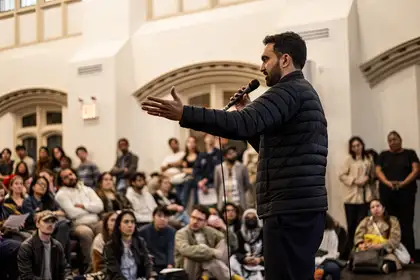
Zohran Mamdani speaking at a DSA 101 meeting at the Church of the Village in New York City, November 2024. Image credit: Bingjiefu He, CC BY-SA 4.0, via Wikimedia Commons.
The political earthquake has struck.
On the evening of November 4, 2025, the impossible became fact: Zohran Kwame Mamdani was declared the Mayor of New York City with 56% of the final ranked-choice vote. A 34-year-old, Ugandan-born, Indian-Muslim, DSA-endorsed State Assembly member is now the youngest mayor in modern city history, and his victory is far more than a statistic—it is the creation of an authentic, unapologetic socialist register in American politics.
This is not a story of political moderation; it is the triumph of an anti-fascist organising strategy that refused to be silenced by the red-scare firewall or the liberal silencing machine.
When Mamdani stood at the podium and declared, “The future is in our hands,” he was declaring that the working class—the 99%—has seized the narrative.
An authentic articulation: Socialism against erasure
From the beginning, the Mamdani campaign defied the mandate to assimilate or disappear.
Amid a barrage of racist dog whistles and Islamophobic slurs that weaponised fear, his response was the sound of political authenticity: “The name is Mamdani. I’m a socialist. And I’m here to fight for the 99%—Muslim, Jewish, Dominican, Bengali, Black, White.”
This wasn't branding; this was a refusal of the fascist demand for erasure.
In a moment when President Donald Trump's 2024 re-election has been tied to a staggering 180% spike in anti-Muslim incidents, Mamdani's platform was an ontological refusal to back down.
He modelled a politics wherein subaltern bodies are not supplicants but authors of the city's future. His authenticity was a political technology that directly opposed far-right narratives of marginalisation against immigrant and working-class voices.
The infrastructure of hope: Organising as antifascist praxis
It was a masterclass in organizing by Mamdani himself, and the broader campaign, deploying listening to people’s voices and witnessing their daily struggles amidst a cost-of-living crisis.
The registers anchoring fundamental demands for decent childcare, minimum wage, housing and transportation, anchored in the expression of fundamental rights made electoral campaigning a sustained practice of hope-building.
The core insight was that political campaigning is a process of organising for hope against fascist despair and far-right hate. This campaign seamlessly wove together grassroots power, digital amplification, and unyielding authenticity to build an unstoppable movement.
Door-knocking as material solidarity: Fueling authenticity
The campaign, with committed volunteers, knocked on three million doors and reached four million plus people, not with scripts and pollsters. It was volunteers dialogically engaging communities with the belief that all New Yorkers belong in New York.
The door knocks and phone calls replaced data extraction with a collective relationship infrastructure anchored in a transformative imagination. It wasn't about gathering information but building a real rapport that underlined Mamdani's authentic message.
In Trump-voting precincts where mosque vandalisms had tripled, volunteers including hijab-wearing women, heard the same grievance: rent, groceries, medical debt.
The response was not a pitch but truth shared: “That’s my story too. Let’s fix it together.”
That kind of powerful solidarity-rooted in shared struggle-validated Mamdani's unapologetic socialist platform for universal needs.
This solidarity model flipped significant electoral margins, showing that proximity dissolves the fascist binary of "us versus them," starving far-right recruitment at its root.
Across Trump voting districts of New York, communities turned up to support Mamdani. The deep and authentic connection forged on the ground informed and reinforced the campaign's message: a city for people over profit.
Social media as an amplifier of authentic grassroots power
The campaign, replete with multi-lingual, multicultural videos in diverse languages, each video often generating five million plus organic impressions across Bengali, Spanish, Arabic, and English channels, built a register for hope rooted in the diverse cultures of New York. These celebrations of diverse cultures as a register of hope however was not a performative multiculturalism; each video was rooted in talking authentically about the everyday struggles of New Yorkers and the concrete solutions Mamdani proposed.
The digital space was simply an extension of the ground game-amplifying the authentic voices and tangible work of the campaign.
Live-streamed community meetings, community walk-abouts and dialogues turned into participatory policy labs that transformed a story of eviction into a draft rent-freeze ordinance; its dissemination via digital platforms drew in more viewers engaged with the story. That was real responsiveness: grassroots issues translated immediately into policy proposals, and this enhanced the campaign's authenticity.
TikTok duets pushed back against far-right disinformation in real-time. "You said groceries are killing you. Here’s how fare-free buses save $1,200/year." These direct, authentic responses cut through noise and connected socialist policies to everyday struggles.
It used joy—through Reels full of block parties filled with samosas, salsa, and qawwali—to drown out far-right hate with collective celebration; this wasn't just digital content, it was a digital echo of real-world community building, and a bright, beautiful example of what a diverse movement, centered in socialist principles, looks like.
Policy from below: Abundance defeats austerity and regulates oligarchs
Mamdani’s campaign platform represented the unvarnished promise of material solidarity, coauthored by the communities it served, showing that socialist governance is the only viable path to affordability for New York's working class. It forefronts policies that treat essential needs as universal rights and directly confront the wealthy elite and corporate power structures-the very oligarchs whose capture of the city has led to the affordability crisis.
Universal, Zero-Fee Childcare: Mamdani's plan for universal, zero-fee childcare for every New Yorker between the ages of six weeks and five years is a fundamentally socialist solution to the core economic burdens crushing families. It de-commodified childcare, treating it as essential social infrastructure and paying early childhood educators a fair wage.
$30 Minimum Wage and Universal Clinics: The call for a $30 minimum wage by 2030 is a direct redistribution of wealth, a mandate for dignity that transfers wealth from corporate profit margins to the working class. Complemented with support of the New York Health Act, health shifts from a commodity into a public good.
In return, this progressive agenda is paid for unapologetically through the regulation and taxation of the oligarchs and big corporations, including increasing the corporate tax rate to 11.5% and a flat 2% income tax on New Yorkers earning over $1 million per year. This makes the neoliberal narrative of the burden and sacrifice needed to secure the city's abundance fall directly on the backs of the rich.
Fare-Free Buses and City-Owned Stores: Free travel on all city buses establishes transportation justice, framing public transit as a collective good.
The idea of city-owned grocery stores becomes a way to resist corporate exploitation in the food business, using government authority to guarantee low prices and food security, and thus competing directly with and regulating private merchants.
The Mamdani mandate is unequivocal: the 99% are not demanding crumbs; they are insisting on a city where the essentials of life—childcare, housing, transportation, and health—are de-commodified and secured. This is the opening of the socialist register in American governance, to deploy policy as a means of organising hope against the authoritarianism of the market.
The new playbook: Organising beyond fear
Mamdani’s unflinching confrontation with Trump-era fascism exemplifies a principled refusal of the liberal impulse toward dialogue and accommodation.
Where centrist Democrats urged “reaching across the aisle” to a president who normalised hate, Mamdani declared, “Raise up the volume.”
He has stared down the fascist machine—$40 million plus in oligarch-funded ads branding him a “Sharia socialist,” death threats doxxing his family, MAGA rallies chanting his name as a slur—and responded not with conciliation but with courageous amplification.
“We can respond to oligarchy and authoritarianism with the strength it fears, not the appeasement it craves.”
This is not performative bravado; it is strategic defiance.
In his victory speech, Mamdani quoted from the “Tryst with Destiny” speech delivered by the first Prime Minister of an Independent India, in August 1947 marking India’s independence from British rule: "A moment comes but rarely in history, when we step out from the old to the new, when an age ends, and when the soul of a nation, long suppressed, finds utterance."
He then adapted it slightly for emphasis: "Tonight, we have stepped out from the old into the new." This line symbolises hope and destiny, tying Mamdani's progressive vision to Nehru's ideals of independence and equity.
By articulating an internationalism that emerges powerfully from this postcolonial roots, he boldly refuses the parochialism of white supremacy that is the hallmark of the Trump ecosystem.
By refusing to lower his voice or soften his socialism, Mamdani exposes the hollowness of fascist intimidation: you cannot bully a movement that meets you in the streets with policy, joy, and door-knocks.
The lesson is clear: fascists are faced not with hopes of bipartisanship, but with the unapologetic power of the organised 99%.
That Mamdani won the mayoralty amounts to a clear verdict: the red scare has been defeated in this race, replaced by an unapologetic mandate for socialism. His campaign is the playbook for anti-fascism in the modern era, drawing on the following communication strategies.
- Door-knocking > Polling: Relationships outlast data and starve fascist isolation.
- Authenticity > Triangulation: Subaltern truth is the sharpest weapon against far-right lies.
- Joy as Strategy: Celebration is prefigurative governance that drowns hate with collective power.
The socialist register is open, and the organisers are writing.
The fascist chill is meeting a socialist spring.
Mamdani’s campaign has shown that hope is not naïve; it's strategic. And it is the only force capable of stopping the far right. The 99% are no longer waiting for permission.
Professor Mohan Dutta is Dean’s Chair Professor of Communication at Te Kunenga ki Pūrehuroa Massey University. He is the Director of the Center for Culture-Centered Approach to Research and Evaluation (CARE), developing culturally-centered, community-based projects of social change, advocacy, and activism that articulate health as a human right.
Related news
Professor Mohan Dutta receives 2024 Global Communication Award
Professor Dutta has been recognised for his pioneering work in de-westernising communication research and promoting social justice through community-led initiatives.

Opinion: The immorality of famine as a colonial tool: Gaza, Bengal, and the echoes of hunger
By Professor Mohan Dutta

Opinion: India's General Election 2024: Everyday habits of democracy that resist authoritarian populism
By Professor Mohan Dutta

Professor Mohan Dutta’s academic-activism recognised with prestigious Presidential Citation
Professor Mohan Dutta has been recognised by the National Communication Association (NCA) with the Presidential Citation.